Subsea Pipe Clamp Hydraulic Cylinder for Pipeline
Duplex stainless steel double acting piston cylinder — purpose-built for subsea clamp systems operating in seawater, mud, and sand at depths beyond 500 meters.
Product Overview
Hundreds of meters below the ocean surface, a pipeline clamp needs to grip and hold a section of pipe with absolute certainty. There is no room for a second attempt. No dive team can reach it quickly if a seal leaks or a piston stalls. The subsea pipe clamp hydraulic cylinder performing that clamping action must work flawlessly the first time and continue working — submerged in seawater, buried in sediment, exposed to hydrostatic pressure — for years without intervention.
That is the operating reality we design for. Our subsea pipe clamp cylinder is a welded, double acting hydraulic cylinder manufactured entirely from duplex stainless steel. It is engineered specifically for subsea clamp and grip systems used in offshore pipeline installation, pipeline repair, and seabed infrastructure maintenance. Every surface that contacts seawater is polished to resist pitting corrosion — the single most common failure mode for hydraulic actuators deployed on the ocean floor.
As a specialized hydraulic cylinder manufacturer, we have delivered subsea clamp cylinders for pipeline projects across the Korean Peninsula, the East China Sea, Southeast Asian waters, and the Middle East. Whether your application involves J-lay pipe installation, mid-line tie-in clamps, or pipeline repair sleeves, our engineering team works directly with your subsea engineers to match every critical dimension, pressure rating, and material specification.
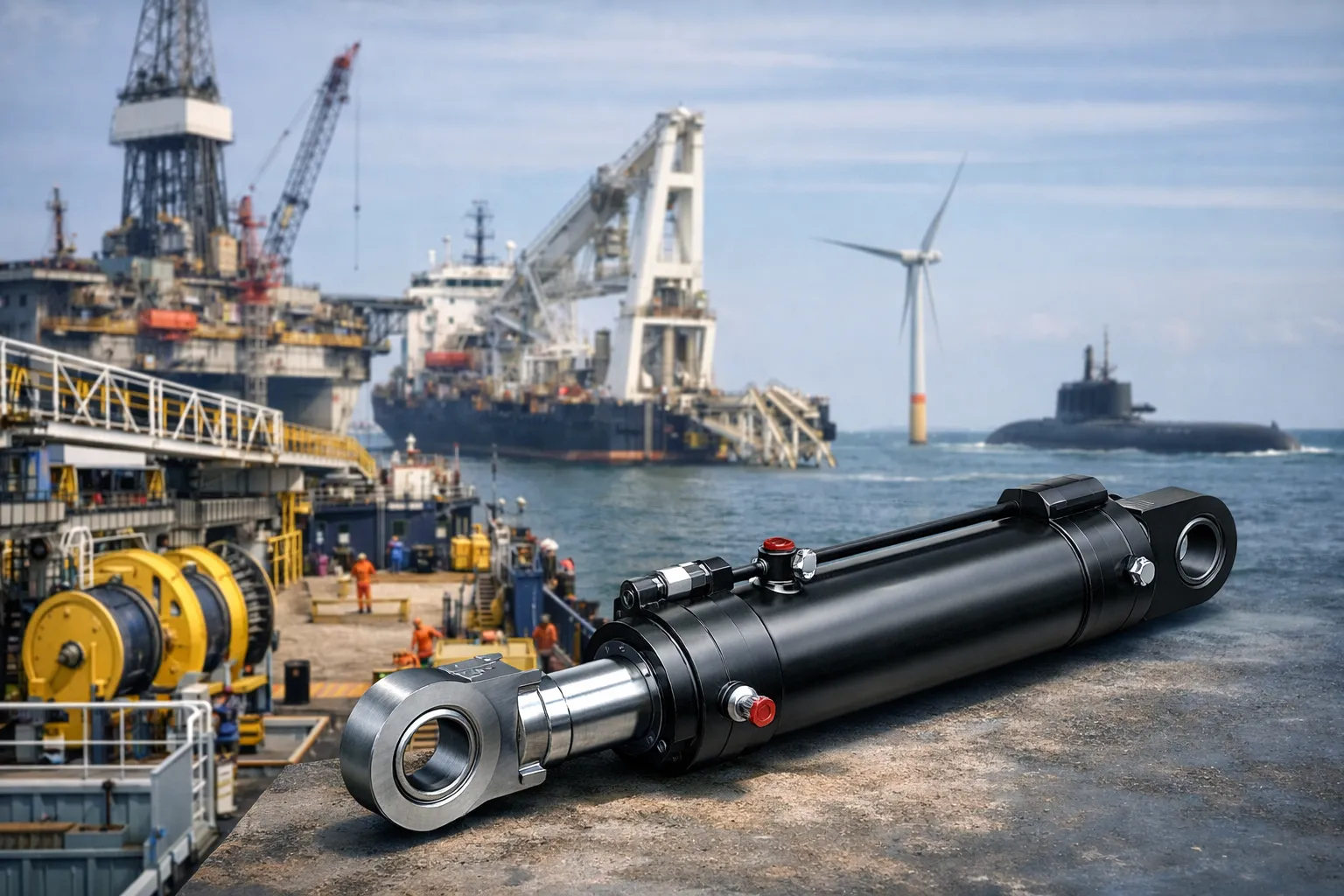
What makes our product different from standard industrial hydraulic oil cylinders is material selection and corrosion engineering. A conventional carbon steel cylinder with chrome-plated rod will begin pitting within weeks of subsea deployment. Our units use UNS S31803 / S32205 duplex stainless steel throughout — cylinder body, piston rod, end caps, and all wetted hardware — combined with mirror-polished surfaces that deny chloride ions the surface irregularities needed to initiate corrosion. That attention to metallurgical detail is why our subsea cylinders maintain full seal integrity in seawater-plus-sand environments where lesser designs fail within months.
Technical Specifications
The following tables outline the customizable parameter ranges for our subsea pipe clamp hydraulic cylinder. All specifications can be adjusted to meet your project requirements and classification standards.
Basic Specifications
| Parameter | Customizable Range |
|---|---|
| Bore Diameter | 50 mm – 300 mm |
| Rod Diameter | 35 mm – 200 mm |
| Stroke Length | 50 mm – 800 mm |
| Operating Pressure | 21 MPa – 70 MPa |
| Test Pressure | 1.5x rated pressure (hydrostatic) |
| Action Type | Double acting piston cylinder |
| Structure Type | Welded piston cylinder |
| Maximum Depth Rating | Up to 3000 m (project dependent) |
| Clamping Force | 50 kN – 2000 kN (per cylinder) |
Mounting Options
| Mounting Style | Description |
|---|---|
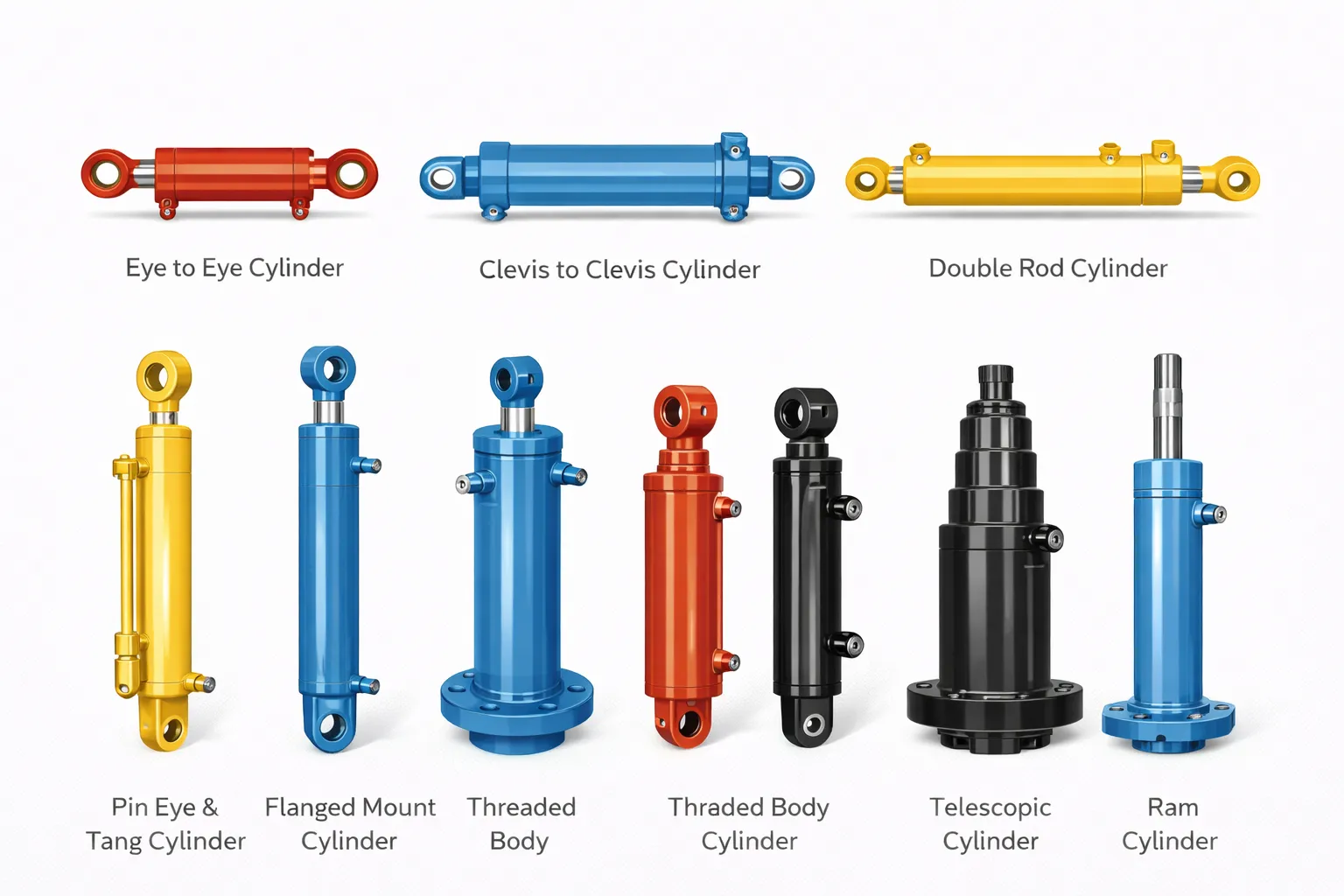
| Flange Mount (Front / Rear) | Most common for clamp frame integration; bolted directly to clamp housing |
| Trunnion Mount | Allows angular compensation during clamp closure on uneven seabed terrain |
| Clevis / Pin Eye | For mechanical linkage-type clamp systems requiring articulated motion |
| Custom Geometry | Designed to integrate with proprietary clamp tool frames and ROV interfaces |
Materials and Surface Treatment
| Component | Material / Treatment |
|---|---|
| Cylinder Body | Duplex stainless steel UNS S31803 / S32205, honed bore, H8 tolerance |
| Piston Rod | Duplex stainless steel, mirror polished to Ra ≤ 0.2 micrometers |
| Piston | Duplex stainless steel or super duplex (S32750) with PTFE-bronze wear bands |
| Seals | Subsea-rated FKM / FFKM elastomers + PTFE compound; pressure-compensated design |
| End Caps / Glands | Welded duplex construction; optional threaded gland for retrievable maintenance |
| External Finish | Full surface passivation (ASTM A967) + optional cathodic protection compatibility |
| Fasteners | A4-80 or duplex stainless bolting to NACE MR0175 / ISO 15156 |
Environmental Adaptability
| Condition | Rating |
|---|---|
| Seawater Immersion | Continuous — full design life submerged |
| Sand / Sediment Exposure | Designed for mud and abrasive particle ingress protection |
| Operating Temperature | -10 C to +60 C (seabed ambient + fluid temperature) |
| External Hydrostatic Pressure | Up to 300 bar (3000 m water depth) |
| Corrosion Environment | Seawater + mud + sand + marine biological fouling |
| Design Life | 20-25 years subsea (field life matched) |
How the Subsea Pipe Clamp Cylinder Works
A subsea pipe clamp is, at its core, a remotely operated mechanical grip that closes around a pipeline section on the seabed. The pipe clamp hydraulic cylinder provides the actuation force that drives the clamp jaws from open to closed position — and holds them there under sustained load for the entire operational life of the installation.
During the clamping sequence, pressurized hydraulic fluid — typically a subsea-rated biodegradable fluid or water-glycol mixture — enters the bore-side port of the double acting cylinder. The fluid acts against the full piston area, generating the push force that drives the clamp arms together around the pipeline. Because subsea clamp systems must generate extremely high grip forces relative to cylinder size (often 500 kN or more from a compact envelope), operating pressures in these applications routinely reach 35 to 70 MPa — far higher than typical surface-level industrial cylinders.
Once the clamp is fully closed, the hydraulic circuit locks. A pilot-operated check valve or mechanical locking mechanism holds the cylinder in its extended position without requiring continuous pressure supply. This is essential because many subsea clamp installations operate as passive systems after initial deployment — the cylinders must maintain clamping force indefinitely without an active hydraulic power source.
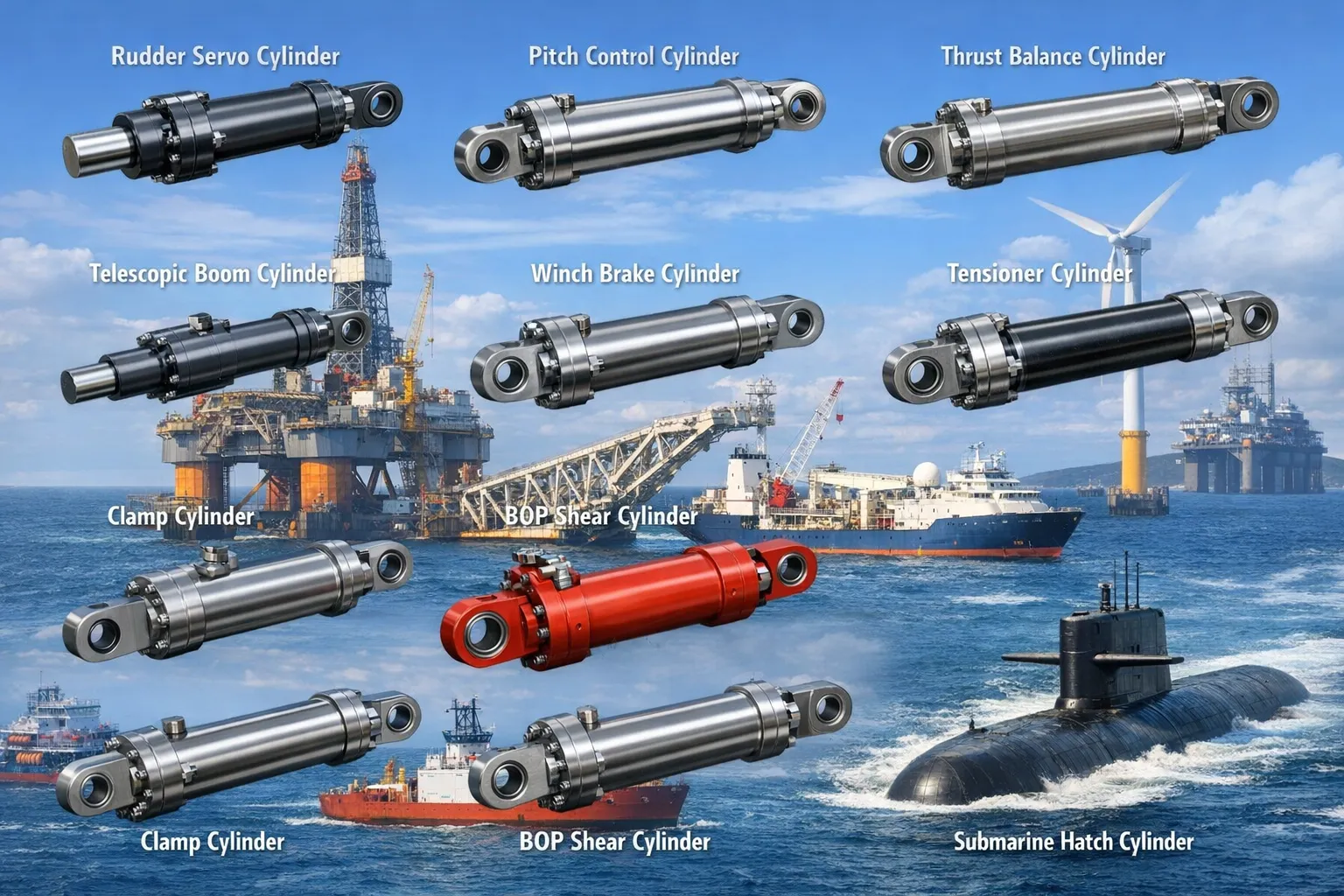
For clamp release — during pipeline decommissioning or repositioning — fluid is directed to the rod-side port. The annular area of the hydraulic cylinder piston generates a controlled retraction force, pulling the clamp jaws open. An ROV (Remotely Operated Vehicle) typically performs this operation via a hot-stab or diver-operated hydraulic connector mounted on the clamp frame.
The critical engineering challenge unique to subsea clamp cylinders is differential pressure management. At 1000 meters depth, the external hydrostatic pressure is approximately 100 bar. The seal system must prevent seawater ingress into the cylinder while also managing the pressure differential between internal hydraulic pressure and external ambient pressure. Our design uses a pressure-compensated arrangement where an external seawater chamber balances the hydrostatic load on the rod seal, allowing the dynamic seals to handle only the working pressure differential rather than the full depth-plus-working-pressure sum.
Compatible Replacement for Major Subsea Equipment
Note: Brand names below are referenced solely for cross-reference and equipment selection purposes. They remain registered trademarks of their respective owners and are not affiliated with our products.
Our subsea pipe clamp hydraulic cylinder is designed as a form-fit-function replacement for clamp actuators used in systems manufactured by:
- Subsea 7 — pipeline installation and repair clamp tooling
- TechnipFMC — subsea pipeline connectors and mechanical clamp systems
- Oceaneering — ROV-deployed clamp and grip tools
- Aker Solutions — subsea production and pipeline intervention equipment
- Saipem — pipe-lay and pipeline repair spread tooling
- IKM Subsea / Boskalis Subsea — intervention and maintenance clamp systems
- STATS Group — pipeline isolation and repair clamp actuators
- Hyundai Heavy Industries and Samsung Heavy Industries subsea equipment divisions
To begin a replacement project, provide us with the original cylinder drawing or the key dimensions: bore, rod, stroke, operating pressure, depth rating, and mounting geometry. Our engineers will prepare a detailed GA drawing and material compliance document for your review within 3 to 5 business days.
Explore our complete catalog of custom hydraulic cylinders for offshore and industrial applications.
Core Technical Advantages
Full Duplex Stainless Steel Construction
Every pressure-retaining and seawater-exposed component is manufactured from UNS S31803 or S32205 duplex stainless steel. Duplex grades offer roughly twice the yield strength of standard austenitic stainless steels (316L) while providing superior resistance to chloride-induced pitting and crevice corrosion. This means we can build a lighter, more compact cylinder that outperforms heavier carbon steel alternatives in the most aggressive seawater environments. For extreme depth or sour-service conditions, we offer super duplex (S32750) upgrades compliant with NACE MR0175.
Mirror-Polished Surfaces to Prevent Pitting
Pitting corrosion is the primary failure mechanism for subsea hydraulic cylinders. A single pit on the rod surface breaches the seal contact band, allowing seawater to enter the cylinder bore — and once that happens, the unit is compromised. Our rod and bore surfaces are polished to Ra 0.2 micrometers or better, creating a surface so smooth that chloride ions cannot find the micro-irregularities needed to initiate a pit. Combined with proper passivation treatment per ASTM A967, this surface finish delivers verified pitting resistance in laboratory-simulated seawater-plus-sand environments for over 25 years of equivalent service.
Pressure-Compensated Seal Architecture
Standard seal configurations fail in deep water because they must resist both the working hydraulic pressure and the external hydrostatic pressure simultaneously. Our cylinders use a pressure-compensated design: a seawater-filled external chamber equalizes ambient pressure on the outboard side of the rod seal, so the dynamic seal only handles the differential working pressure. This dramatically extends seal life and reduces the risk of catastrophic seal failure at depth. The design has been validated to 3000 meters water depth equivalent in our in-house hyperbaric test chamber.
High-Pressure Compact Envelope
Subsea clamp frames have tight space constraints. Our pipe clamp cylinder is optimized for maximum force output from the smallest possible bore and overall length. By using duplex stainless steel (with yield strengths above 450 MPa) and precision-machined thick-wall tube construction, we achieve working pressures up to 70 MPa in bore sizes that a conventional 316L or carbon steel cylinder could not safely support at the same dimensions.
Anti-Fouling and Sediment Exclusion
Subsea cylinders sit on the seabed for years, exposed to marine growth, silt deposition, and sand abrasion. Our external rod seal arrangement includes a multi-stage wiper and scraper system designed to exclude sand particles during any rod movement — even after years of sediment accumulation around the cylinder body. Internal flow passages are sized and positioned to prevent mud packing in dead zones that could impede piston movement.
ROV-Compatible Interface Design
All hydraulic ports are configured for ROV hot-stab connection using industry-standard API 17H or client-specified interface panels. Override ports, gauge ports, and vent connections are accessible by standard ROV manipulator arms. Where required, we integrate subsea-rated position sensors or limit switches directly into the cylinder body, giving the ROV operator real-time confirmation of clamp jaw position.
Fatigue-Rated Weld Joints for Cyclic Loading
Although subsea clamp cylinders typically operate with low cycle counts, each actuation involves extremely high pressure differentials. All pressure-bearing welds are full-penetration designs with smooth transition radii, qualified to ASME Section IX and tested per NORSOK M-101. Non-destructive examination includes 100% radiographic testing on circumferential welds and phased-array ultrasonic inspection on trunnion and flange attachments.
Long-Term Load Holding Without Active Pressure
Many pipe clamp installations function as permanent fixtures. After the initial clamping operation, the cylinder must maintain its extended position — and the corresponding grip force — for the remaining life of the pipeline. Our cylinders incorporate pilot-operated check valves and optional mechanical lock-ring systems that guarantee zero-leak load holding for 20+ years. Internal leakage rates are tested and documented to client specifications, typically below 0.1 cc/min at rated pressure.
Manufacturing Process and Quality Control
Complete In-House Production
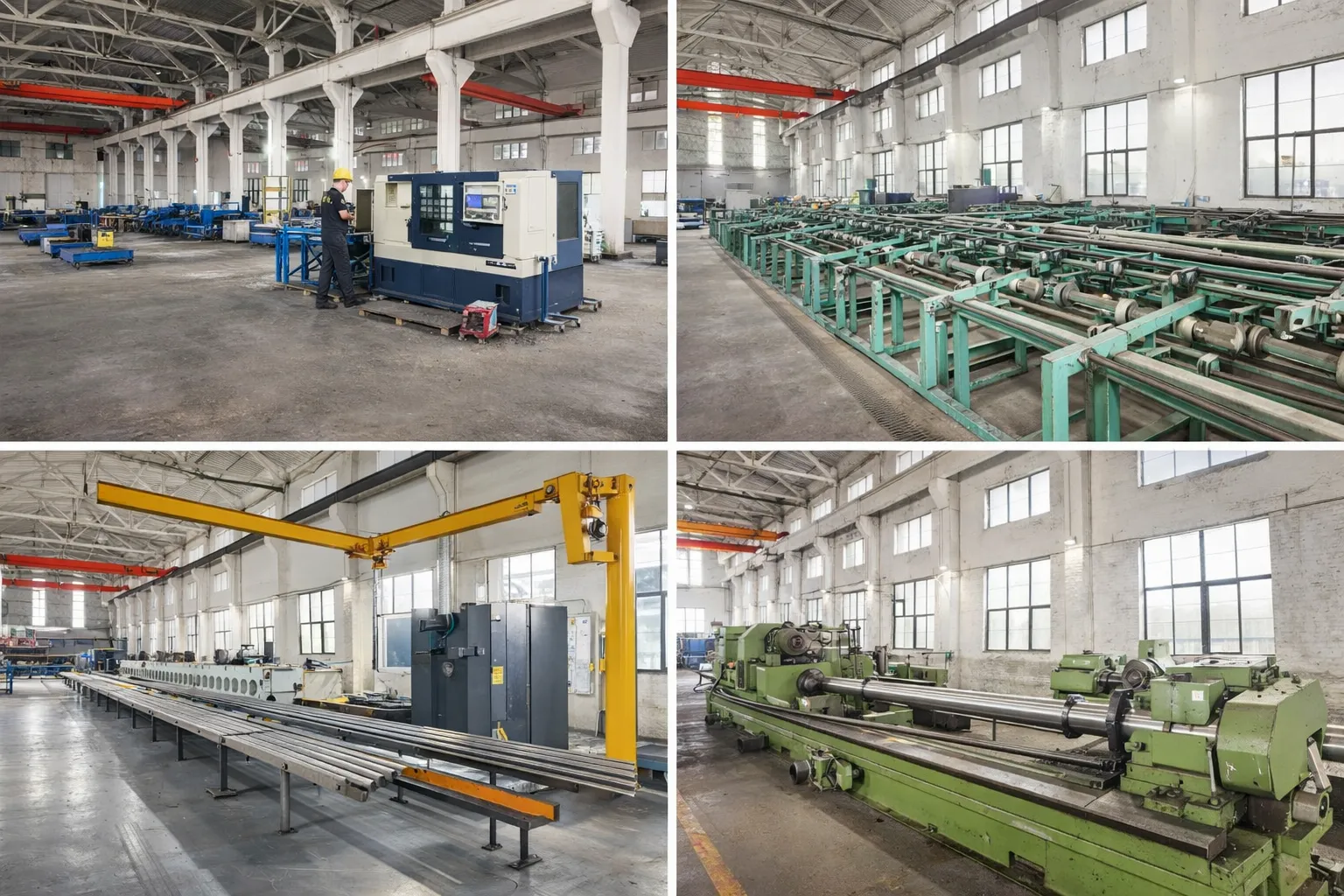
From incoming material inspection through final assembly, every manufacturing step is executed within our own facility. This covers CNC turning and boring, deep-hole drilling, internal honing, mirror polishing, orbital and TIG welding, passivation treatment, seal assembly, and pressure testing. There are no outsourced processes. That level of vertical integration gives us full control over dimensional accuracy, surface quality, material traceability, and delivery schedules — all of which are non-negotiable for subsea hydraulic cylinder components.
100% Hydrostatic and Functional Testing
Every cylinder is tested before shipment. The standard protocol includes: hydrostatic pressure hold at 1.5x rated working pressure for a minimum of 15 minutes with zero visible external leakage; full stroke functional cycling at rated pressure to verify smooth operation and correct force output; internal leakage measurement at rated pressure in both extend and retract directions; external leakage verification at all ports, seals, and weld joints; and dimensional validation of stroke, mounting centers, and port positions against the approved GA drawing. For deep-water units, hyperbaric simulation testing is available to verify performance at simulated depth pressure.
Certifications and Material Traceability
Our quality management system is certified to ISO 9001:2015. Material certificates per EN 10204 Type 3.1 are provided for all duplex stainless steel components, with full chemical analysis and mechanical property verification traceable to the original steel mill heat number. Welding procedures are qualified to ASME Section IX, and all welders hold current qualifications for duplex stainless steel. Documentation packages are prepared to meet the requirements of DNV GL, ABS, Lloyd’s Register, Bureau Veritas, and Korean Register (KR). Third-party witnessed testing by classification society surveyors or client inspectors can be arranged at our facility.
Corrosion Testing and Validation
Beyond standard salt spray testing, we perform ASTM G48 Method A pitting corrosion tests on production witness samples to verify that the finished surface treatment delivers the required critical pitting temperature (CPT). For projects with specific environmental conditions (H2S, CO2, elevated chloride concentrations), we conduct extended immersion testing and can supply corrosion test reports as part of the documentation package.
NDE and Weld Quality Assurance
All structural and pressure-bearing welds undergo non-destructive examination per NORSOK M-101 or client-specified codes. This includes 100% radiographic testing (RT) on butt welds, phased-array ultrasonic testing (PAUT) on trunnion and flange joints, liquid penetrant inspection (PT) on all accessible weld surfaces, and ferrite content measurement on all duplex stainless steel welds to verify proper microstructure. Weld maps, NDE reports, and ferrite survey records are included in every project documentation package.
Typical Industry Applications
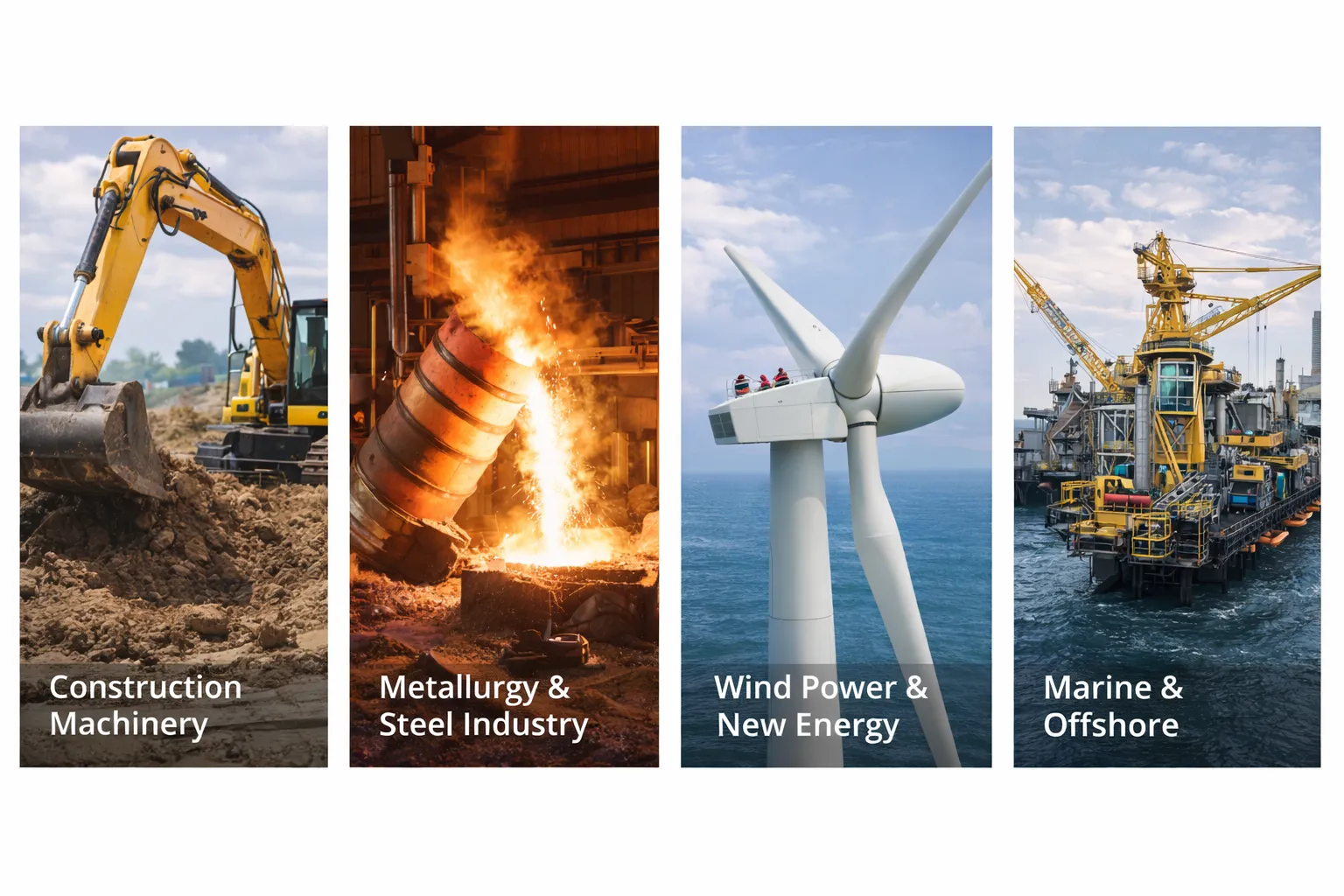
While this page focuses on the subsea pipe clamp application, our hydraulic cylinder design and manufacturing capabilities cover a broad range of demanding industries. Here is where our cylinders are working today:
Subsea Oil and Gas Infrastructure
Pipeline clamp cylinders, subsea valve actuators, manifold connector lock cylinders, PLET (Pipeline End Termination) clamp actuators, and flexible riser hang-off clamp systems. These represent our most technically demanding applications, where every hydraulic cylinder must deliver decades of reliable service at ocean-floor conditions with no possibility of routine maintenance.
Offshore Platform and FPSO Equipment
Riser tensioner cylinders, mooring winch actuators, turret swivel locking systems, and topside crane luffing cylinders. The combination of marine corrosion and heavy dynamic loads makes these applications a natural extension of our subsea engineering capability.
Construction and Heavy Machinery
Excavator boom and bucket cylinders, tunnel boring machine thrust actuators, piling rig hammers, and bridge construction jack systems. Learn more about our construction machinery hydraulic cylinders.
Metallurgy and Heavy Manufacturing
Continuous casting mold oscillation cylinders, rolling mill actuators, ladle tilting hydraulic rams, and scrap baling press cylinders. These high-temperature, high-cycle environments demand the same quality of materials and manufacturing precision we apply to subsea units. See our metallurgical industry solutions.
Mining and Mineral Processing
Shovel crowd and hoist cylinders, dragline luffing actuators, crusher adjustment hydraulic parts, and underground longwall roof support cylinders. Mining environments push cylinder durability to the limit with abrasive dust, constant vibration, and 24-hour operation.
Renewable Energy and Marine Infrastructure
Offshore wind turbine foundation gripper cylinders, tidal energy device actuators, wave energy converter hydraulic power take-off units, and subsea cable protection clamp cylinders. The growing offshore renewable sector shares many of the same corrosion and depth challenges as oil and gas — our duplex stainless steel manufacturing expertise transfers directly.
Special and Custom Projects
Hyperbaric chamber actuators, deep-sea research equipment, naval vessel systems, and underwater construction tools. If your application involves hydraulic actuation in a corrosive, pressurized, or confined environment, our engineering team can design the solution.
Standard Cylinder vs. Our Subsea Pipe Clamp Cylinder
The gap between a conventional industrial hydraulic cylinder and a purpose-built subsea unit is substantial. Here is a direct comparison:
| Feature | Standard Industrial Cylinder | Our Subsea Pipe Clamp Cylinder |
|---|---|---|
| Body / Rod Material | Carbon steel or 316L stainless | Duplex stainless steel (UNS S31803 / S32205) |
| Surface Treatment | Hard chrome plating or nickel plating | Mirror polish to Ra 0.2 um + passivation |
| Corrosion Resistance | 200-1000 hours salt spray | Continuous seawater immersion, 20+ year design life |
| Maximum Operating Pressure | 16-35 MPa typical | Up to 70 MPa |
| Depth Rating | Surface use only | Up to 3000 m water depth |
| Seal System | Standard NBR or PU seals | Pressure-compensated FKM/FFKM + PTFE subsea seals |
| Load Holding Capability | Requires continuous pressure supply | Passive lock-hold for 20+ years |
| NDE / Weld Inspection | Visual inspection | 100% RT + PAUT + PT per NORSOK M-101 |
| Material Certification | Standard mill certificate | EN 10204 Type 3.1 + NACE MR0175 compliance |
| ROV Interface | Not applicable | API 17H compatible hot-stab connections |
Real-World Project Case Studies
Case 1 — Subsea Pipeline Repair Clamp, South Korea
Client: A Korean offshore engineering contractor based in Geoje, supporting pipeline maintenance operations in the East China Sea.
Challenge: The contractor needed 12 replacement clamp actuator cylinders for an emergency pipeline repair spread. The original European-sourced cylinders had a 20-week lead time — far too long for the repair window dictated by the pipeline operator. The cylinders had to match the original dimensions exactly, rated for 350 bar operating pressure at 180 meters water depth, all in duplex stainless steel with full classification documentation.
How they found us: The project manager contacted us in August 2023 after finding our website through a search for subsea hydraulic cylinder manufacturers in Asia. He submitted the original GA drawings through our online inquiry form the same day.
Solution: We confirmed dimensional compatibility within 48 hours, sourced certified duplex stainless steel from our existing material stock, and delivered all 12 cylinders within 7 weeks — including full material certificates, weld procedure qualifications, and hydrostatic test reports.
Result: The pipeline repair was completed on schedule. Post-installation ROV inspection confirmed all cylinders were fully functional with zero leakage. The contractor has since ordered additional spares and placed us on their approved vendor list for future subsea projects.
“Seven weeks from order to delivery for subsea-grade duplex cylinders — that was faster than we thought possible. Quality documentation was thorough and the class surveyor signed off without comments.” — Project Manager, Geoje
Case 2 — Deepwater Pipeline Installation Clamp Tooling, Southeast Asia
Client: An international pipe-lay contractor performing J-lay installation of a 24-inch gas export pipeline in the South China Sea at depths exceeding 800 meters.
Challenge: The pipe-lay contractor’s existing clamp tool cylinders were approaching their certified service life limit and needed replacement before the campaign. The new cylinders had to be rated for 700 bar test pressure, operate reliably at 800+ meters, and interface with the existing ROV-deployed clamp frame without modifications.
How they found us: Referral from a subsea equipment fabricator in Singapore who had sourced topside hydraulic oil cylinders from us for an FPSO project in 2022. Initial contact was made through our Singapore-based sales representative in January 2024.
Solution: We manufactured 8 clamp cylinders in super duplex S32750 to handle the high-pressure, deepwater requirements. Each unit was hyperbaric tested to 100 bar external pressure simulation and functionally cycled at 500 bar working pressure. Full NORSOK documentation and DNV-witnessed test certificates were supplied.
Result: The pipe-lay campaign was completed in Q2 2024 with zero clamp tool failures. Over 120 clamp operations were performed across the pipeline route, and every cylinder maintained full function throughout. The contractor reported zero seal leaks and stated the cylinders outperformed the originals in terms of actuation smoothness.
“We needed absolute confidence in these cylinders at 800 meters. The hyperbaric testing and material documentation gave us that confidence. Performance during the campaign was faultless.” — Subsea Operations Manager, Singapore
Case 3 — Offshore Wind Farm Cable Protection Clamp, Taiwan Strait
Client: A Taiwanese offshore wind developer installing inter-array submarine power cables for a 600 MW wind farm in the Taiwan Strait.
Challenge: The cable protection system required compact hydraulic clamp actuators that could secure 200 mm diameter power cables to the J-tube entry structures on each monopile foundation. The cylinders needed to survive continuous seawater immersion at 25-40 meters depth for the 25-year design life of the wind farm, with zero scheduled maintenance after installation.
How they found us: The cable installation subcontractor identified us through an industry directory listing for subsea hydraulic actuator manufacturers. They sent an initial specification inquiry in March 2024.
Solution: We designed a compact pipe clamp cylinder in duplex stainless steel with a 100 mm bore, 60 mm rod, and 120 mm stroke, rated at 250 bar. Each cylinder included an integrated mechanical lock ring for permanent position retention after clamping. We delivered 96 units over two production batches.
Result: All cable protection clamps were installed during the Q4 2024 installation window. Diver inspection 6 months after installation confirmed 100% of clamps were holding position with no visible corrosion or seal deterioration.
“96 cylinders, zero rejects during installation, and every clamp holding perfectly after 6 months in the water. That is the reliability we needed for a 25-year asset.” — Cable Installation Project Manager, Taipei
Case 4 — Pipeline Isolation Clamp Repair Tool, Middle East
Client: A national oil company in the Arabian Gulf performing pipeline intervention on a live 36-inch crude oil export pipeline at 60 meters water depth.
Challenge: An emergency repair required a hot-tap isolation clamp to be deployed around the pipeline to allow a section replacement. The clamp actuator cylinders needed to generate over 1200 kN of combined clamping force, operate via ROV, and seal reliably against a pipeline with external marine growth and surface irregularities.
How they found us: The pipeline intervention contractor (a UK-based firm with a regional office in Abu Dhabi) had previously purchased surface-level hydraulic cylinders from us for a refinery turnaround project. They contacted our engineering team directly in September 2024.
Solution: We manufactured 4 high-force clamp cylinders with 250 mm bore, 180 mm rod, and 200 mm stroke, rated at 420 bar. Material was super duplex S32750, with all wetted surfaces polished and passivated. ROV hot-stab interfaces were configured per the client’s standard panel layout.
Result: The isolation clamp was successfully deployed and sealed on the first attempt. Pipeline repair was completed within the planned 10-day offshore window. The cylinders were recovered, inspected, and found to be in excellent condition with no pitting or seal wear visible.
“First-attempt success on a live pipeline isolation — the clamp cylinders performed exactly as specified. We will continue to source from this supplier for future intervention projects.” — Intervention Project Lead, Abu Dhabi
Case 5 — Subsea Manifold Connector Actuators, Japan
Client: A Japanese engineering firm fabricating subsea production manifolds for a gas field development off the coast of Western Australia, with final assembly in Kobe.
Challenge: The manifold design required 16 compact actuator cylinders to drive the mechanical connectors that lock pipeline jumpers onto the manifold hubs. Each cylinder needed to operate at 500 bar, resist seawater at 450 meters depth, and provide a verified internal leakage rate below 0.05 cc/min for load-holding compliance.
How they found us: A recommendation from a Korean subsea valve manufacturer who had supplied the manifold’s isolation valves and was familiar with our duplex stainless steel cylinder capabilities. First contact was in November 2023.
Solution: We produced 16 cylinders plus 4 spares in duplex stainless steel with mirror-polished bores and rods. Hyperbaric testing was performed at simulated 500-meter depth. Internal leakage was measured on every unit and documented — all cylinders achieved below 0.03 cc/min, comfortably exceeding the specification.
Result: The manifold was successfully load-out and installed in Q3 2024. Subsea commissioning confirmed all connector locks engaged correctly, and the field has been producing gas since early 2025 with zero reported actuator issues.
“The leakage test results were outstanding — every cylinder well below the 0.05 cc/min requirement. That kind of consistency across 20 units speaks to the manufacturing control in their factory.” — Subsea Systems Engineer, Kobe
Frequently Asked Questions
What depth rating can your subsea pipe clamp cylinders achieve?
Why do you use duplex stainless steel instead of 316L or Inconel?
Can you supply classification society documentation (DNV, ABS, LR, BV, KR)?
What is the typical lead time for subsea-grade pipe clamp cylinders?
How do your cylinders handle sand and sediment on the seabed?
What hydraulic fluids are compatible with your subsea cylinders?
Can you match the dimensions of an existing OEM clamp actuator for replacement?
Do you offer hyperbaric testing for deepwater applications?
What is the expected service life of your subsea pipe clamp cylinders?
Can I visit your manufacturing facility before placing an order?
Ready to Discuss Your Subsea Project?
Whether you need a single prototype actuator or a production batch of 100 subsea clamp cylinders, our engineering team is prepared to review your specifications and deliver a detailed technical and commercial proposal.
Send us your clamp drawing, cylinder specification, or project brief — and we will respond within 48 hours with a preliminary assessment.
Editor: Cxm