Swing Cylinder For Telescopic Boom Crane Hook Control
Engineered for absolute load stability. Eliminate high-frequency seal wear and optimize your heavy lifting equipment’s spatial performance with our advanced low-friction dampening technology.
Product Overview: The Core of Precise Load Positioning
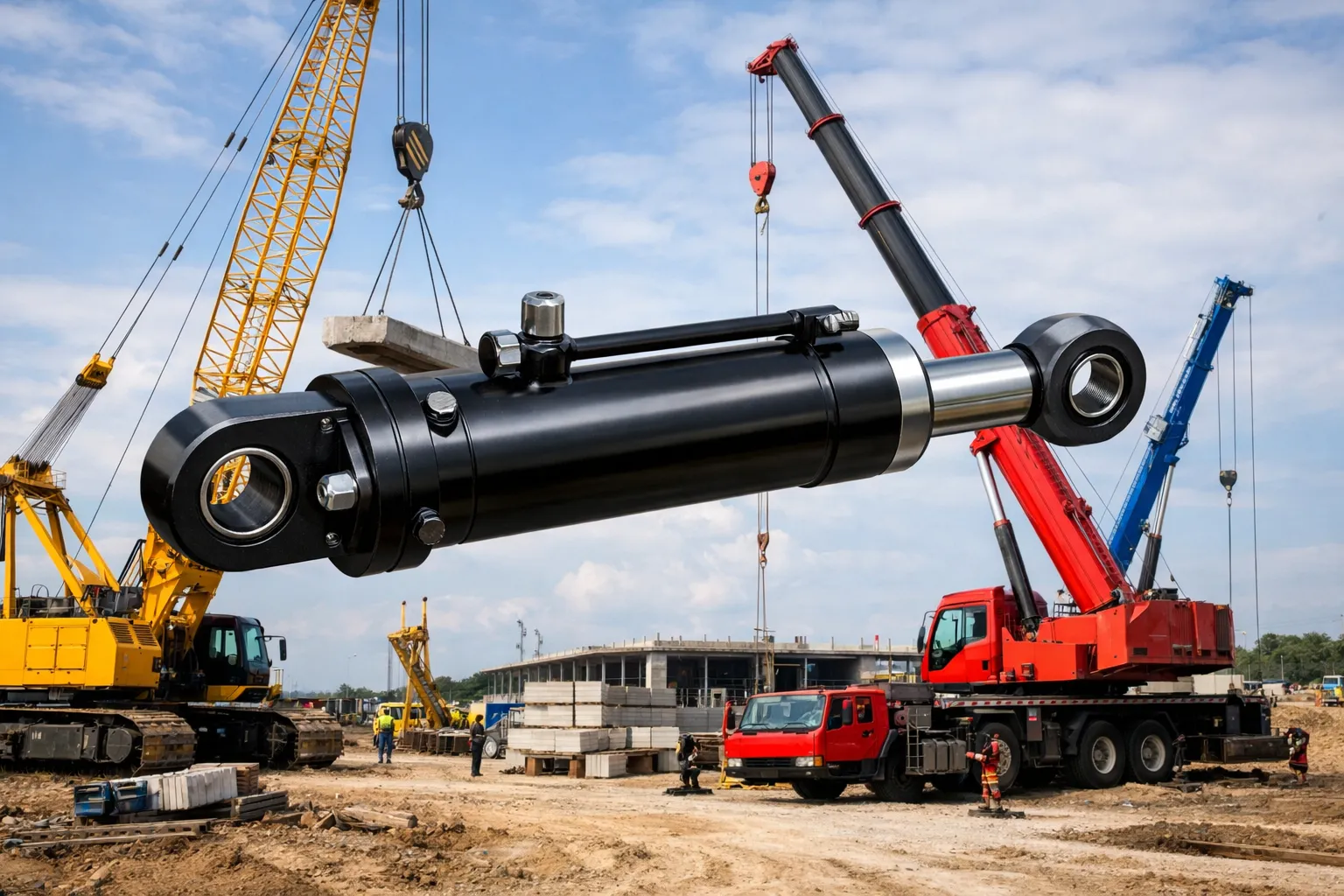
Operating heavy construction machinery requires precise, unyielding control over massive, suspended payloads. In a telescopic boom crane, the hook swing subsystem is a highly stressed mechanical component that directly dictates the safety and efficiency of the entire lifting operation. When a crane lifts a heavy concrete panel or structural steel beam, unpredictable wind shear and the natural rotational momentum of the boom cause the load to sway. To stabilize this dangerous pendulum effect and protect ground personnel, the machine relies entirely on a highly specialized swing cylinder. This actuator is fundamentally different from a standard linear pusher; it must perform flawlessly under continuous, high-frequency micro-adjustments without hesitation.
The primary mechanical challenge in this specific operational environment is the stroke profile. The small amplitude swing prevents adequate hydraulic fluid circulation within the barrel. Consequently, standard actuators suffer from rapid localized heat accumulation. This boundary friction leads to premature seal wear, catastrophic fluid bypass, and the dreaded “stick-slip” shuddering effect. As a dedicated hydraulic cylinder manufacturer with two decades of fluid power engineering experience, we recognized this systemic failure point across the lifting industry. We specifically engineered our proprietary swing hydraulic cylinder to eradicate the vulnerabilities associated with high-frequency oscillation. By implementing an advanced low-friction seal matrix and utilizing ultra-high-strength 27SiMn alloy steel, our welded design guarantees absolute load stability.
For B2B procurement managers and fleet operators across South Korea, Japan, and the broader East Asian infrastructure development sector, unexpected equipment downtime directly erodes project profit margins. Choosing our highly engineered hydraulic parts means investing in a permanent structural solution to repetitive maintenance failures. We deliver a premium fluid power product that significantly extends your machinery’s lifecycle, offering an exceptionally competitive hydraulic cylinder price when evaluating total long-term operational costs and the drastic reduction in emergency field service requirements.
Detailed Technical Parameters and Customization Range
Seamless mechanical integration into existing telescopic boom crane infrastructure requires exacting dimensional and material specifications. The technical table below outlines the core configuration data, customizable engineering ranges, and specific metallurgical selections applied to our heavy-duty dampening series.
| Engineering Category | Standard Specification & Customizable Options |
|---|---|
| Target Industry | Construction Machinery, Heavy Industrial Lifting, Marine Logistics |
| Equipment Category | Telescopic Boom Crane, Rough Terrain Mobile Machinery |
| Subsystem / Action | Hook Swing Dampening / Active Lateral Load Stabilization |
| Product Name | Swing Cylinder (Hook Control Actuator) |
| Action Method | Double Acting Hydraulic Cylinder (Bidirectional Force) |
| Structure Type | Heavy-Duty Piston Cylinder with Enhanced Lateral Guidance |
| Manufacturing Structure | Welded Construction (Automated Submerged Arc) |
| Material System | 27SiMn Alloy Steel (Superior yield point and impact toughness) |
| Surface Treatment | Hard Chrome Plated (30 to 50 micrometers thickness, HV850+) |
| Environmental Grade | High tolerance to coastal salt spray, abrasive dust, and thermal shock |
| Working Condition Features | Small amplitude swing, incredibly high-frequency actuation cycles |
| Typical Failure Mode Handled | Seal Wear (Caused by localized thermal friction and dry running) |
| Recommended Configuration | Low-Friction Seal matrix (PTFE composites), Enhanced thermal bypass ports |
Operational Physics: How the Swing Hydraulic Cylinder Functions
A deep understanding of hydrostatic fluid dynamics is necessary to appreciate how our actuator controls the hook of a telescopic boom crane. Unlike a simple single acting hydraulic cylinder that uses fluid pressure to extend and relies entirely on gravity or an external mechanical spring to retract, the active stabilization of a multi-ton suspended payload demands a highly responsive double acting hydraulic cylinder. When the crane operator makes a minute adjustment on the control joystick to arrest a swaying load, the main proportional directional control valve instantly meters highly pressurized hydraulic oil into one side of the cylinder chamber.
This pressurized fluid acts against the surface area of the precision-machined hydraulic cylinder piston, generating an immediate, immense linear force. Because the swinging motion must be actively dampened in both directions to prevent erratic bouncing, the double-acting design allows for continuous push-and-pull force generation. This ensures the hook remains locked in the exact spatial coordinate dictated by the operator, completely neutralizing the kinetic energy of the swinging concrete panel or steel beam. It is a critical function that a standard lift cylinder is simply not engineered to perform.
The most critical engineering challenge in this specific application is the stroke profile. The actuator operates in a state of high-frequency and small-amplitude swing. This means the piston only moves a few millimeters back and forth, hundreds of times an hour. In conventional fluid power designs, this rapid micro-stroking prevents the hydraulic oil from properly forming a hydrodynamic lubricating film across the rod and barrel surface. The resulting boundary friction generates intense localized heat, which rapidly vulcanizes and destroys standard nitrile or polyurethane seals. Our advanced design overcomes this severe physical limitation by incorporating a specialized low-friction seal assembly that glides effortlessly even in near-dry conditions, ensuring smooth operation and completely eliminating the seal wear failure mode that plagues standard hydraulic cylinder components.
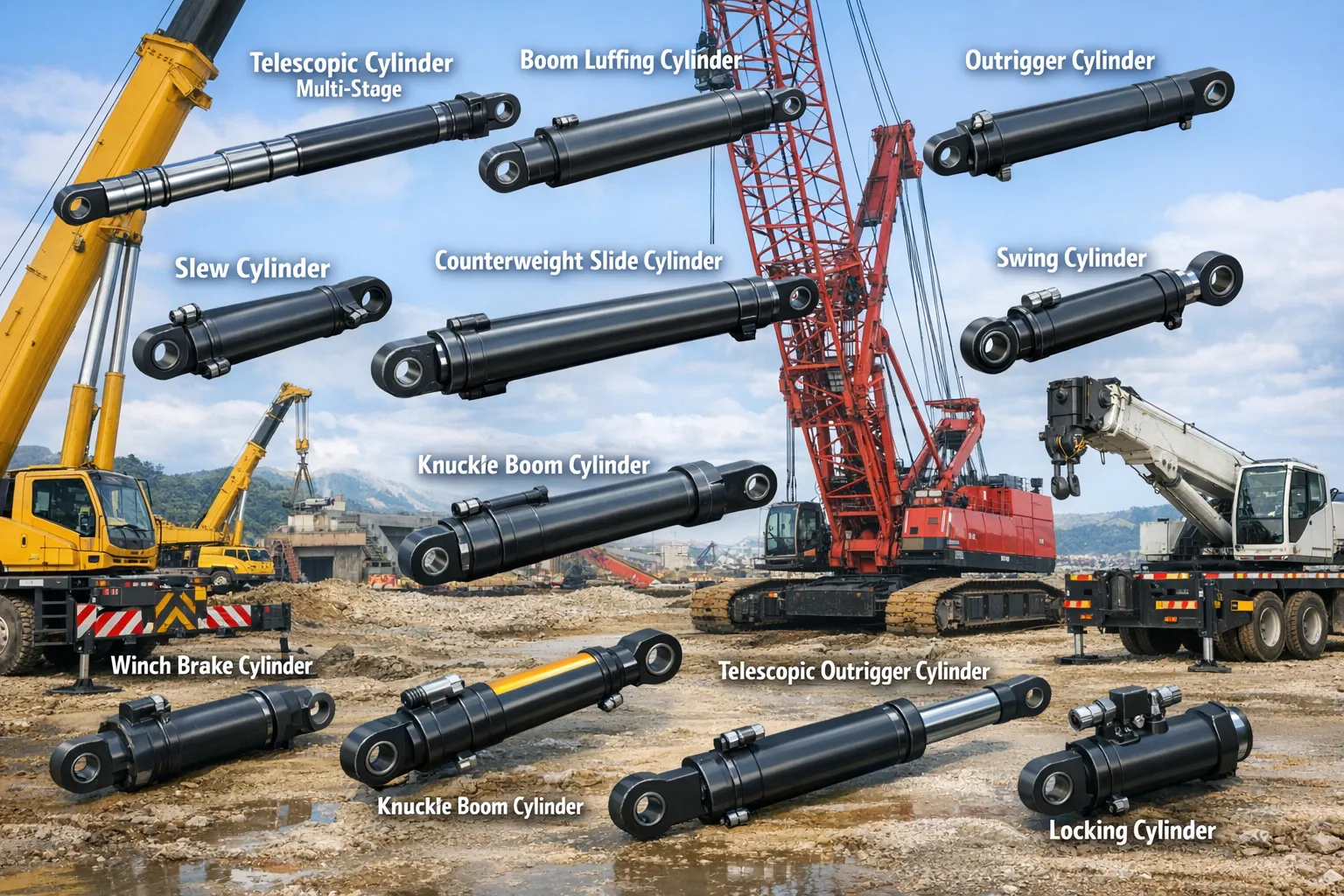
Perfect Drop-In Replacement for Global Machinery Brands
When a heavy lifting machine goes down on an active construction site, waiting months for an expensive original equipment manufacturer component is not a viable financial option. Our engineering department maintains an exhaustive geometric database containing the exact pin-to-pin retracted lengths, stroke dimensions, rod diameters, and hydraulic port thread specifications for the world’s most prominent telescopic boom crane platforms. We understand that time spent fixing hydraulic cylinders is time lost on the project critical path.
Our high-performance swing hydraulic cylinder series serves as a seamless, direct drop-in replacement for leading global machinery brands, including Liebherr, Tadano, XCMG, Sany, Zoomlion, Kato, Kobelco, Demag, and Grove. When your maintenance team is tasked with replacing hydraulic rams in the field, they will not need to execute any dangerous chassis modifications, cutting, or field welding. Our precision-machined units bolt directly into the existing factory mounting trunnions and clevis brackets, restoring your machinery to full operational capacity in a fraction of the time.
Legal Disclaimer regarding trademarks: The brand names mentioned above are referenced exclusively for the purpose of demonstrating dimensional compatibility and to aid procurement officers in selecting the correct replacement sizes. We operate entirely as an independent precision component manufacturer and hold no formal affiliation, sponsorship, or trademark association with these original equipment manufacturers.
Five Core Technical Advantages of Our Swing Cylinder Design
Building a component that survives the brutal realities of a high-frequency construction environment requires intent in every phase of metallurgical and tribological engineering. Here are the five definitive technological upgrades integrated into our fluid power solutions that set us apart from generic aftermarket suppliers.
1. Ultra-Low Friction Sealing Technology
To directly combat the primary failure mode of seal wear caused by high-frequency, small-amplitude swing operations, we completely discarded standard elastomer seals. We integrate a proprietary sealing matrix utilizing advanced PTFE (Polytetrafluoroethylene) composite step-seals and specialized bronze-filled guide rings around the hydraulic cylinder piston. This low-friction seal architecture possesses an incredibly low coefficient of dynamic friction, effectively preventing the “stick-slip” phenomenon and halting the localized thermal buildup that destroys ordinary seals.
2. High-Yield 27SiMn Alloy Steel Construction
Standard commercial actuators frequently utilize basic 45# carbon steel to reduce manufacturing costs, leaving them vulnerable to pressure swelling and fatigue. We strictly machine our cylinder barrels and main structural components from premium 27SiMn (Silicon-Manganese) alloy steel. This specific metallurgy provides significantly higher tensile strength, yield point, and impact toughness. When a suspended load shifts suddenly, the 27SiMn barrel absorbs the kinetic shock without suffering permanent micro-deformation.
3. Heavy-Duty Welded Piston Cylinder Architecture
The structural integrity of the base caps and mounting eyes is critical when dampening the relentless kinetic shock of a swinging load. We utilize automated, deep-penetration submerged arc welding to construct our assemblies. This highly controlled robotic process ensures void-free, massive weld penetration. Subsequent thermal stress-relief treatments remove localized brittleness, granting the entire pressure vessel extreme resilience against heavy dynamic impacts and high-frequency vibrations.
4. Micro-Cracked Chrome Plated Surface Defense
Operating in severe outdoor environments exposes the cylinder rod to abrasive concrete dust, acidic rain, and highly corrosive coastal salt spray. A single scratch will shred the wiper seals. Our piston rods undergo a rigorous electrochemical hard chrome plating process, achieving a dense protective layer between 30 to 50 micrometers thick with a surface hardness exceeding HV850. This impenetrable, micro-cracked barrier holds tiny amounts of lubrication while shrugging off environmental corrosion.
5. Optimized Thermal Stability for Continuous Duty
Because the hydraulic fluid does not exchange effectively during a small amplitude swing, we have meticulously redesigned the internal porting geometry to maximize thermal dissipation. By slightly enlarging the fluid galleries and pairing them with our low heat-generating seals, we maintain the operating temperature of the internal hydraulic fluid well within safe viscosity margins, effectively doubling the operational fatigue life of the internal components compared to standard OEM iterations.
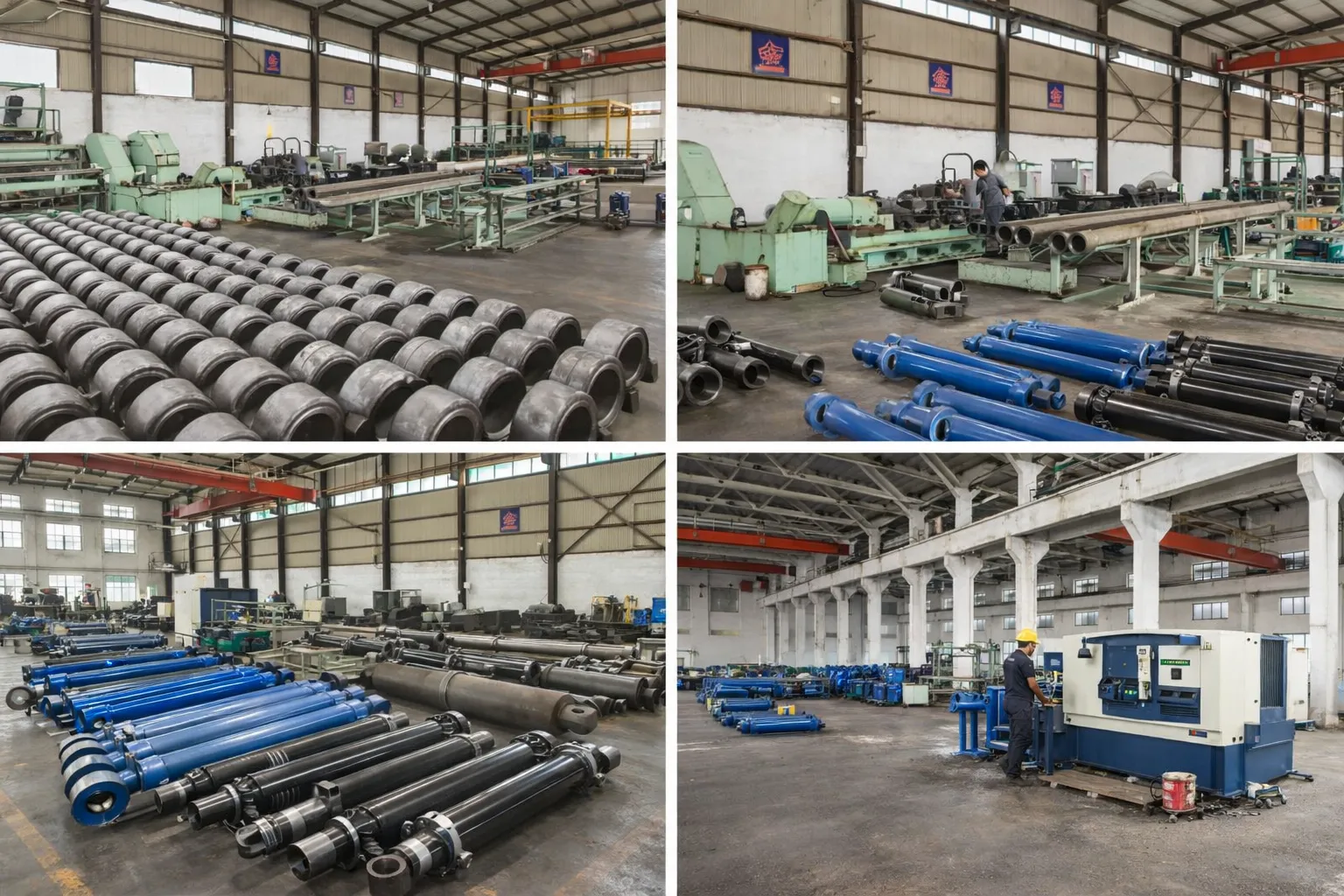
Rigorous Manufacturing Craftsmanship and Quality Control
Absolute trust in a heavy machinery component is established through a completely transparent and rigorously controlled manufacturing environment. We control the entire lifecycle of the product within our own vertically integrated facility, adhering strictly to ISO 9001 quality management standards to ensure every batch meets the highest industrial benchmarks. We never rely on third-party sub-assemblers, ensuring that every hydraulic cylinder meets our exacting tolerances.
The internal bore of our 27SiMn barrels undergoes a specialized CNC skiving and roller-burnishing process. This advanced machining technique physically compresses the internal metal grain structure, producing a flawless, mirror-like surface finish. This exact smoothness is critical; it works in perfect harmony with our low-friction seals, significantly reducing dynamic friction and practically eliminating internal wear over the actuator’s extended operational life.
Furthermore, our unyielding commitment to field safety mandates that 100% of our produced units undergo mandatory factory testing before dispatch. We absolutely reject the concept of random statistical batch sampling. Every single swing cylinder is securely mounted on a specialized hydrostatic test bench and subjected to fluid pressures 1.5 times their maximum rated working capacity. Our technicians meticulously monitor the system for microscopic pressure drops, verify stroke smoothness, and confirm absolute zero internal fluid bypass. Finally, a unique serial number is laser-engraved onto the cylinder base, guaranteeing full metallurgical and assembly traceability for the lifespan of the equipment, simplifying the procurement of replacement hydraulic cylinder repair kits.
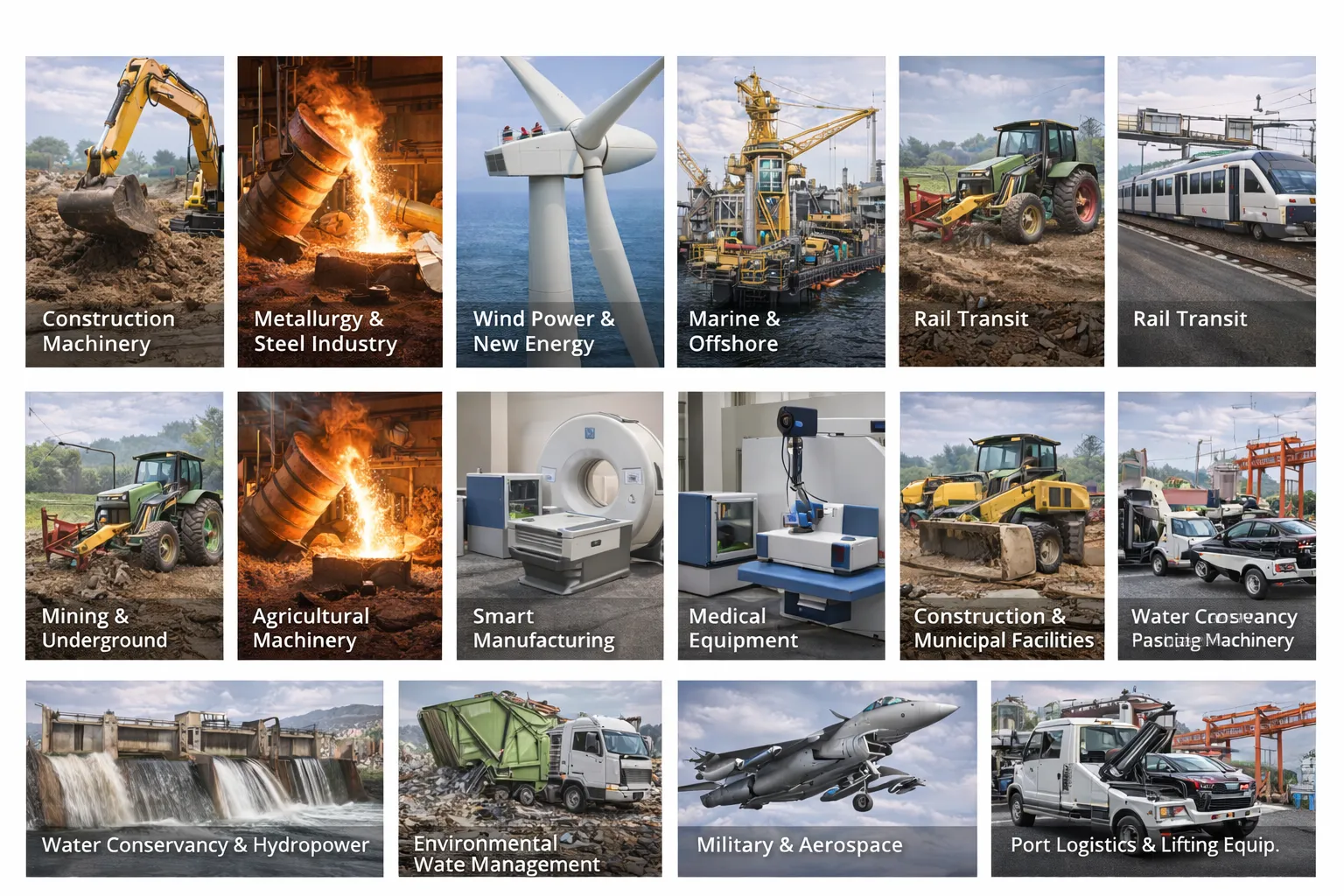
Typical Industry Applications
While uniquely engineered to conquer the high-frequency demands of telescopic boom crane hook swinging, the highly robust nature, zero-drift holding power, and ultra-low friction characteristics of our fluid power solutions make them highly sought after across multiple demanding industrial sectors. You can explore more about our specialized systems by visiting our technical guide on the construction machinery industry.
- Construction Machinery: Telescopic boom cranes, rough-terrain lifting equipment, crawler cranes, and precise rotary drilling rig positioning systems where rapid micro-adjustments are continuous.
- Metallurgy & Heavy Manufacturing: Ladle manipulation and swinging mechanisms in steel mills where high ambient heat requires extreme thermal stability and specialized high-temperature sealing configurations to prevent catastrophic spills.
- Plastics & Rubber Machinery: Injection molding clamping systems relying heavily on the rigid, non-deforming nature of our 27SiMn alloy steel barrels under sustained, immense clamping pressure cycles.
- Material Handling & Logistics Automation: Gantry cranes at busy sea ports and reach stackers operating in highly corrosive coastal environments, utilizing our dense hard-chrome plating defense to protect the rod against salt fog.
- New Energy & Environmental Equipment: Specialized erecting cranes used for lifting onshore wind turbine blades where wind shear demands perfect dampening and absolute micro-positioning for safe bolt alignment.
- Specialized Custom Scenarios: Subsea lifting equipment requiring stainless steel rod iterations and marine-grade protective epoxy coatings to withstand deep-water hydrostatic pressures and saline attack.
Comparative Analysis: Ordinary Cylinders vs. Our High-Performance Swing Cylinder
Making an informed B2B procurement decision requires a deep understanding of the long-term total cost of ownership. The initial purchase price is merely a fraction of the operational equation. The technical table below outlines the distinct engineering differences between standard commercial aftermarket cylinders and our meticulously engineered heavy-duty stabilization solutions.
| Feature Component | Ordinary Market Cylinders | Our Engineered High-Performance Cylinders |
|---|---|---|
| Barrel Metallurgy | Basic 45# carbon steel (Prone to fatigue swelling under high cycle shock) | High-yield 27SiMn alloy steel (Exceptional structural rigidity and memory) |
| Dynamic Sealing | Standard NBR Elastomers (High friction, fast thermal failure in small swings) | Low friction PTFE & PU matrix (Eliminates stick-slip heat entirely) |
| Rod Surface Protection | Thin commercial chrome plating (Vulnerable to rock scoring and fast rusting) | 30-50 micrometers hard chrome plating (HV850+, salt-spray validated) |
| Welding Standard | Manual arc welding (Inconsistent penetration, brittle heat-affected zones) | Automated submerged arc, thermally stress-relieved for maximum fatigue life |
| Operational Life | Requires frequent repacking and maintenance every 4-6 months | Massively extended fatigue life, designed for years of continuous duty |
Real-World Case Studies: Proven Results in the Asian Market
Engineering theory must be proven on the muddy, high-pressure reality of an active job site. Below are five detailed instances where our targeted fluid power solutions resolved critical equipment failures for major B2B clients operating in highly demanding Asian environments.
Case Study 1: Eliminating Seal Burnout in South Korean Urban Construction
Location: Seoul, South Korea (October 2024)
Client Profile: A top-tier commercial high-rise construction consortium.
Application: Hook swing dampening on a fleet of 100-ton telescopic boom cranes.
The Engineering Challenge: During the precision placement of heavy steel I-beams in windy urban canyons, operators used the joysticks continuously for micro-adjustments. The OEM swing cylinder units suffered catastrophic seal wear every four months due to heat accumulation, paralyzing lifting schedules. They contacted us after searching Google for a reliable hydraulic cylinder manufacturer capable of custom engineering.
The Solution and Result: We supplied our specialized 27SiMn, low-friction sealed cylinders. Tracked over an 18-month period following installation, the fleet has experienced zero internal fluid bypass incidents, saving tens of thousands in downtime costs.
“The thermal management of these engineered components is exactly what we needed. We spent all of last year tearing down machines. Since switching to this supplier, the hook holds perfectly still, and our downtime has vanished.” — Park Min-su, Fleet Technical Director.
Case Study 2: Conquering Saltwater Corrosion at a Japanese Port
Location: Port of Osaka, Japan (February 2025)
Client Profile: Heavy maritime logistics and stevedoring company.
Application: Mobile harbor crane load stabilization and material handling straddle carriers.
The Engineering Challenge: The intense saline humidity and ocean spray rapidly pitted the standard rod chrome. As the crane made its high-frequency short strokes, these microscopic rust pits acted like a rasp, destroying the external wiper seals and causing massive environmental oil leaks onto the cargo decks. They urgently needed replacement hydraulic parts.
The Solution and Result: We delivered custom units featuring our upgraded HV850+ hard chrome plating and double-lip marine-grade polyurethane wipers. Installed in early 2025, the rods remain completely free of oxidation and the decks are oil-free.
“Our coastal environment destroys standard steel. The surface treatment on these replacement parts is vastly superior to the original factory equipment. Zero leaks in over a year of daily container loading.” — Kenji Tanaka, Port Engineering Manager.
Case Study 3: High-Temperature Durability in Vietnam Infrastructure
Location: Ho Chi Minh City, Vietnam (August 2024)
Client Profile: Civil engineering contractor building elevated highway systems.
Application: Precast concrete girder lifting cranes.
The Engineering Challenge: Operating under intense tropical summer heat, combined with the internal friction heat generated by continuous micro-swing adjustments, pushed the hydraulic fluid viscosity past critical limits. The cranes were drifting during placement, and hydraulic cylinder repair costs were skyrocketing.
The Solution and Result: By implementing our friction-reducing sealing matrix and expanding the port diameters for better fluid flushing, we stabilized the operating temperatures. The cranes now hold the concrete girders motionless, even during the hottest afternoon shifts.
“Safety is our top metric. If the load drifts an inch, someone could get hurt. These hydraulic rams hold massive weight completely steady under very hot conditions. Highly recommended engineering.” — Nguyen Van Hieu, Lead Site Engineer.
Case Study 4: Structural Rigidity for Heavy Metallurgy in Taiwan
Location: Kaohsiung, Taiwan (November 2025)
Client Profile: Heavy metallurgy plant and industrial rigging movers.
Application: Heavy overhead crane ladle swinging mechanism.
The Engineering Challenge: The client’s original actuators, built with standard 45# steel, exhibited microscopic barrel ballooning under sudden shock loads, causing the piston seals to temporarily bypass fluid and drop the molten load a few dangerous millimeters. They contacted us urgently for assistance with fixing hydraulic cylinders permanently.
The Solution and Result: We designed entirely new actuators based on their schematic, utilizing heavy-wall 27SiMn alloy steel. The immense hoop strength of this material entirely eliminated the barrel expansion issue under shock load testing.
“We needed a manufacturer capable of true custom metallurgical solutions. The 27SiMn units they delivered are structurally unyielding. Perfect partner for specialty fluid power in high-risk environments.” — Lin Wei-Ting, Operations Manager.
Case Study 5: Cost-Effective Fleet Retrofitting in Singapore
Location: Singapore (January 2026)
Client Profile: Renewable energy contractor erecting wind turbines.
Application: General replacement parts for an aging fleet of massive crawler cranes.
The Engineering Challenge: Sourcing replacement actuators directly from the OEM dealers was destroying their project margins due to excessive commercial markups and unacceptable 6-month lead times. They needed immediate replacements to avoid stalling wind turbine installations.
The Solution and Result: Our facility provided direct drop-in dimensional matches for their entire fleet. We manufactured and shipped the bulk order within 25 days, providing an upgraded component at a highly favorable hydraulic cylinder price, immediately restoring their fleet readiness.
“The direct communication with the factory engineering team made all the difference. The pricing allowed us to retrofit the whole fleet instead of just three machines. They bolted right in without any modifications.” — David L., Procurement Head.
Frequently Asked Questions (FAQ) for B2B Procurement
Thorough technical and logistical vetting is essential before integrating a new supply chain partner. Below are concise answers to the most frequent inquiries we receive from regional fleet managers and procurement directors regarding our hook stabilization solutions.
1. What is the typical lead time for shipping a bulk order to South Korea?
Thanks to our highly optimized in-house CNC machining and automated welding cells, the standard manufacturing lead time for custom batch orders is typically 20 to 25 days. Ocean freight from our facility to major South Korean ports like Busan generally adds 5 to 7 days, allowing for highly predictable and swift maintenance scheduling.
2. Why is a double acting hydraulic cylinder required for hook swinging?
Unlike a single acting hydraulic cylinder that utilizes fluid pressure to extend the rod but relies entirely on external mechanical weight or internal springs to retract, crane hook swinging requires absolute, powered control in both directions. The double acting design enables the operator to actively push and pull the mechanism against wind shear and payload momentum, neutralizing the pendulum effect instantly.
3. How do your cylinders prevent the common seal wear issue?
Seal wear in swinging applications is caused by boundary friction heating up the trapped oil during small, rapid movements. We prevent this by substituting standard rubber seals with a proprietary PTFE (Polytetrafluoroethylene) low-friction composite matrix. This material possesses a naturally low coefficient of friction, allowing it to glide smoothly over the barrel without generating the immense localized heat that destroys ordinary elastomer seals.
4. Do you provide replacement hydraulic cylinder components for ongoing maintenance?
Yes. We fully support the total lifecycle of our products. While our components dramatically extend service intervals, wear is eventually inevitable in any kinetic system. We supply perfectly matched, engineered seal kits, external wipers, and replacement guides directly to your maintenance crews to assist with on-site servicing, ensuring your machinery achieves maximum uptime.
5. What makes 27SiMn steel better for these hydraulic rams?
27SiMn is a specialized high-strength alloy steel that provides significantly higher yield strength, tensile strength, and impact toughness compared to standard 45# carbon steel. In dampening applications, the cylinder barrel must resist sudden, violent lateral torque peaks without swelling. 27SiMn ensures the cylinder maintains its perfect geometric concentricity under extreme kinetic shock loads.
6. Can you manufacture custom hydraulic cylinders for obsolete crane models?
Absolutely. If you operate an older, discontinued machine where OEM parts are no longer available on the market, our engineering department can reverse-engineer the required specifications from a worn physical sample or from original schematic drawings. We can produce a brand-new, modernized unit to keep your valuable asset fully operational.
7. Is your pricing competitive with OEM parts?
We operate as a primary, vertically integrated manufacturing facility, not a brand distributor. By procuring directly from our factory floor, you bypass the immense commercial markups applied by equipment dealers. This direct-to-market strategy allows us to utilize vastly superior materials—like 27SiMn steel and PTFE seals—while still providing a massive cost savings to your overall procurement budget.
Secure Your Critical Lifting Operations Today
Do not allow standard aftermarket components to compromise the safety of your job site or continuously inflate your maintenance budget. Upgrade your heavy machinery with our specialized fluid power solutions. Browse our comprehensive hydraulic cylinder category to view our full engineering capabilities.
Initiate Technical Consultation
Editor: Cxm