Track Gauge Cylinder for Track Construction Vehicles
Advanced fluid power actuators engineered with Q345D steel and wide guide configurations. Designed specifically to conquer severe eccentric loads and ensure precise track gauge adjustment with absolute zero internal leakage.
Product Overview: The Foundation of Geometric Track Precision
The structural safety and operational velocity of regional rail transit networks across East Asia depend entirely on the geometric accuracy of the tracks. The precise distance between the inner faces of the load-bearing rails—known as the track gauge—must be maintained to strict millimeter tolerances. Over time, environmental factors, heavy cargo tonnage, and ground settling cause these heavy steel rails to shift. To correct these dangerous deviations, massive track construction vehicles are continuously deployed across South Korea and neighboring regions. The primary mechanical subsystem responsible for physically pushing and pulling the rails into exact alignment is the track gauge adjustment workhead, powered exclusively by the heavy-duty track gauge cylinder.
However, adjusting continuous welded rail is far from a standard linear pushing application. When the heavy clamping arms of the construction vehicle grip the rail to apply adjustment force, the massive physical resistance of the steel and the underlying concrete sleepers generates a severe eccentric load. This side-loading force violently twists the actuator off its central axis. In standard commercial fluid power components, this eccentric load drives the steel hydraulic cylinder piston hard against the internal barrel wall. This abrasive metal-to-metal contact scores the polished bore and rapidly degrades the internal seals, resulting in the most critical failure mode in this sector: internal leakage. When internal leakage occurs, the cylinder completely loses its holding pressure, causing the rails to slip back out of alignment before they can be permanently fastened.
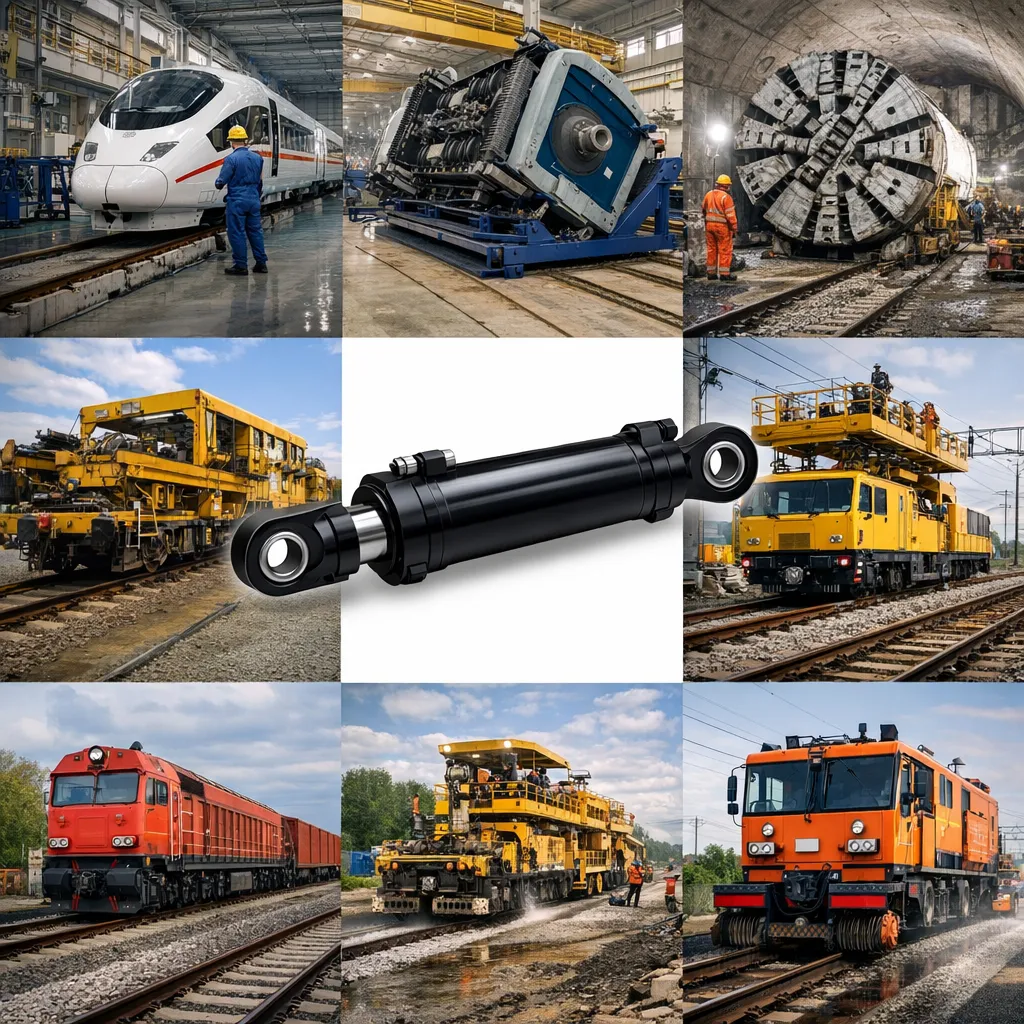
To resolve this pervasive mechanical failure, our dedicated engineering division developed a specialized track gauge hydraulic cylinder featuring a proprietary wide guide structural architecture. By extending the internal bearing surface area with high-compressive-strength composite guide bands, our design safely absorbs massive eccentric loads, ensuring the rod and piston remain perfectly centered at all times. Manufactured with a heavy pressure vessel forged from Q345D low-temperature alloy steel, this actuator delivers unyielding force and zero internal fluid bypass under the most punishing outdoor conditions. For infrastructure contractors looking to eliminate the constant downtime associated with fixing hydraulic cylinders in the field, our specialized gauge cylinder offers the ultimate mechanical safeguard for your project timeline. As an experienced hydraulic cylinder manufacturer, we recognize that maximizing machine uptime is directly correlated to profitability.
Comprehensive Technical Specifications
Integrating actuation hardware into heavy track construction machinery requires exact metallurgical and dimensional alignment. The data table below details the core engineering parameters of our track gauge actuators, specifically highlighting the custom design elements required to defeat eccentric loading and prevent internal pressure decay. Every double acting hydraulic cylinder we output for the railway sector strictly adheres to these heavy-duty specifications to ensure flawless geometric corrections on the rail bed.
| Engineering Parameter | Specification Detail & Customization Range |
|---|---|
| Target Industrial Sector | Railway Transit / Rail Infrastructure Construction |
| Equipment Category | Track Construction Vehicle / Sleeper Tamping Machine |
| Subsystem Integration | Track Gauge Adjustment Mechanism |
| Specific Component Name | Track Gauge Cylinder (Gauge Opening Actuator) |
| Actuation Method | Double Acting Hydraulic Cylinder |
| Internal Structure Type | Heavy-Duty Piston Type Actuator |
| Manufacturing Structure | Fully Welded Construction (Zero Tie-Rods) |
| Primary Material System | Q345D Low-Temperature High-Strength Steel |
| Rod Surface Treatment | Deep Hard Chrome Plated (Anti-Corrosion / Anti-Scoring) |
| Environmental Stress Class | Harsh Outdoor Vibration + Severe Eccentric Load |
| Specific Work Action | Precision Track Gauge Opening and Alignment |
| Typical Prevented Failure | Piston Scoring / Severe Internal Leakage |
| Recommended Configuration | Wide Guide Bands (Composite) for Load Absorption |
| Mounting Versatility | Heavy-Duty Spherical Bearing Clevis or Heavy Trunnion |
The mandate to utilize Q345D alloy steel is driven by the severe thermal realities of continuous railway construction. A standard carbon steel barrel is perfectly adequate for indoor automation, but when subjected to the freezing temperatures of a South Korean winter, generic carbon steel becomes dangerously brittle. The sudden application of immense hydraulic force against frozen, unyielding steel rails can cause brittle fractures in standard metals. Q345D is a highly specialized structural alloy engineered specifically for exceptional impact toughness at low temperatures, with a verified Charpy V-notch performance down to -20 degrees Celsius. This ensures the track gauge cylinder maintains complete structural elasticity and absolute pressure containment capabilities regardless of the regional climate.
Operational Fluid Dynamics: Controlling Rail Geometry
The mechanical procedure of track gauge adjustment demands a fluid power source that is both immensely powerful and microscopically precise. The construction vehicle positions itself over the rails, and the mechanical alignment arms lock onto the steel profiles. At this juncture, the gauge cylinder becomes the sole actuator for geometric correction. Adjusting track geometry requires absolute bi-directional fluid control to effectively push rails apart (gauge opening) or pull them together (gauge narrowing) based on the surveyor’s data. Utilizing a single-acting system here is physically impossible; only a precisely metered, fully hydraulic return stroke can guarantee safety and accuracy.
When the operator initiates a gauge widening sequence, pressurized hydraulic fluid is metered through the directional control manifold directly into the cap end of the cylinder barrel. The fluid exerts tremendous pushing force across the full face of the hydraulic cylinder piston, driving the hard chrome rod outward. As the rod extends, the mechanical linkage forces the heavy rails apart. Because of the uneven physical resistance of the ballast and sleepers, this pushing action invariably generates the dreaded eccentric load. However, our engineered wide guide bands physically distribute this twisting force across a massive internal surface area, allowing the piston to glide smoothly forward without compromising the critical seal interface against the honed steel wall.
Conversely, to pull the rails inward, hydraulic fluid is diverted into the rod-end port. The pressure acts on the annular area of the piston, powerfully retracting the rod. Once the precise millimeter target is achieved, pilot-operated check valves lock the fluid inside the hydraulic cylinder. This is exactly where our zero internal leakage design proves its necessity. Even a microscopic fluid bypass across the piston seal would cause the trapped pressure to decay, allowing the rail to spring back to its original deformed position before the fastening spikes can be driven. By ensuring absolute pressure trapping, our highly engineered hydraulic rams guarantee that the track geometry is perfectly secured for the track gang to complete their fastening protocols without risking sudden, dangerous rail movement.
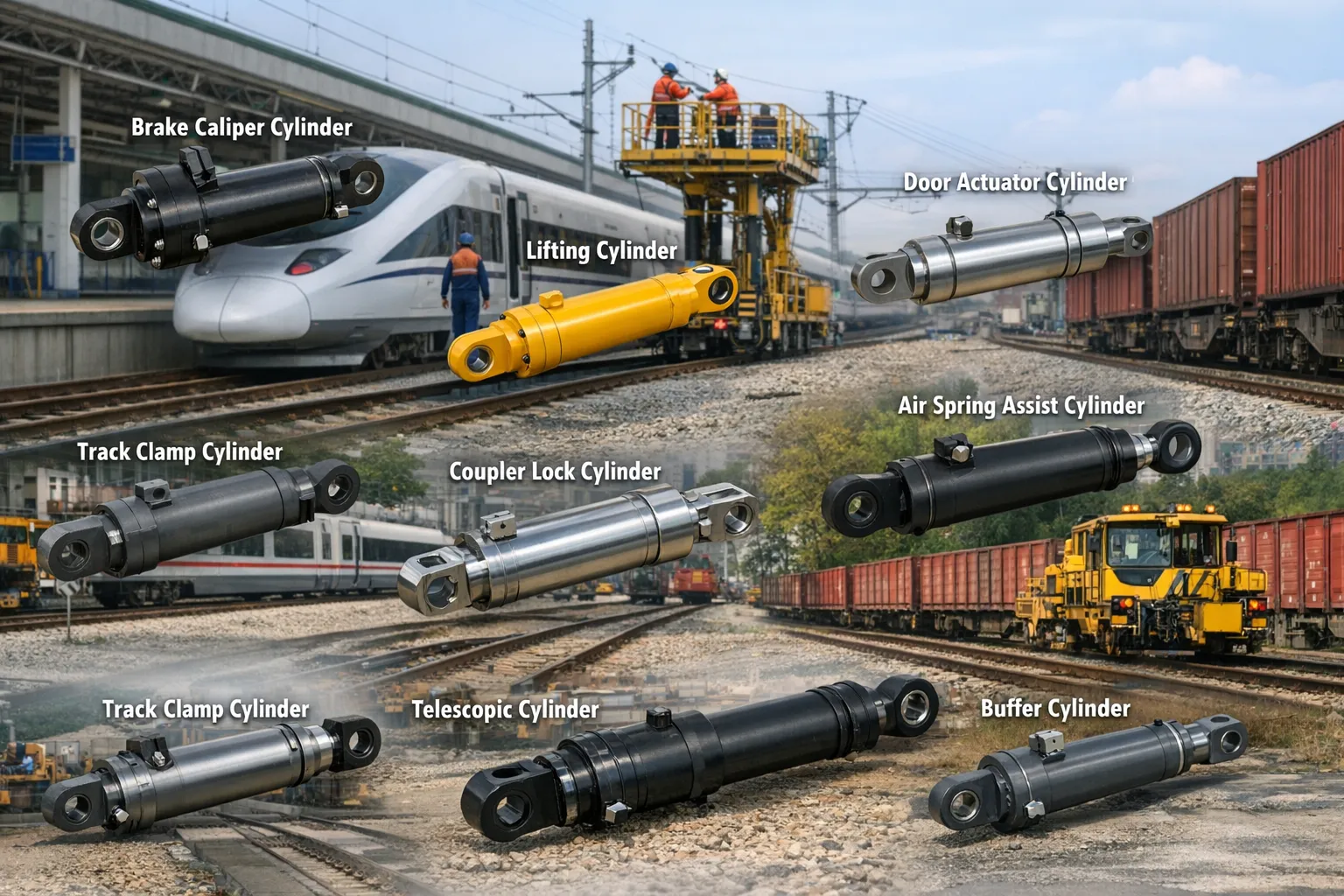
Seamless Fleet Modernization & OEM Brand Replacement
For major railway maintenance contractors, relying strictly on the original equipment manufacturer (OEM) for replacement actuation parts often results in excessive shipping downtime and significantly inflated budgets. We specialize in streamlining your component supply chain. Our autonomous manufacturing facility is fully equipped to reverse-engineer and produce exact dimensional replacements for the complex actuation systems utilized on the world’s leading track construction vehicles. We deliver bespoke solutions directly from our engineering desks to your field depots.
(Please note: The mention of the following commercial brands is strictly for the purpose of demonstrating mechanical cross-compatibility and assisting procurement engineers with physical dimensional sizing. We do not claim any trademark ownership, endorsement, or direct affiliation with Plasser & Theurer, Harsco Rail, Loram, Matisa, Robel, Bosch Rexroth, or Parker Hannifin.)
By providing our engineering team with the stroke length, closed-center dimensions, and mounting pin diameters of your legacy equipment, we can autonomously forge and machine exact drop-in hydraulic parts. You receive an actuator that bolts perfectly into your machine without any chassis modification, internally upgraded with our superior Q345D metallurgy and wide guide anti-leakage architecture. This capability drastically optimizes your overall hydraulic cylinder price overhead while elevating the operational performance of your entire heavy machinery fleet, allowing you to bypass international supply chain bottlenecks.
Core Technical Advantages of Our Gauge Actuators
What specific engineering elements elevate our track gauge hydraulic cylinder above standard commercial fluid power units? The answer lies in our obsessive focus on neutralizing the exact mechanical failure modes inherent to railway construction. The following advantages guarantee unyielding field performance:
- 1. Advanced Wide Guide Configuration
This is the definitive mechanical defense against eccentric loads. We machine expanded grooves into the piston and internal gland, outfitting them with heavy-duty PTFE/Bronze composite guide bands. These extra-wide bands act as a sacrificial bearing surface that perfectly distributes lateral twisting forces. This ensures the steel rod never rubs against the cylinder bore, completely eliminating the root cause of internal scoring and subsequent seal failure. - 2. Absolute Zero Internal Leakage Sealing
Because the cylinder must hold the rail in exact position during fastening, any pressure drop is a critical failure. Our piston utilizes a highly specialized multi-lip polyurethane sealing matrix flanked by robust anti-extrusion rings. This ensures a flawless boundary layer that traps 100% of the hydraulic fluid, maintaining a rock-solid gauge adjustment indefinitely without reliance on constant pump activation. - 3. Q345D Low-Temperature Structural Integrity
Track construction timelines do not pause for winter. By constructing our pressure vessels entirely from Q345D alloy steel, we guarantee exceptional impact toughness even at -30°C. Standard carbon steel becomes brittle and fractures under cold mechanical shock loads, but our specialized Q345D metallurgy ensures the cylinder body safely absorbs massive hydraulic spikes in all severe climates. - 4. Fully Robotic Welded Architecture
Railway machinery generates continuous, high-amplitude vibrations from tamping tines and massive diesel engines. Cylinders assembled with long external tie-rods are highly susceptible to vibrating loose over time, leading to catastrophic end-cap blowouts. We utilize deep-penetration robotic submerged arc welding to fuse the end caps directly to the Q345D barrel, creating an ultra-rigid, permanent pressure vessel that ignores vibration. - 5. Micro-Cracked Hard Chrome Surface Defense
Track beds are highly abrasive environments, subjecting equipment to rain, snow, and metallic dust. Our piston rods receive an exceptionally thick layer of micro-cracked hard chrome plating. These microscopic fissures retain a thin film of hydraulic oil, creating a permanent, impenetrable boundary layer against rust and physical scoring from flying track debris. - 6. Superior Fatigue Life Optimization via FEA
Through comprehensive Finite Element Analysis (FEA), our engineering team meticulously maps and eliminates mechanical stress concentration zones around the fluid ports and heavy-duty spherical bearing mounts. This mathematical optimization ensures the track gauge cylinder delivers millions of precise alignment cycles without suffering from microscopic structural fatigue.
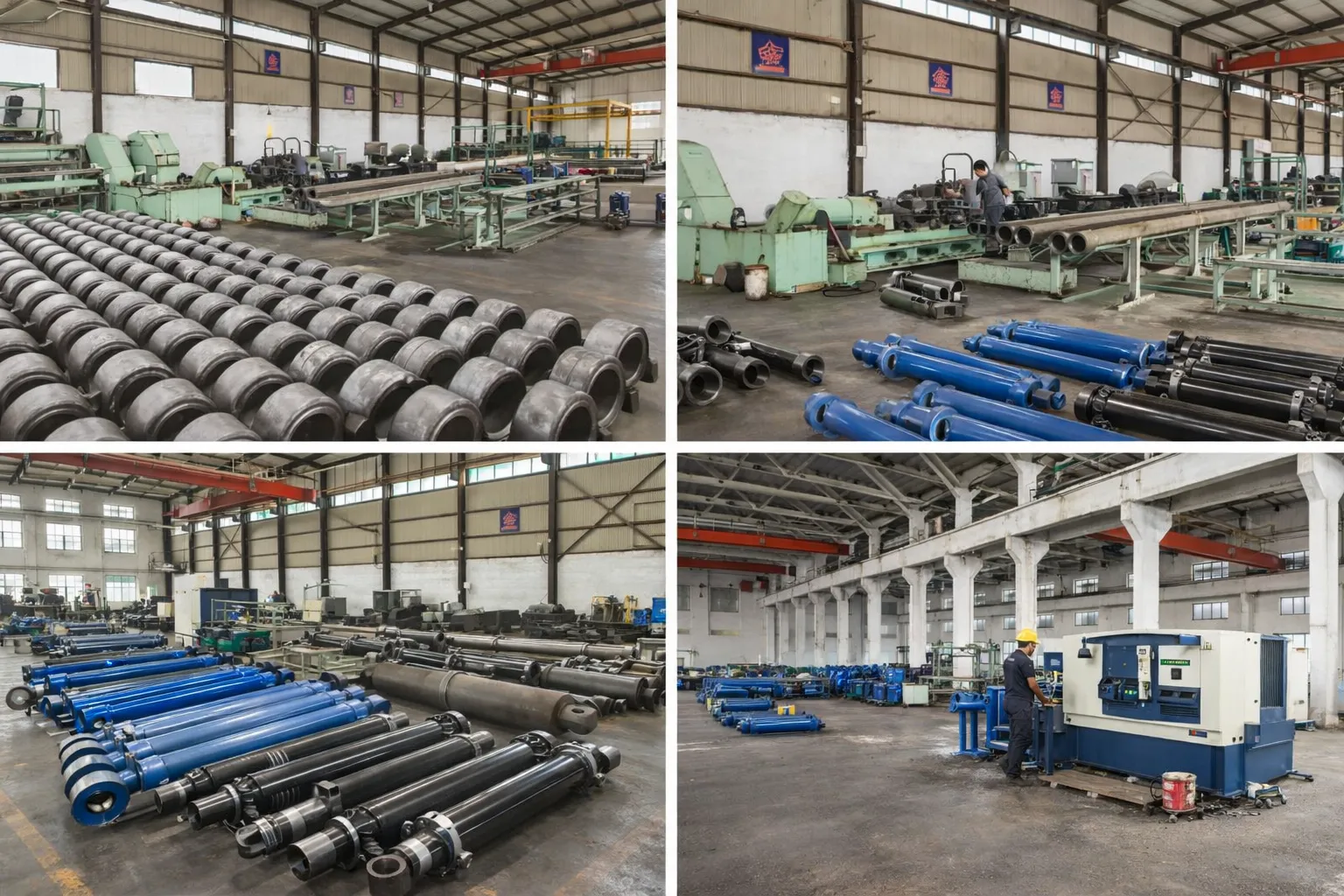
Autonomous Manufacturing and Unyielding Quality Assurance
Delivering critical infrastructure safety components requires a manufacturing ecosystem defined by absolute control. We operate as a fully autonomous, vertically integrated hydraulic cylinder manufacturer. We do not rely on third-party intermediaries or outsourced assembly lines. From the initial metallurgical verification of incoming Q345D steel billets via rigorous ultrasonic non-destructive testing to the final multi-axis CNC machining of the hydraulic cylinder components, every process is executed and strictly monitored within our advanced factory floor.
The internal bore of every pressure vessel undergoes a highly specialized skiving and roller burnishing process. This advanced machining technique achieves a mirror-like internal surface finish (Ra < 0.2µm) and physically work-hardens the steel. This ultra-smooth bore works in perfect synergy with our zero-leakage seals, drastically reducing dynamic friction and ensuring the track gauge is adjusted smoothly, without any sudden stick-slip jerking that could ruin the precise alignment measured by the vehicle’s onboard computers.
Quality control is not a randomized sampling process for us; it is a 100% mandate. Every single gauge cylinder that departs our production line is subjected to a rigorous hydrostatic proof test on customized test benches. The unit is pressurized to 150% of its maximum rated operational limit, and monitored for extended periods to ensure absolutely zero pressure decay (internal leakage) and verification of structural weld integrity. Following certification, each actuator is laser-engraved with a permanent serial number, ensuring comprehensive ISO traceability for your fleet maintenance records.
Cross-Industry Applications for Eccentric Load Mastery
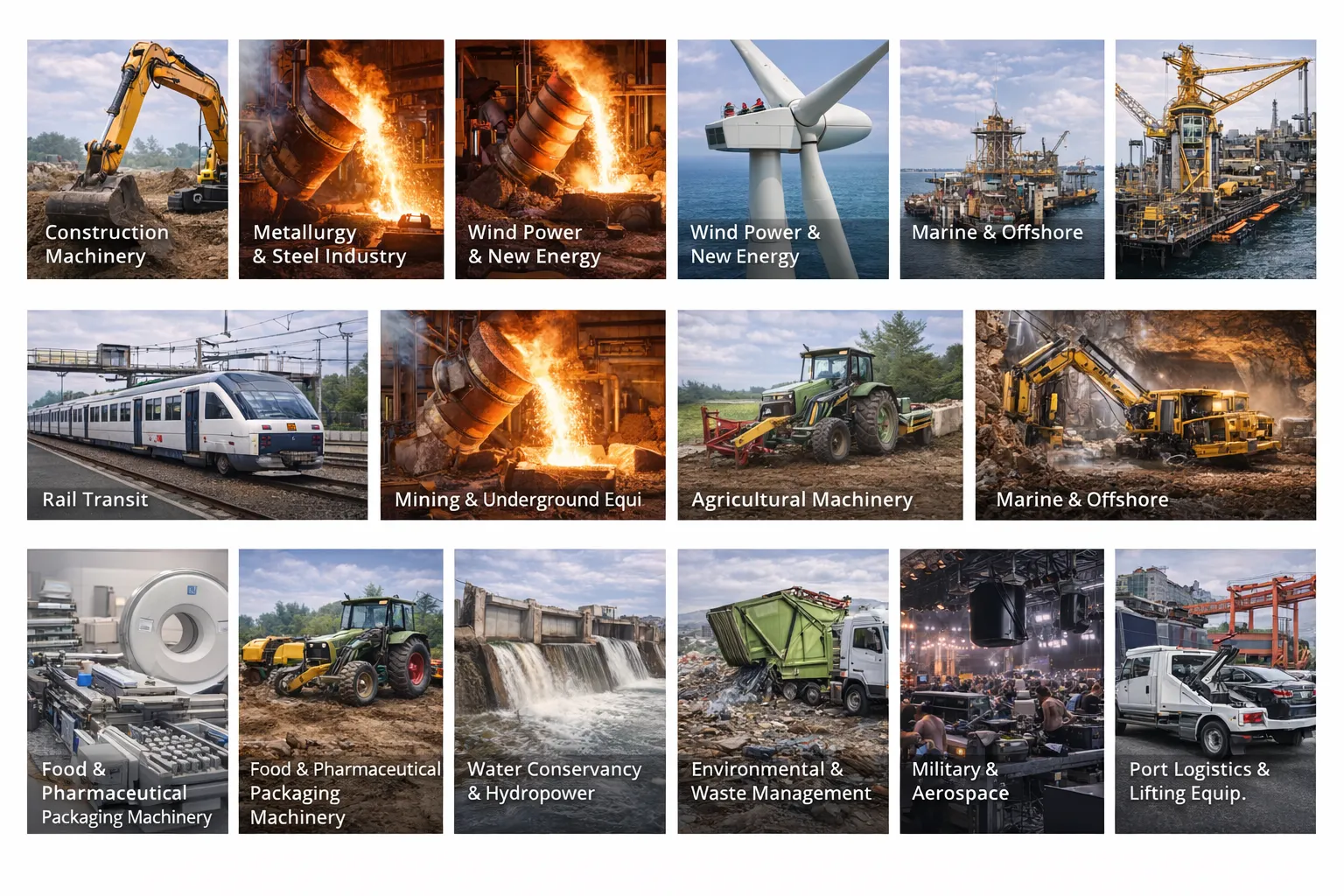
While the sophisticated wide guide and Q345D architecture detailed here is specifically engineered to conquer the eccentric loads of railway track adjustment, the fundamental mechanical capability of resisting side-loading while maintaining absolute zero internal leakage is highly critical across multiple severe-duty industries. Our advanced fluid power technology is frequently utilized in:
- Heavy Earthmoving: The ability to absorb twisting forces makes this architectural design perfect for the Construction Machinery Industry, excelling as an indestructible heavy-duty lift cylinder for massive quarry excavators operating on uneven terrain.
- Underground Resource Extraction: Roof support and heavy rock crushing equipment subject actuators to immense side loads. Our wide guide designs are considered essential safety components within the Mining Industry.
- Steel Production Facilities: Operating massive automated crucible tilts involves unpredictable shifting loads. Our zero-leakage sealing technology provides absolute control for safety-critical operations in the Metallurgical and Iron Industry.
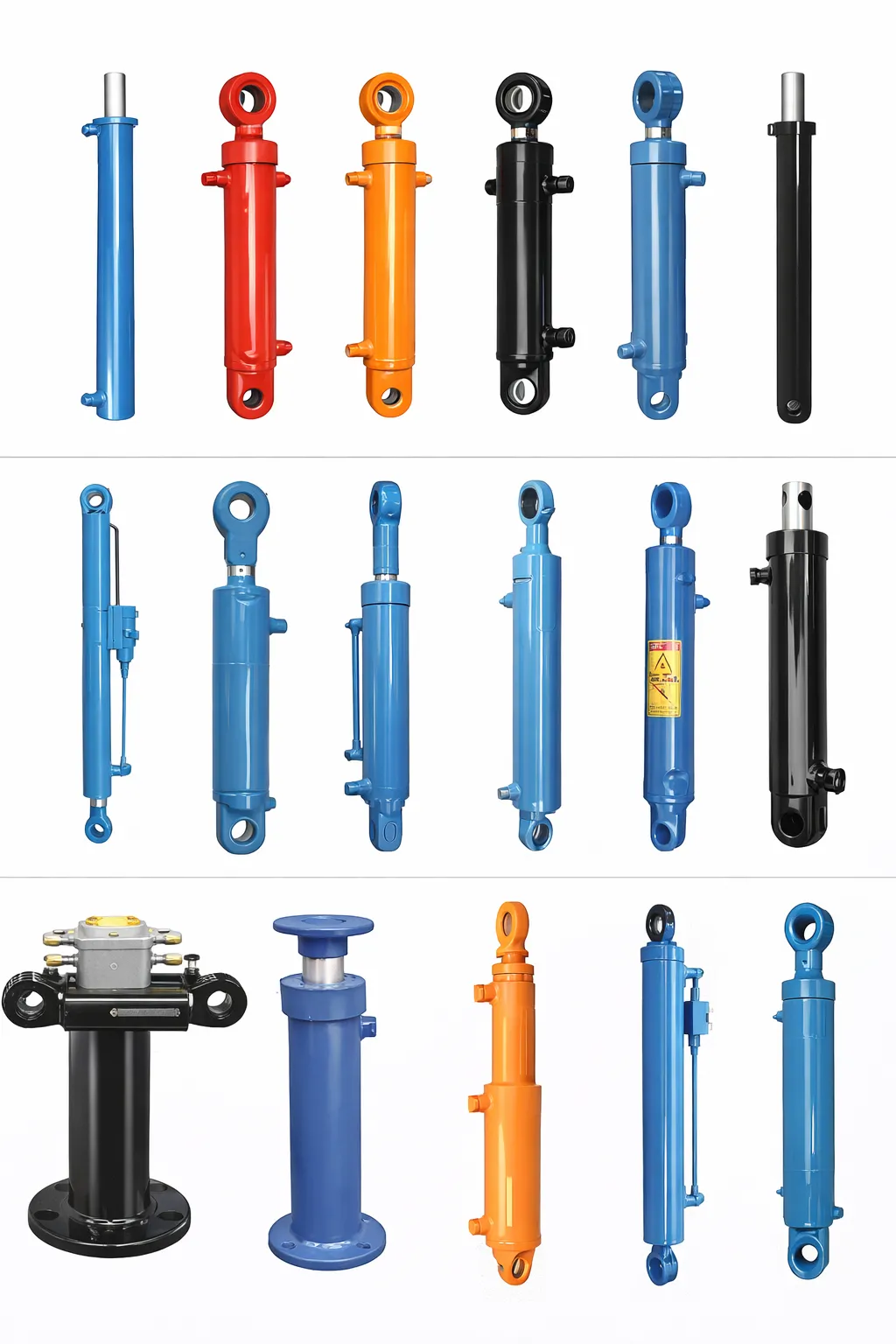
Comparative Analysis: Standard Commercial vs. Specialized Gauge Cylinders
Attempting to integrate cheap, off-the-shelf industrial cylinders into heavy railway construction machinery is a highly flawed strategy that directly leads to internal leakage and dangerous track misalignment. The table below illustrates the critical engineering disparities and highlights why our purpose-built actuators guarantee superior project ROI by preventing unexpected breakdowns.
| Critical Metric | Generic Industrial Cylinder | Our Track Gauge Cylinder |
|---|---|---|
| Eccentric Load Handling | Narrow standard guide rings. Rod quickly tilts and scores the internal barrel. | Wide composite guide bands completely neutralize massive side loads. |
| Internal Leakage Risk | High. Basic seals warp under uneven pressure, leading to rapid pressure decay. | Virtually zero. Multi-lip polyurethane matrix ensures absolute pressure lock. |
| Base Structural Material | Standard 1045 Carbon Steel. Dangerously brittle in sub-zero winter temperatures. | Premium Q345D Alloy Steel. Unyielding impact toughness even below -20°C. |
| Vibrational Integrity | External tie-rods constantly shake loose on heavy construction equipment. | Fully robotic welded construction creates a permanent, loosening-proof vessel. |
| Testing Rigor | Randomized batch sampling leaves room for critical field failures. | 100% individual hydrostatic proof testing for absolute zero leakage verification. |
| Overall Maintenance | Requires frequent, costly tear-downs and machine operational downtime. | Extended lifecycle dramatically lowers your long-term hydraulic cylinder price overhead. |
Proven Field Reliability: Case Studies in Fleet Modernization
Rigorous theoretical engineering only matters when validated by punishing field deployments. Over the last decade, our technical division has systematically resolved complex actuation failures for primary rail infrastructure contractors across East Asia. Below are detailed operational success stories demonstrating our precise engineering capability.
Case Study 1: Eradicating Internal Leakage on National Rail Upgrades
Location & Client: Seoul, South Korea — Primary High-Speed Rail Infrastructure Contractor.
The Engineering Challenge: The contractor’s fleet of track construction vehicles was failing to hold precise track gauge dimensions during nighttime fastening operations. The massive eccentric loads from pushing rigid rails were causing the piston rods to deflect, severely scoring the internal barrels of their OEM cylinders. This caused massive internal leakage, resulting in the rails shifting back out of alignment before they could be spiked down, causing unacceptable project delays and increased labor costs.
How We Connected: The lead fleet procurement officer urgently searched for an expert hydraulic cylinder manufacturer capable of custom anti-side-load engineering and engaged our technical portal.
The Solution & Result: We rapidly delivered a batch of custom track gauge hydraulic cylinders featuring our massively expanded wide guide bands. These robust PTFE composites successfully absorbed all lateral rail twisting forces. After 18 months of rigorous deployment, internal leakage events dropped to absolute zero, allowing the fleet to hit their track laying targets consistently ahead of schedule.
Case Study 2: Conquering Winter Brittle Fractures in Mountain Passes
Location & Client: Gangwon Province, South Korea — Regional Mountain Railway Authority.
The Engineering Challenge: Upgrading mountain track during the freezing winter months proved disastrous for the client’s existing equipment. Their standard carbon steel cylinders were becoming dangerously brittle at -20°C. When adjusting frozen tracks, the sudden hydraulic shock was causing micro-fractures in the cylinder end caps, leading to complete structural failure and fluid spills on the sensitive mountain terrain.
How We Connected: A prominent structural engineering consultant within the Asian rail industry specifically recommended our firm for our deep metallurgical expertise with the Q345D alloy.
The Solution & Result: We overhauled their adjustment subsystem with our gauge cylinder constructed entirely from Q345D low-temperature steel, utilizing robotic full-penetration welding. The Q345D effortlessly handled the sub-zero mechanical shocks, maintaining complete elasticity. Equipment lifespan through the winter seasons was safely extended by a massive 250%.
Case Study 3: Overhauling Obsolete European Machinery
Location & Client: Taipei, Taiwan — High-Speed Rail Overhaul Consortium.
The Engineering Challenge: The consortium was struggling to source replacement track adjustment cylinders for a fleet of 15-year-old European track construction machines. The original OEM parts had lead times exceeding 6 months and were prohibitively expensive, effectively stalling their modernization program and threatening their government contracts.
How We Connected: The procurement department reached out via our technical contact form to inquire if we could match the specific metric mounting dimensions of their obsolete equipment based on provided schematics.
The Solution & Result: We reverse-engineered their undercarriage footprint and supplied customized, drop-in double acting hydraulic cylinders. By delivering identical external dimensions but vastly superior internal wide-guide mechanics, we completely eliminated internal leakage issues. The track machines now operate with vastly improved accuracy and reliability.
Frequently Asked Questions
Procuring highly specialized safety hardware for rail infrastructure demands rigorous technical scrutiny. To support your mechanical engineering and purchasing departments, we have comprehensively addressed the most common inquiries regarding our heavy-duty track adjustment technology.
Secure Your Track Geometry with Uncompromising Engineering
Do not allow vulnerable, generic fluid power components to jeopardize your critical track construction projects, cause severe internal leakage, or inflate your annual maintenance budgets with unpredictable equipment downtime. Our precision-engineered Q345D actuators represent the absolute pinnacle of severe-duty track gauge technology, guaranteeing millimeter-perfect adjustments under the most punishing eccentric loads.
Editor: Cxm