Ridger Blade Lift Cylinder for Agricultural Ridging Machines
Q345D structural steel, oversized chrome rod, and heavy-duty dust protection. Engineered for the sustained downforce and side loads of ridge-forming operations.
What Happens When a Ridger Cylinder Fails Mid-Field, and Why It Keeps Happening
A ridger blade cylinder failure does not announce itself gently. One moment the machine is building clean, uniform ridges for potato or sweet potato planting. The next, the operator notices that one side of the ridger is cutting shallow while the other digs too deep. The ridges become lopsided. Within minutes, the field has a section of crooked, uneven beds that cannot be planted without rework. The tractor stops. The operator climbs down. There is oil dripping from a cylinder rod seal, or worse, the rod itself is visibly bent, and the cylinder is binding on every stroke.
This scenario plays out on farms and contract operations across Korea, Japan, and Southeast Asia every ridging season. The root cause is almost always the same: a standard-duty hydraulic cylinder that was not designed for the specific combination of sustained downforce, lateral soil resistance, and abrasive dust exposure that ridging work demands. Ridger blades do not just push straight down into the soil. They plow laterally, moving large volumes of earth sideways to build up the ridge profile. This lateral soil resistance creates bending loads on the cylinder rod that standard-diameter rods cannot handle over multiple seasons.
Our ridger blade lift cylinder addresses this failure pattern directly. It is a double acting hydraulic cylinder built from Q345D low-alloy structural steel with an oversized piston rod selected for bending resistance rather than just axial push capacity. The chrome layer is 20 micrometers minimum, ground and polished to protect against the abrasive dust that ridging operations generate in massive quantities. A heavy-duty dust scraper ring at the gland prevents soil ingress into the seal zone. Everything about this cylinder is specified for the real-world demands of ridge forming, not borrowed from a general agriculture catalog.
Soil Resistance and Rod Loading: Why Ridging Is Harder on Cylinders Than Cultivation
Many buyers wonder why a ridger cylinder needs to be heavier-duty than a cultivator depth cylinder when both machines work in similar soil. The answer lies in the direction and duration of the load.
A cultivator blade cuts downward into the soil and moves forward in a narrow slot. The reaction force is primarily axial, straight back along the cylinder rod. A ridger blade, on the other hand, enters the soil at an angle and then sweeps a large wedge of earth to one side or both sides to form the ridge. This sideways earth-moving action generates a sustained lateral force on the blade that translates into a continuous bending load on the cylinder rod. Unlike the brief impact from a stone hit, this lateral force persists for the entire length of every ridge pass.
The following table shows approximate lateral force factors for different soil types during ridging operations, expressed as a percentage of the vertical downforce. These values are based on field measurements and published agricultural engineering data for typical ridger geometries.
| Soil Type | Vertical Downforce | Lateral Force Factor | Resulting Rod Side Load | Rod Bending Risk |
|---|---|---|---|---|
| Sandy Loam | 8 – 12 kN | 20 – 30% | 1.6 – 3.6 kN | Low to moderate |
| Clay Loam | 12 – 18 kN | 30 – 45% | 3.6 – 8.1 kN | Moderate to high |
| Heavy Clay (Dry) | 18 – 28 kN | 40 – 55% | 7.2 – 15.4 kN | High (standard rods bend) |
| Compacted Subsoil | 22 – 35 kN | 45 – 60% | 9.9 – 21 kN | Very high (requires oversized rod) |
As the table shows, lateral rod loads in heavy clay ridging can exceed 15 kN, which is well beyond the bending capacity of a standard 35 mm carbon steel rod. Our oversized 40 mm to 45 mm Q345D alloy rod provides the additional bending resistance needed to survive these loads season after season without permanent deflection.
How the Ridger Blade Lift Cylinder Operates
The ridger blade assembly mounts to the machine toolbar through a hinged arm or parallelogram linkage. The ridger blade lift cylinder connects between the toolbar and this linkage arm, typically at a clevis or pin-eye mounting point. When the operator lowers the ridger into working position, pressurized oil extends the cylinder rod, pushing the linkage arm downward and driving the blade into the soil to the target depth.
During ridging, the blade displaces soil laterally to form the ridge profile. The soil reaction force has both vertical and horizontal components. The vertical component is absorbed by the cylinder in axial compression. The horizontal component creates a bending moment on the rod. On single-blade ridgers, this lateral force acts in one direction. On disc-type or wing-blade ridgers that throw soil to both sides, alternating lateral forces create a cyclic bending pattern that is even more demanding on the rod.
At the end of each pass, the operator raises the ridger for the headland turn. The cylinder retracts fully, pulling the blade out of the ground. This full-stroke retraction provides a brief lubrication benefit for the seals, but it also exposes the freshly oiled rod surface to a cloud of airborne dust from the soil disturbed during the ridge-forming pass. The scraper ring at the gland must intercept this dust before the rod fully enters the gland bore on the next extension stroke.
Technical Specifications
| Specification | Available Range |
|---|---|
| Bore Diameter | 50 mm – 100 mm |
| Rod Diameter (Oversized) | 32 mm – 70 mm |
| Stroke Length | 80 mm – 450 mm |
| Working Pressure | Up to 20 MPa (2,900 PSI) |
| Action Type | Double Acting |
| Structure | Welded Piston Cylinder |
| Body Material | Q345D Low-Alloy Structural Steel |
| Piston Rod | Q345D, Hard Chrome 20+ micron, Micro-Polished |
| Body Finish | Black Oxide + Epoxy Paint |
| Piston Seal | High-Strength PU + PTFE Wear Ring |
| Rod Seal | NBR + PTFE Back-up Ring |
| Dust Scraper | Metal-Cased Polyurethane |
| Mounting | Clevis, Pin Eye, Trunnion, Custom |
| Port Thread | BSP / NPT / Metric |
| Operating Temperature | -20 C to +80 C |
| Environment Rating | Dust + Hard Soil / Lateral Loading |
Six Advantages Designed Around Ridging-Specific Failure Modes
Oversized Rod for Lateral Bending Resistance
The rod diameter is selected one standard size above what axial load requires. For a 63 mm bore, we use 40 mm or 45 mm rod instead of the standard 35 mm. Bending resistance increases with the fourth power of diameter, so this upgrade dramatically reduces the risk of permanent rod deflection from the sustained lateral soil forces that ridging produces.
Q345D Alloy Steel with Low-Temperature Toughness
Q345D provides 345 MPa minimum yield with Charpy impact toughness guaranteed at -20 C. This matters for early spring ridging when soil is still cold and brittle fracture risk is highest. The alloy also welds more consistently than carbon steel, producing stronger barrel-to-cap joints that resist the cyclic pressure loading from hard soil ridging passes.
Extended Gland Bearing for Side-Load Distribution
The gland bushing length is increased to 1.5 times rod diameter, spreading lateral force over a wider contact area. This prevents the localized wear grooves that short-guided designs develop after sustained side loading, and it improves rod alignment during dynamic operation.
Metal-Cased Dust Scraper for Heavy Soil Environments
Ridging throws enormous volumes of soil past the cylinder body. Standard rubber wipers work loose from vibration within a single season. Our metal-cased scraper is mechanically retained in a machined groove and cannot dislodge. The hardened polyurethane lip shears off caked clay and embedded grit from the rod surface before it enters the gland.
PTFE Wear Rings on Piston and Gland
The continuous lateral loading from ridging presses the piston and rod against the bore wall. Without wear rings, this metal-to-metal contact scores the bore surface and accelerates seal failure. Our PTFE-bronze composite wear rings absorb lateral loads and eliminate metal contact, maintaining bore integrity for over 3,000 hours.
Reinforced Port Bosses for Vibration Environments
Ridger cylinders experience heavy vibration from soil contact transmitted through the blade and linkage. Port boss reinforcement and CNC-machined threads with tight tolerances ensure fittings remain tight and leak-free through seasons of continuous vibration loading.

Where This Cylinder Gets Put to Work
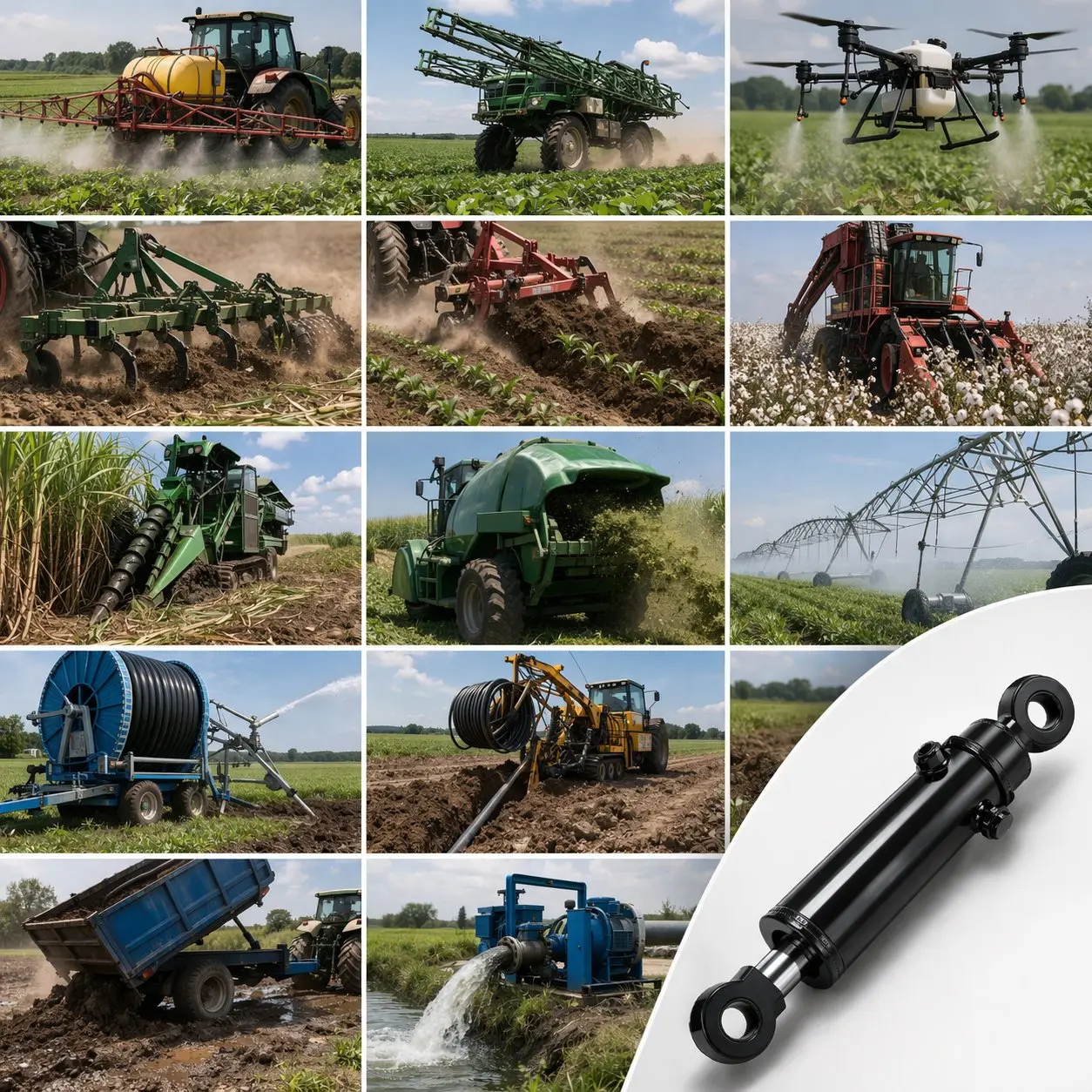
Potato and Sweet Potato Ridgers: The core application. Single and double-row ridgers form the raised beds essential for tuber crops. Our cylinder maintains consistent ridge height and profile shape across varying soil conditions within the same field.
Peanut Ridging and Hilling Machines: Peanut cultivation requires mid-season hilling passes to cover developing pegs. The agricultural hydraulic cylinder on the hilling blade must hold depth precisely while the blade moves large volumes of sandy soil laterally.
Vegetable Bed Formers: Raised-bed vegetable production in Korea and Japan uses powered or passive bed formers that rely on hydraulic cylinders to set blade depth and wing angle. The compact welded body fits the tight frame spacing on multi-bed forming machines.
Sugarcane Ridging and Earthing-Up: Sugarcane hilling operations in Southeast Asia and South Asia use heavy-duty ridgers that move massive volumes of soil at each pass. The high lateral loads in this application are among the most severe any hydraulic cylinders for agricultural machinery experience.
Drainage Ditch Forming Equipment: Machines that cut field drainage ditches operate similarly to ridgers but in reverse, removing soil rather than building it up. The lateral loads on the blade cylinder are comparable, making our oversized-rod design equally suitable for this application.
Manufacturing Process
Every ridger cylinder is built entirely in our own factory. Q345D tube and rod stock is verified by spectrometer on arrival. Barrels are CNC bored and honed to Ra 0.2 bore finish. Rods are ground, chrome plated to 20+ micrometers, and micro-polished. Welding is performed by certified operators with MIG shielded arc, followed by visual and magnetic particle inspection. Assembly takes place in a filtered clean area. Every finished unit is pressure tested at 1.5 times rated working pressure for three minutes with full leak inspection and functional stroke verification. Serial numbered with complete traceability to material batch, seal lot, and test data maintained for a minimum of ten years. ISO 9001 certified facility. Material test reports and pressure test certificates are included with every shipment.
Standard Lift Cylinder vs. Our Ridger Blade Lift Cylinder
| Ridging-Specific Metric | Standard Lift Cylinder | Our Ridger Cylinder |
|---|---|---|
| Rod Lateral Bending Capacity | Sized for axial load only | Oversized for combined axial + lateral |
| Gland Bearing Length | 1.0x rod diameter | 1.5x rod diameter |
| PTFE Wear Rings | None (metal-to-metal contact) | Piston + gland wear rings included |
| Dust Scraper | Press-fit rubber (loosens) | Metal-cased PU (retained) |
| Body Material | S45C Carbon Steel | Q345D Low-Alloy Steel |
| Rod Bending Incidents per Season (clay soil) | 3 – 8 per machine | 0 – 1 per machine |
| Seal Replacement Interval (dusty soil) | Every 1-2 seasons | Every 4-5 seasons |
Customer Results
Yesan County, Chungcheongnam-do, South Korea
Customer: Sweet potato farming cooperative operating 56 ridging machines across 1,100 hectares
How They Found Us: Cooperative equipment manager searched Google for “ridger hydraulic cylinder bent rod solution” in December 2024.
Results: Replaced cylinders on all 56 machines before the April 2025 ridging season. Rod bending incidents dropped from an average of 4.2 per machine per season to 0.1 (6 total across the fleet). Annual cylinder maintenance costs fell by an estimated 70%.
“Sweet potato ridging in Chungnam clay soil bends standard rods like noodles. Going from over 230 bent rods across our fleet to only 6 in one season is a result I would not have believed if I had not seen it myself.” – Mr. Yoo, Equipment Manager, October 2025
Seogwipo City, Jeju Province, South Korea
Customer: Agricultural equipment dealer serving Jeju’s potato and garlic farming sector
How They Found Us: Referral from a mainland dealer. First trial order of 30 units placed in January 2025.
Results: Jeju volcanic soil is abrasive but relatively stone-free, so the primary failure mode here is seal wear from fine volcanic dust rather than rod bending. Our metal-cased scraper eliminated the dust ingress problem that was causing annual seal replacements. All 30 units completed the full 2025 season without seal maintenance. The dealer now carries our product as standard stock.
“On Jeju, dust is the enemy, not rocks. The scraper ring on these cylinders handles volcanic dust far better than the rubber wipers we were selling before.” – Mr. Oh, Dealer Manager, November 2025
Tottori Prefecture, Japan
Customer: Sand dune vegetable production cooperative growing yams and daikon radish on sandy raised beds
How They Found Us: Found our technical pages while browsing hydraulic cylinders for sale for agricultural ridging applications. Inquiry in April 2025.
Results: Tottori sand dune soils are fine-grained and extremely abrasive. The cooperative had been replacing rod seals twice per season. Our scraper ring and chrome-polished rod combination extended seal life to over two full seasons with no detectable leakage.
“The sand here gets into everything. Having cylinders that can keep working without constant seal changes saves us time we need for the harvest.” – Mr. Taniguchi, Equipment Chief, September 2025
Binh Duong Province, Vietnam
Customer: Large-scale cassava farming operation using ridging machines on 800 hectares of red laterite soil
How They Found Us: Their maintenance supervisor found us through a Google search for “heavy duty ridger cylinder agricultural” in September 2024.
Results: Red laterite soil is extremely dense and abrasive when dry. The farm had been bending 3 to 5 cylinder rods per machine per season on their 14 ridging machines. After switching to our oversized-rod Q345D cylinders, rod bending dropped to zero across the entire fleet through two consecutive seasons. The farm estimates annual savings of over 40% on ridger hydraulic maintenance.
“Laterite soil in the dry season is almost like concrete. Standard rods never survived a full campaign. These ones did two campaigns back to back with no issues. Very impressive result.” – Mr. Tran, Maintenance Supervisor, March 2025
Adana Province, Turkey
Customer: Agricultural machinery OEM building ridging and hilling implements for the cotton and potato sectors
How They Found Us: Met at EIMA International (Bologna) in November 2024. Requested samples in December 2024.
Results: After a 4-month field evaluation in Cukurova plain clay soils, the OEM approved our cylinder as standard equipment on their entire ridger product line. Warranty claims for cylinder-related failures dropped from 7% to under 1%. Annual production order is approximately 450 units.
“The Cukurova plain has some of the heaviest clay soil in Turkey. Ridging here generates extreme side loads on the cylinder. After the field trial showed zero rod bending, we decided this is the only cylinder we will use going forward.” – Mr. Yilmaz, Chief Engineer, April 2025
Frequently Asked Questions
What size cylinder do I need for a potato or sweet potato ridger?
Why do ridger cylinder rods bend more than cultivator cylinder rods?
Can I replace my existing ridger cylinders with your oversized-rod version?
What is the lead time and shipping for ridger cylinders?
How do I maintain ridger cylinders between seasons?
Build Better Ridges With a Cylinder That Handles the Side Load
Share your ridger model, soil type, and current cylinder dimensions. Our engineering team will recommend an oversized-rod replacement and provide a quotation within 48 hours.
Editor: Cxm