Steering Cylinder for Agricultural Field Transport Vehicles
Q345D structural steel with dual-port symmetric seals and chrome rod. Delivers drift-free, equally responsive left-right steering control for field transport trailers, self-propelled farm vehicles, and utility carts on both field tracks and public roads.
Steering Drift at Road Speed Is Not Just Annoying. It Is a Safety Hazard.
A steering cylinder on a field transport vehicle converts operator input into wheel angle changes. Unlike a stationary implement cylinder that extends and retracts occasionally, a steering cylinder operates continuously during every moment the vehicle is in motion. It makes hundreds of small corrections per kilometer on public roads and dozens of larger corrections per field traverse. Every correction involves oil flowing through both ports simultaneously, and any internal leakage allows the steering angle to drift between corrections—a condition the driver perceives as wandering or pulling to one side.
On a loaded transport vehicle traveling at 25 to 40 km/h on a public road, steering drift of even 1 to 2 degrees causes the vehicle to wander into adjacent lanes. The operator constantly corrects, which creates fatigue during the long road transfers between fields that are a daily routine during harvest season. Driver fatigue from steering wander is a contributing factor in agricultural vehicle road accidents, particularly on narrow rural roads where the margin for lane wander is minimal. Internal leakage in the hydraulic cylinder is the most common root cause of this wandering behavior, and it gets progressively worse as the seals wear from continuous bidirectional cycling.
The additional engineering challenge specific to a steering cylinder is that it must respond equally in both directions. When the operator turns left, oil enters the left port and exits the right. When turning right, the flow reverses. If the piston seal leaks more in one direction than the other—which is common with asymmetric seal profiles—the steering develops a directional bias: it holds better turning one way than the other. The driver feels this as a vehicle that drifts consistently toward one side, requiring constant correction in the opposite direction.
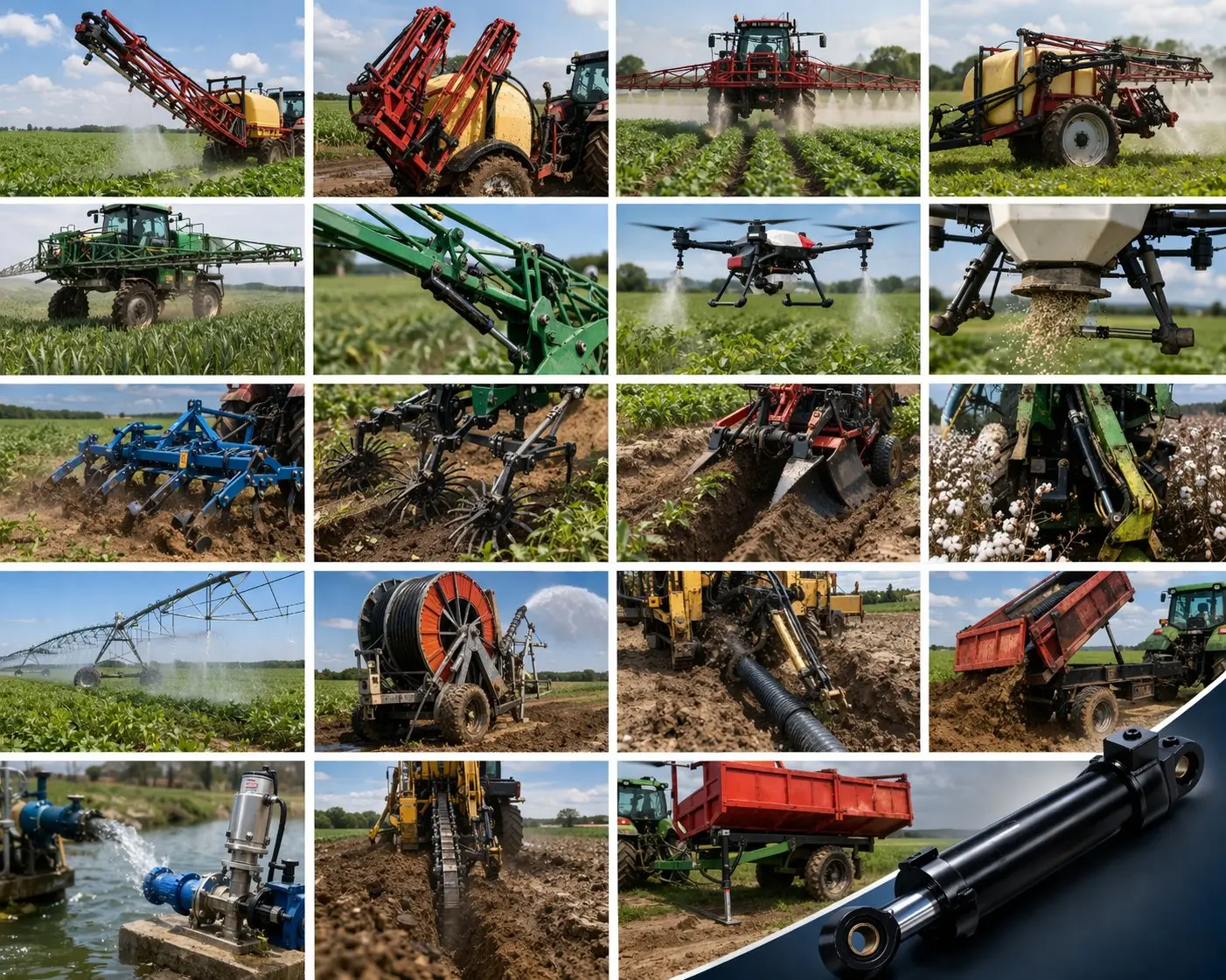
Our steering cylinder is a double acting hydraulic cylinder built from Q345D with a symmetric piston seal that provides equal sealing force in both pressure directions, dual PTFE anti-extrusion rings that prevent seal deformation regardless of which side is pressurized, a bore honed to Ra 0.2 with 0.01 mm roundness for uniform circumferential seal contact, and a chrome rod with PU wiper for road and field debris protection. The result is symmetric left-right steering response with internal leakage below 0.2 ml per minute in both directions—eliminating the directional drift that makes agricultural vehicle road transport fatiguing and dangerous.
Technical Specifications
| Specification | Available Range |
|---|---|
| Bore Diameter | 40 mm – 80 mm |
| Rod Diameter | 22 mm – 45 mm |
| Stroke Length | 80 mm – 350 mm |
| Working Pressure | Up to 16 MPa (2,320 PSI) |
| Action Type | Double Acting |
| Structure | Welded Piston Cylinder |
| Body Material | Q345D Low-Alloy Structural Steel |
| Piston Rod | Q345D, Hard Chrome 20+ micron |
| Piston Seal | Symmetric PU + Dual PTFE Anti-Extrusion Rings |
| Rod Seal | NBR + PTFE Back-up |
| Dust Seal | PU Wiper Ring |
| Body Coating | Epoxy Paint |
| Mounting | Ball Joint, Clevis, Rod End Bearing, Custom |
| Port Thread | BSP / NPT / Metric |
| Operating Temperature | -25 C to +80 C |
| Environment | Road + Field / Continuous Bidirectional / Road Debris |
Dual-Port Seal Symmetry: Why Steering Requires Equal Sealing in Both Directions
A steering cylinder has one hydraulic port at each end. When the operator turns left, oil enters the left port and exits the right. When turning right, the flow reverses. The piston seal must prevent internal bypass in both flow directions equally. If the seal leaks more in one direction—a common problem with single-lip seals that have inherently asymmetric profiles—the steering develops a directional bias.
This directional bias compounds with road camber. Most roads are crowned for drainage, meaning they slope downward from center to edge. A steering cylinder that leaks slightly more during left corrections than right corrections will allow the vehicle to drift toward the road edge on the crowned slope—exactly the direction where drift is most dangerous. The driver must constantly apply right correction to counteract this combined hydraulic and gravitational drift, which creates the chronic fatigue that makes long road transfers hazardous.
| Seal Characteristic | Single-Lip Asymmetric Seal | Our Symmetric Dual-Lip Seal |
|---|---|---|
| Left-turn internal leakage | 0.3 – 0.5 ml/min | Below 0.2 ml/min |
| Right-turn internal leakage | 0.8 – 1.5 ml/min (higher due to lip direction) | Below 0.2 ml/min |
| Left-right symmetry ratio | 1:2 to 1:4 (biased) | Within 10% (symmetric) |
| Driver-perceived behavior | Consistent pull toward one side | Neutral straight-line tracking |
| Anti-extrusion protection | One side only | Dual PTFE rings, both directions |
Our symmetric piston seal uses a double-lip profile that provides equal sealing force whether pressure acts from the left port or the right port. The dual PTFE anti-extrusion rings on both sides of the seal prevent extrusion-induced deformation regardless of pressure direction. Combined with the bore roundness tolerance of 0.01 mm that eliminates angular leakage paths, this design maintains symmetric internal leakage within 10 percent between directions—eliminating the directional steering bias that single-lip seals inherently produce.
How the Steering Cylinder Operates in Agricultural Transport Service
The steering cylinder connects between the vehicle chassis and the steering arm on the steerable axle. When the operator turns the steering wheel, a hydraulic steering valve directs oil to one end of the cylinder while allowing oil to return from the other end. The extending or retracting rod pushes or pulls the steering arm, rotating the wheels through their steering arc. The cylinder must respond proportionally to the operator’s input speed—fast for emergency corrections, slow and precise for minor adjustments during straight-line driving.
Agricultural transport vehicles face a dual operating environment that makes steering cylinder service particularly demanding. During field transfers, the cylinder operates at slow speeds in mud and crop debris. During road transport between fields, it operates at higher speeds in road grit, gravel spray, and seasonal salt or sand. Each environment deposits different contaminants on the rod surface, and the PU wiper must handle both without allowing either type of debris to reach the primary seal. The Q345D body with epoxy coating resists the road spray corrosion that the undercarriage mounting position exposes the cylinder to during every road journey.
Self-aligning ball joint mounting is critical for steering applications because the angle between the steering arm and the cylinder axis changes as the wheels turn through their arc. A rigid clevis mount forces the cylinder rod to accept side loading at the gland as the turning angle increases, which accelerates seal wear and creates the progressive internal leakage that causes steering drift. Ball joint mounts accommodate this angular change without transmitting side loads into the rod, preserving seal geometry and maintaining the symmetric left-right response that drift-free steering requires.
Five Features Engineered for Drift-Free Agricultural Steering
FEATURE 01
Symmetric Piston Seal with Dual PTFE Anti-Extrusion Rings
The heart of drift-free steering. The double-lip seal profile provides equal sealing force in both pressure directions. Dual PTFE rings on both sides prevent seal deformation regardless of which port is pressurized. Internal leakage stays below 0.2 ml/min in both directions with left-right symmetry within 10 percent. This eliminates the directional pull that single-lip seals produce and ensures neutral straight-line tracking on crowned roads.
FEATURE 02
Precision Bore (Ra 0.2, Roundness 0.01 mm)
Bore roundness within 0.01 mm eliminates the angular leakage paths that cause directional steering bias in cylinders with less precise bore geometry. Uniform circumferential seal contact ensures the symmetric seal performance is maintained around the full piston circumference, not just at the measurement points. The Ra 0.2 finish provides optimal seal-to-bore oil film retention for smooth, low-friction response during continuous steering corrections.
FEATURE 03
Ball Joint Mounting Option
Self-aligning ball joints at both ends of the steering cylinder accommodate the changing angle between the steering arm and the cylinder as the wheels rotate through their full arc. This prevents the side loading on the rod that accelerates seal wear in rigid-mount configurations. By eliminating side load, the ball joints preserve the symmetric seal contact that drift-free steering depends on, extending seal service life by 2 to 3 times compared to rigid clevis mounting on steering applications.
FEATURE 04
Q345D Body with Epoxy Coating
The steering cylinder mounts on the vehicle undercarriage where it is exposed to road spray, mud, gravel impact, and winter salt or de-icing chemical on roads in Korea and Japan. Q345D provides structural strength with -20 C low-temperature toughness for cold-morning operation. The epoxy coating protects against the aggressive road-spray corrosion environment that the undercarriage mounting position creates.
FEATURE 05
PU Wiper for Dual-Environment Debris
Agricultural transport cylinders face two contamination environments: field soil and crop debris during farm operations, and road grit, gravel chips, and salt during road transport. The PU wiper handles both coarse field particles and fine road grit without allowing either to reach the primary rod seal that maintains the steering precision.
Application Scenarios
Agricultural Transport Trailer Steering: The primary application. Steerable axles on tandem and tridem dump trailers for road transport between fields. The steering cylinder operates continuously during every road journey, making symmetric response essential for driver safety and comfort.
Self-Propelled Farm Utility Vehicle Steering: Farm utility vehicles, feed carts, and field service vehicles use similar hydraulic steering. Our custom hydraulic cylinder mounting options cover all common steering linkage geometries for these vehicles.
Orchard and Vineyard Narrow-Track Vehicles: Compact vehicles with tight turning radii require precise, responsive steering from small-bore cylinders. The symmetric seal design is particularly important on narrow-track vehicles where any directional pull creates immediate row-tracking errors in orchard or vineyard pass work.
Agricultural Crane and Loader Carriers: Self-propelled agricultural crane carriers and mobile grain handling vehicles use hydraulic steering cylinders under heavy front-axle loads. The ball joint mounting and precision bore eliminate the side-load-induced seal wear that causes drift under these heavier loads.
GPS Auto-Steer Assist Retrofit: GPS-guided auto-steering retrofits on agricultural transport vehicles require cylinders with low hysteresis and symmetric response for accurate path tracking. Our steering cylinder meets the response specifications that agricultural machinery hydraulic cylinder GPS guidance systems require.
Manufacturing and Quality Control
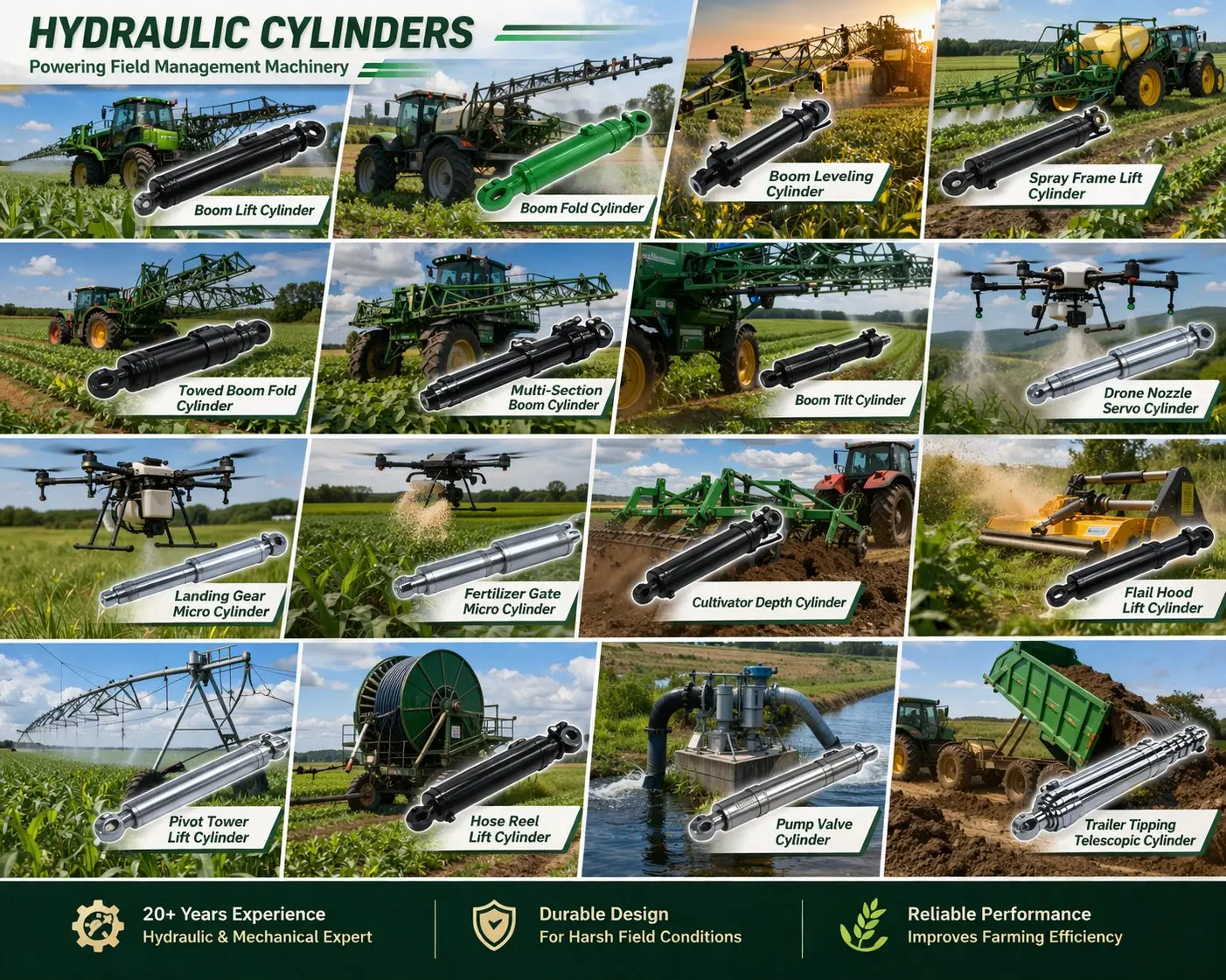
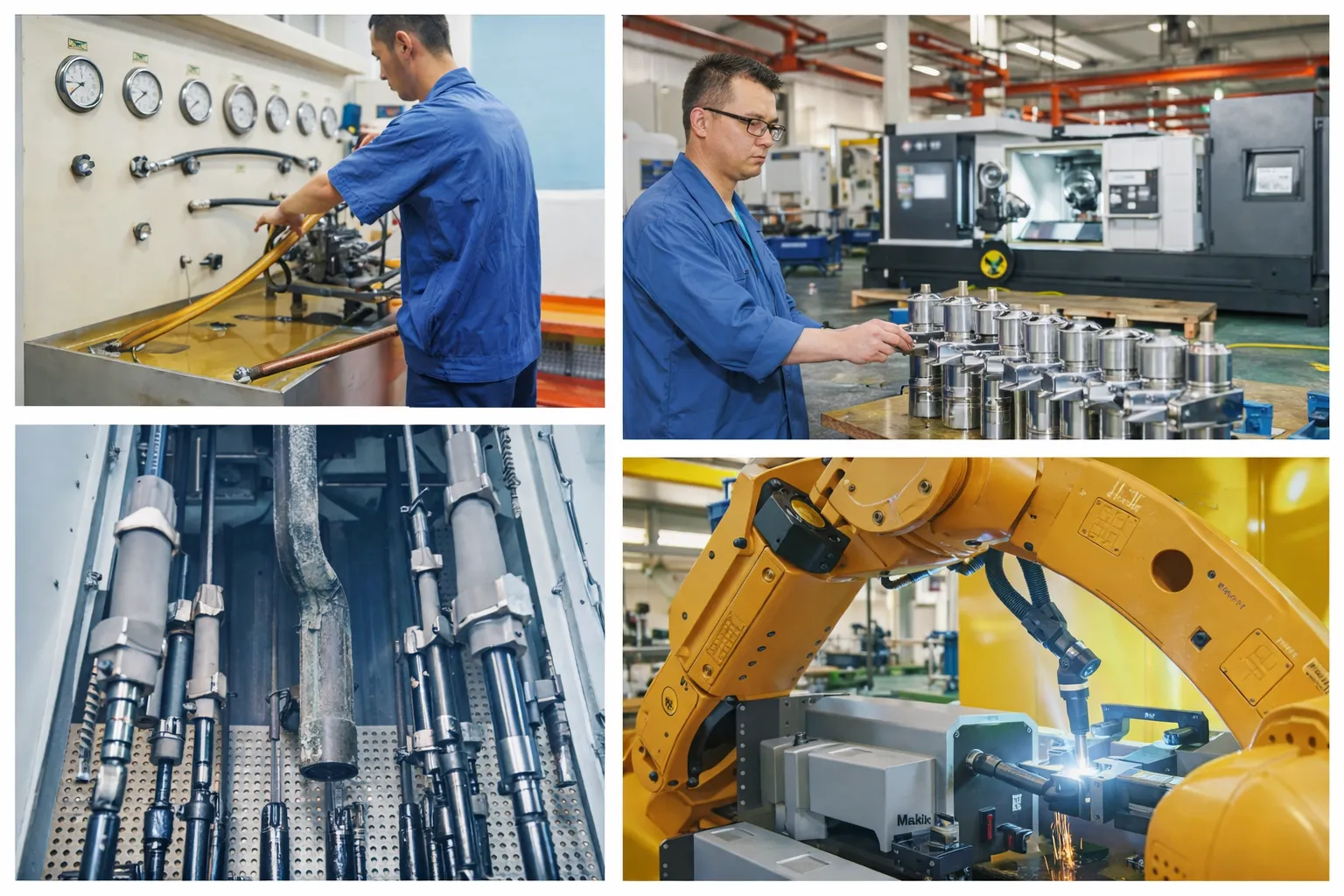
Every steering cylinder is manufactured in-house in our ISO 9001 certified facility. Q345D tube and rod stock verified by spectrometer with -20 C Charpy testing. Bores CNC bored and honed to Ra 0.2 with roundness verified at 0.01 mm tolerance by dial bore gauge at three positions along the bore length. Rods ground to h7 and hard chrome plated to 20+ micron. Symmetric piston seal assemblies pre-assembled in clean conditions with dual PTFE ring concentricity verified. Internal leakage tested in both directions on every cylinder, with left-right symmetry within 10 percent recorded on the individual test certificate. 100% pressure tested at 1.5 times rated pressure. Ball joint assemblies (when specified) articulation-tested for full angular range. Serial numbered with ten-year traceability. Full documentation package included.
Standard Farm Cylinder vs. Our Agricultural Steering Cylinder
| Steering Service Metric | Standard Farm Cylinder | Our Steering Cylinder |
|---|---|---|
| Piston Seal Type | Single-lip asymmetric | Symmetric dual-lip + dual PTFE rings |
| Left-Right Leakage Symmetry | 1:2 to 1:4 bias | Within 10% |
| Road Wander at 35 km/h | Noticeable pull to one side | Neutral straight-line tracking |
| Bidirectional Leakage Test | Not tested per direction | Both directions measured, certificate included |
| Mounting | Rigid clevis (causes side load) | Ball joint option (eliminates side load) |
Customer Case Studies
Danyang County, Chungcheongbuk-do, South Korea
Customer: Agricultural trailer OEM producing steerable dump trailers for Korean farms, with annual production of 600 units
How They Found Us: Engineering manager searched for “symmetric steering hydraulic cylinder agricultural trailer” after receiving driver complaints about steering pull during harvest road transfers in October 2024.
Results: Road testing showed steering wander reduced by 80% compared to previous supplier’s cylinders. Driver fatigue complaints on long road transfers between fields dropped significantly. Korean road safety inspection passed without additional review. Adopted as standard steering cylinder on all trailer models. Annual order is 400 units.
“Our drivers haul 30 km between fields daily during harvest. Less wander means less fatigue and safer road transport. The symmetric seal was the difference.” – Mr. Choi, Engineering Manager, October 2025
Shiga Prefecture, Japan
Customer: Farm vehicle manufacturer building compact utility vehicles for Japanese dairy operations with on-road registration requirements
How They Found Us: Found our agricultural machinery hydraulic cylinder pages through a Google search in March 2025 after their vehicles failed the straight-line stability component of the Japanese road safety inspection.
Results: Symmetric bidirectional leakage below 0.2 ml/min confirmed on all delivered units with left-right symmetry within 8 percent. Vehicles passed the Japanese road safety inspection for on-road agricultural vehicle registration on the first resubmission. Annual order is 200 units.
“Japanese road safety standards are strict. Symmetric steering response is required for road registration. These cylinders passed on the first submission—our previous supplier’s units had failed twice.” – Mr. Nakamura, Compliance Engineer, November 2025
Udon Thani Province, Thailand
Customer: Agricultural transport equipment manufacturer building farm trailers for Thai and Laotian markets, producing 300 units per year
How They Found Us: Contacted via website in July 2024 seeking a steering cylinder that would eliminate the road-drift complaints from their Thai dealer network.
Results: Field testing across three Thai provinces confirmed neutral straight-line tracking at road speeds up to 40 km/h with no measurable directional drift. Dealer complaints about steering pull dropped to zero after the cylinder change. The OEM calculated that the symmetric steering cylinder reduced their annual warranty claim costs for steering-related issues by 70%.
“Steering pull was our number one dealer complaint. Symmetric sealing in both directions eliminated it completely. Warranty costs dropped 70%.” – Mr. Prasit, OEM Engineering Director, December 2025
Lampung Province, Indonesia
Customer: Palm oil plantation transport fleet operating 60 steerable trailers carrying fresh fruit bunches from plantation to mill on narrow estate roads
How They Found Us: Fleet safety officer found our website through a search in September 2024 after two road-edge incidents attributed to steering drift on loaded trailers.
Results: Narrow plantation roads (3.5 to 4 meters wide) leave almost zero margin for steering wander. After refitting all 60 trailers with our symmetric steering cylinders, the road-edge incident rate dropped from 2 to 3 per month to zero over the following 12 months. The fleet manager cited neutral straight-line tracking as the decisive safety improvement.
“On a 3.5 meter plantation road with a loaded trailer, any steering pull is a ditch risk. Zero road-edge incidents in 12 months after the cylinder change speaks for itself.” – Mr. Gunawan, Fleet Safety Officer, October 2025
Afyonkarahisar Province, Turkey
Customer: Agricultural trailer OEM building steerable transport vehicles for Turkish and Middle Eastern markets, producing 450 trailers per year
How They Found Us: Met at Konya Agriculture Fair, September 2024. Engineering evaluation began November 2024.
Results: OEM bench testing confirmed left-right symmetry within 8 percent across all samples. Road testing at 35 km/h on crowned test road showed no detectable directional drift with standard and overweight loads. Adopted as standard across their entire steerable trailer product line. Annual order is 300 units.
“Straight-line stability on crowned highways is a safety issue for our export trailers. The bidirectional symmetry test data gave us the documentation our customers need for their road safety certifications.” – Mr. Yaman, Test Director, August 2025
Related Products and Spare Parts
A steering cylinder works alongside the steering valve, hydraulic pump, and reservoir to form the complete steering system. We manufacture the following related products and replacement parts that integrate with our steering cylinders for complete system capability.
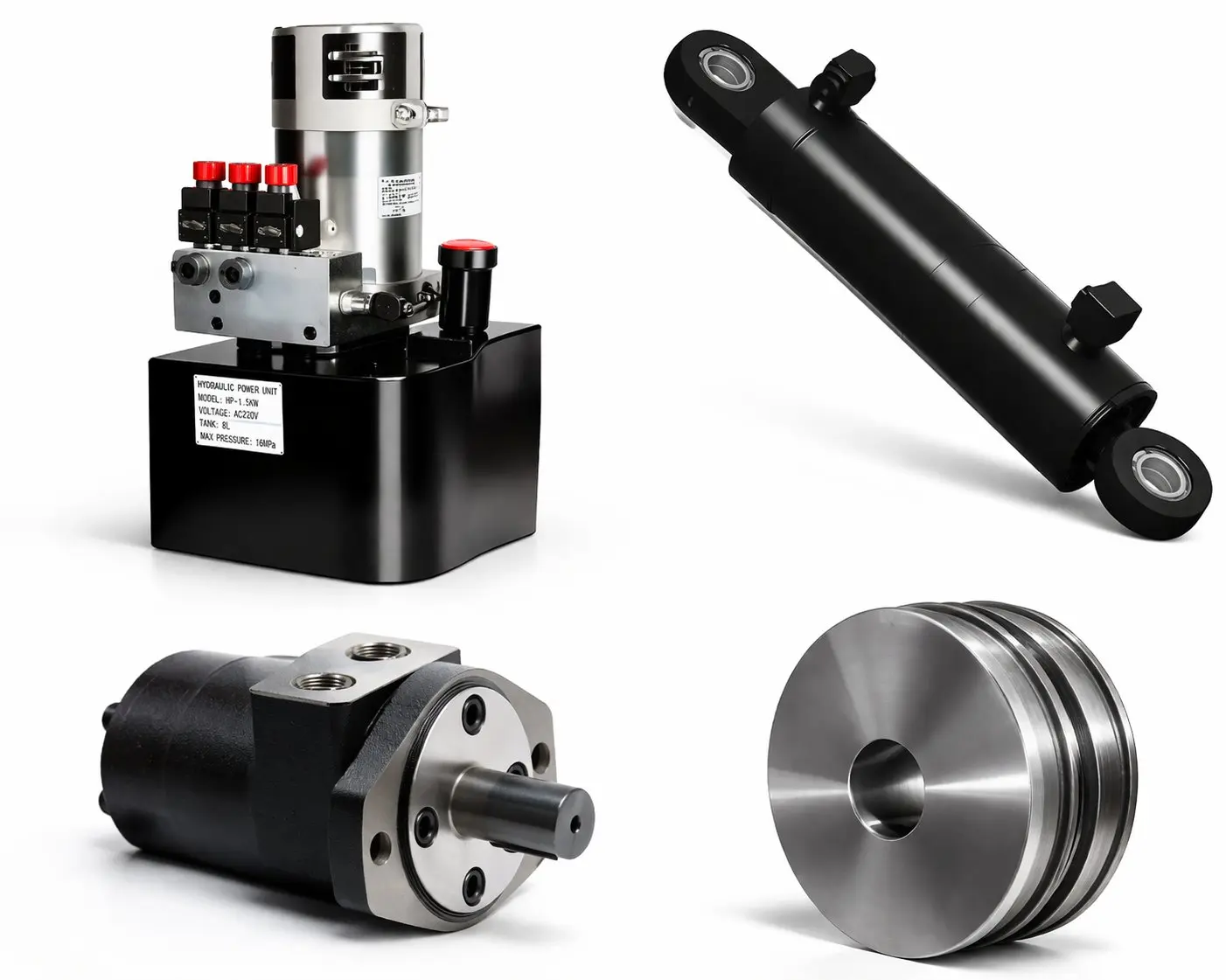
Hydraulic Power Unit: Compact power units for vehicle steering and auxiliary hydraulic systems. Electric and engine-driven configurations, pre-matched to our steering cylinder bore and flow requirements for responsive proportional steering control.
Hydraulic Pump: Gear and vane pumps for steering circuits. Flow rates from 5 to 25 liters per minute matched to the response speed requirements of agricultural vehicle steering valve systems. Priority flow options available for systems with shared pump supply.
Hydraulic Motor: Orbital motors for power steering gerotor valve assemblies. Displacement matched to our steering cylinder bore for correct steering wheel ratio and feedback torque.
Replacement Piston Rod: Factory-matched replacement rods for all our steering cylinder models. Same Q345D material, chrome spec, and tolerance as original. Supplied with symmetric rod seal kit and PU wiper for complete rod-end rebuild.
Replacement Cylinder Barrel: Precision-honed replacement barrels with same Ra 0.2 bore finish, 0.01 mm roundness, seal groove dimensions, and port specifications. Complete rebuild kit available including barrel, symmetric piston seal assembly, wear ring, and all O-rings.
All related products and spare parts available alongside new hydraulic cylinders for sale or separately for existing vehicle fleets.
Frequently Asked Questions
Why does a steering cylinder need a symmetric seal instead of a standard piston seal?
What bore size is typical for an agricultural transport vehicle steering cylinder?
Do you provide bidirectional leakage test certificates?
What is the lead time for steering cylinders?
Straight Roads. Precise Turns. Zero Steering Drift.
Share your vehicle steering geometry and axle load. We will recommend a precision steering cylinder with symmetric seal and matched ball joints, and deliver a quotation within 48 hours.
Editor: Cxm