
Stabilizer Leg Cylinder for Agricultural Field Transport Vehicles
Q345D structural steel with drop-forged mounting ears and welded gusset reinforcement ribs. Prevents tip-over during dump body tipping by holding the vehicle level under heavy offset loads on the uneven field ground where agricultural trailers actually operate.
The Ear Cracks Before the Barrel Does. That Is Why Forging Matters Here.
Agricultural field transport vehicles tip their dump bodies at angles of 45 to 55 degrees to discharge loads of grain, root crops, silage, or manure. During this tipping operation, the vehicle’s center of gravity shifts dramatically toward the rear and to one side. If the vehicle is parked on even slightly uneven ground—which describes every agricultural field and most farm yards—the off-center load creates a tipping moment that the vehicle’s suspension and tires alone cannot resist. Stabilizer legs deploy from the sides or rear of the chassis, pressing against the ground to provide a wider support base that prevents rollover during tipping.
The stabilizer leg cylinder inside each leg carries the full off-center tipping force, which can reach 30 to 60 percent of the vehicle’s gross weight depending on the ground slope and dump angle. This force acts at an angle through the stabilizer leg geometry, creating a significant bending moment at the cylinder mounting ear—the structural connection between the hydraulic cylinder and the vehicle chassis. The mounting ear experiences the full combined compression and bending load every time the vehicle tips a load, and on uneven ground, the loading becomes asymmetric: one stabilizer carries a disproportionate share while the opposite side carries less.
This is where the difference between forged ears and cast or flame-cut ears becomes a safety issue. Flame-cut plate ears have a rough heat-affected zone at the cut edge that initiates fatigue cracks under cyclic bending. Cast ears have internal porosity and shrinkage defects that weaken them unpredictably. Forged ears have a continuous grain flow aligned with the load direction, no internal defects, and superior fatigue resistance—surviving 5 to 10 times more load cycles than cast alternatives under the same bending conditions. When the component is a safety-critical stabilizer leg cylinder where ear failure leads directly to vehicle rollover, the forging cost premium is trivially small compared to the liability risk of a structural failure during a dump operation.
Our stabilizer leg cylinder is a double acting hydraulic cylinder built from Q345D low-alloy structural steel with drop-forged alloy steel mounting ears and welded gusset reinforcement ribs at the ear-to-barrel junction. The gussets distribute bending moment over 3 to 4 times wider barrel area than a bare ear attachment, reducing peak stress at the critical weld root below the fatigue endurance limit of Q345D even under severe offset load conditions on sloped ground. Internal sealing is precision-grade for load holding, and a metal-cased scraper protects against the field soil and mud that contact the rod when the stabilizer leg presses into the ground.
Technical Specifications
| Specification | Available Range |
|---|---|
| Bore Diameter | 50 mm – 100 mm |
| Rod Diameter | 32 mm – 70 mm |
| Stroke Length | 200 mm – 600 mm |
| Working Pressure | Up to 20 MPa (2,900 PSI) |
| Action Type | Double Acting |
| Structure | Welded Piston Cylinder with Forged Ears |
| Body Material | Q345D Low-Alloy Structural Steel |
| Piston Rod | Q345D, Hard Chrome 20+ micron |
| Body Coating | Zinc Primer + Epoxy Topcoat |
| Mounting Ears | Drop-Forged Alloy Steel + Welded Gusset Ribs |
| Piston Seal | High-Strength PU + PTFE Back-up |
| Rod Seal | NBR + PTFE Back-up |
| Scraper | Metal-Cased PU Scraper |
| Port Thread | BSP / NPT / Metric |
| Operating Temperature | -25 C to +80 C |
| Environment | Offset Load / Uneven Ground / Field Mud / Road Transport |
Offset Loading on Uneven Ground: Why Standard Ears Fail on Stabilizer Cylinders
On flat concrete, stabilizer loads distribute evenly across all legs. On agricultural fields—where transport vehicles actually tip their dump bodies—the ground is never flat. One stabilizer pad sits 50 to 150 mm higher or lower than the opposite side due to plow furrows, wheel ruts, drainage ditches, and natural field slope. This height difference shifts the load distribution so that the lower leg carries 60 to 80 percent of the total stabilizing force while the higher leg carries only 20 to 40 percent. The heavily loaded leg experiences bending at its mounting ear that far exceeds the nominal flat-ground design assumption.
| Ground Slope Difference | Load on Heavy Side | Ear Bending vs. Level Ground | Standard (Cast/Plate) Ear Risk | Our Forged + Gusset Ear |
|---|---|---|---|---|
| Level (0 mm) | 50% | Baseline | Within design range | Large safety margin |
| Slight slope (50 mm) | 60-65% | +30 to 40% | Approaching fatigue limit | Still below 50% of fatigue limit |
| Moderate slope (100 mm) | 70-75% | +60 to 80% | Above fatigue limit, crack initiation | Still within safe range |
| Severe slope (150 mm) | 75-80% | +80 to 120% | Rapid crack growth, failure risk | Approaching design limit but still safe |
On a moderate field slope that is completely normal in agricultural operations, the ear bending load increases 60 to 80 percent beyond the flat-ground baseline. Flame-cut plate ears and cast ears reach their fatigue endurance limit at this loading level, meaning micro-cracks begin forming after a few hundred tip cycles. Forged ears with gusset reinforcement push the fatigue threshold high enough that even severe slope conditions (150 mm difference, representing roughly a 5-degree tilt) remain within the safe operating envelope for the design life of the cylinder. This is the engineering rationale for insisting on forged ears with gussets on every stabilizer leg cylinder we manufacture—the real-world loading on agricultural fields regularly exceeds the conditions that standard ears can survive.
How the Stabilizer Leg Cylinder Prevents Rollover During Dump Operations
Before the dump body begins tipping, the operator deploys the stabilizer legs from their stowed position on the chassis. The stabilizer leg cylinder extends downward through a mechanical leg assembly until the foot pad contacts the ground. The operator continues extending until the pad presses firmly against the ground surface, pre-loading the stabilizer to resist the tipping moment that will develop when the dump body raises.
As the dump body tips, the vehicle’s center of gravity shifts progressively rearward and to the discharge side. This generates a rollover moment that increases with tip angle. The stabilizer system resists this moment by transmitting the tipping force through the leg structure into the ground via the foot pad. The cylinder must hold its extended position against this force with minimal retraction. Any retraction under load allows the vehicle to tilt toward the unstable side, increasing the rollover moment and creating a progressive failure condition that can escalate to full tip-over in seconds.
Our precision piston seal with PTFE anti-extrusion ring maintains internal leakage below 0.3 ml per minute at working pressure, which limits holding drift to less than 1 mm over the typical 2 to 5 minute dump cycle. We recommend pairing the stabilizer leg cylinder with a pilot-operated check valve in the hydraulic circuit for maximum safety—the check valve mechanically locks the oil in the extension side of the cylinder, making retraction physically impossible even if the control valve leaks or the hydraulic line ruptures. This combination of low-leakage sealing and hydraulic locking provides the highest level of tip-over protection achievable in a field-deployable stabilizer system.
Six Safety Features for Stabilizer Leg Service on Uneven Ground
Drop-Forged Alloy Steel Mounting Ears
Grain flow aligned with the load direction provides fatigue resistance 5 to 10 times greater than cast or flame-cut ears under cyclic bending. No internal porosity or shrinkage defects that weaken cast alternatives. Each forged ear is ultrasonically inspected to confirm absence of internal discontinuities before machining and welding to the cylinder barrel. This is the single most critical safety feature on the stabilizer leg cylinder because ear failure under load leads directly to vehicle rollover.
Welded Gusset Reinforcement Ribs at Ear Root
Gusset plates welded between the ear base and the barrel spread the bending moment over 3 to 4 times wider barrel contact area. This reduces peak stress at the critical ear-to-barrel weld root below the fatigue endurance limit of Q345D even under the severe offset loading that 150 mm ground slope creates. The gussets transform a high-stress point load at the ear base into a distributed load across a wide barrel zone, fundamentally changing the stress pattern from fatigue-critical to fatigue-safe.
Precision Internal Sealing for Load Holding
Internal leakage below 0.3 ml per minute prevents stabilizer retraction drift that would allow the vehicle to tilt during the dump cycle. The PTFE anti-extrusion ring prevents seal deformation under the sustained compression load from the vehicle weight. Recommended pairing with a pilot-operated check valve for hydraulic locking that provides absolute hold-position security independent of seal condition.
Metal-Cased PU Scraper
Stabilizer legs press into field soil, splashing mud, sand, and grit directly onto the cylinder rod surface. The metal-cased scraper handles this wet abrasive debris effectively, maintaining rod and seal cleanliness during every deployment cycle. This is the same scraper technology proven on our drainage trench cylinders where wet mud contamination is most severe.
Q345D with Low-Temperature Toughness (-20 C)
Harvest and transport operations in Korea and Japan often continue into early winter when morning temperatures drop below -10 C. The stabilizer leg cylinder must deploy under load at these temperatures without risk of brittle fracture at the ear, gusset, or barrel. Q345D maintains Charpy impact toughness at -20 C, ensuring safe cold-weather stabilizer deployment.
Epoxy Body Coating for Road and Field Exposure
The stabilizer leg cylinder is exposed to road spray during transport and mud splash during field deployment—two different corrosion environments in every trip. The zinc primer plus epoxy topcoat system handles both road salt/gravel spray and agricultural soil/manure contact without losing adhesion or protective capability.
Application Scenarios
Agricultural Dump Trailer Stabilizer Legs: The primary application. Deploying outrigger legs to prevent rollover during dump body tipping on uneven field ground. The stabilizer leg cylinder with forged ears and gussets provides the fatigue-safe structural integrity this safety-critical position demands.
Self-Propelled Field Vehicle Outriggers: Heavy self-propelled farm equipment with side-mounted implements uses outrigger legs for stability during operation. Same offset loading and ear fatigue requirements apply. Our custom hydraulic cylinder configurations fit all common outrigger mounting geometries.
Mobile Grain Handling Equipment: Portable grain augers, belt conveyors, and grain cart transfer stations use stabilizer legs during loading operations where the load shifts progressively as the grain moves. The holding-grade seal prevents stabilizer drift during extended loading sessions.
Agricultural Crane and Loader Outriggers: Tractor-mounted cranes and front loaders with outrigger stabilizers for heavy lifting operations require the same forged-ear fatigue resistance. These represent critical agricultural machinery hydraulic cylinder safety applications.
Manure Tanker Stabilizer Legs: Liquid manure tankers with rear-discharge arms deploy stabilizer legs to counteract the shifting load moment as the tanker empties from the rear. The progressively changing load makes holding-grade sealing and structural ear integrity equally important.
Manufacturing and Quality Control
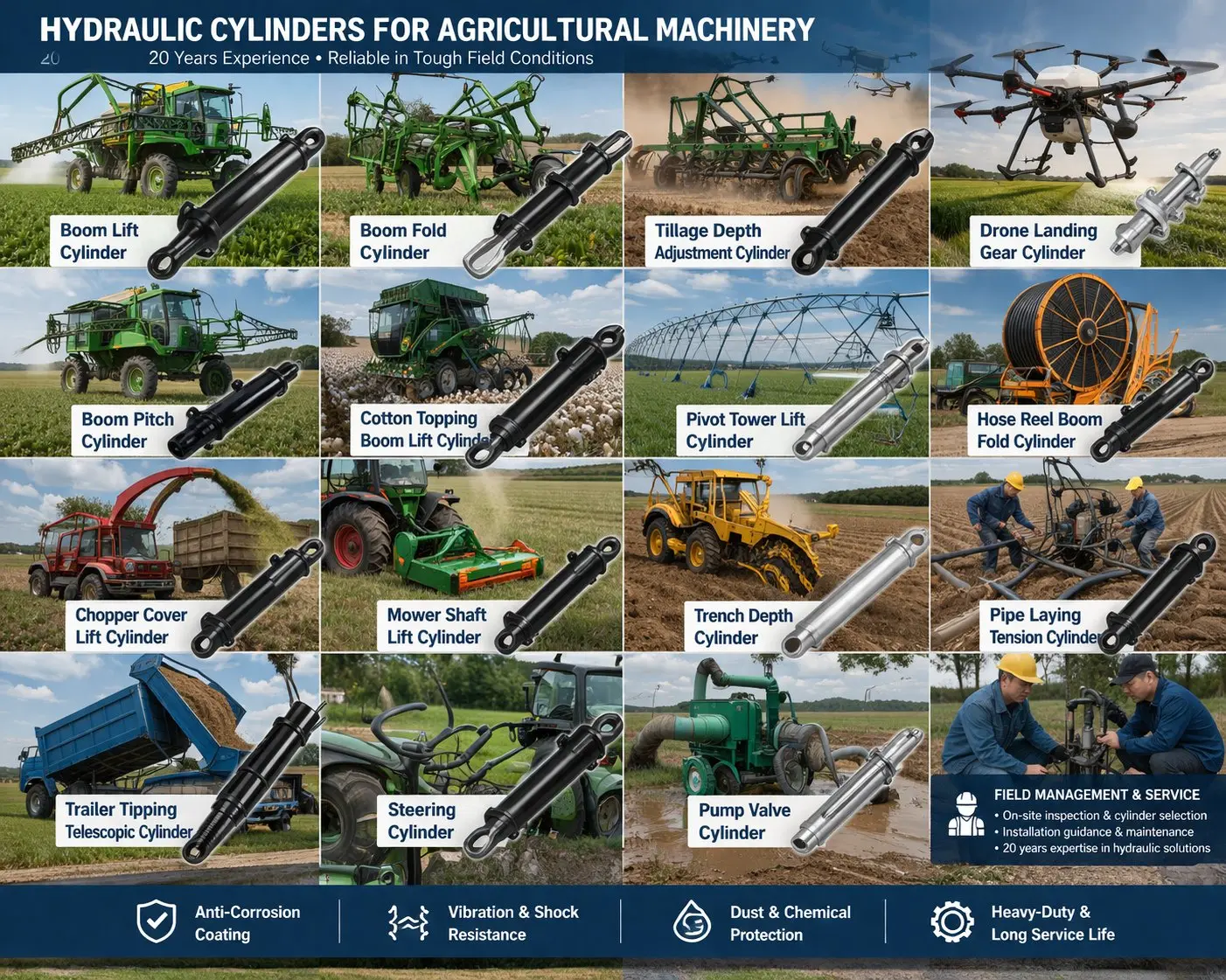
Every stabilizer leg cylinder is manufactured in-house in our ISO 9001 certified facility with dedicated controls for safety-critical forged-ear construction. Q345D tube and rod stock verified by spectrometer with Charpy impact testing at -20 C. Forged ears ultrasonically inspected for internal discontinuities on every piece before machining. Ear bore and pin hole machined to H7/h7 fit tolerance for tight connection to the chassis mounting pins. Gusset ribs MIG welded to both ear-to-barrel junctions by certified welders. Ear-to-barrel and gusset welds magnetic particle tested on every unit to detect surface and near-surface defects. Bores honed to Ra 0.2. Rods chrome plated to 20+ micron. Metal-cased scraper fit-checked. Internal leakage tested under sustained load hold conditions. 100% pressure tested at 1.5 times rated pressure. Serial numbered with ten-year traceability to forging heat, weld procedure, MPT results, and pressure test data. Full documentation including forging certificates, MPT reports, and pressure test certificates included as standard.
Cast-Ear Cylinder vs. Our Forged-Ear Stabilizer Leg Cylinder
| Stabilizer Service Metric | Cast or Plate Ear Cylinder | Our Forged-Ear Stabilizer Cylinder |
|---|---|---|
| Ear Fatigue Life (offset loading) | 150,000 – 200,000 cycles | 1,500,000+ cycles (10x) |
| Stress Distribution at Ear Root | Concentrated (no gusset) | Distributed (gusset spreads 3-4x) |
| Internal Defect Risk | Cast: porosity/shrinkage. Plate: HAZ defects | Forged: continuous grain, UT verified |
| Ear Crack Warranty Rate (OEM data) | 3 – 5% per year | Below 0.3% |
| Weld Quality Verification | Visual only | MPT (magnetic particle) on every unit |
Customer Case Studies
Gimcheon City, Gyeongsangbuk-do, South Korea
Customer: Agricultural trailer OEM producing dump trailers with hydraulic stabilizer legs, annual production 800 units
How They Found Us: Safety director searched for “forged ear stabilizer cylinder anti-crack agricultural trailer” after recording 4% ear cracking warranty rate in their 2024 production fleet.
Results: Ear cracking incidents dropped from 4% of trailers per year to zero after switching to our forged-ear stabilizer leg cylinders with gussets. Zero stabilizer-related tip-over incidents reported across the entire fleet. The OEM calculates that the forging cost premium is recovered within the first year by eliminating warranty claim costs. Adopted as standard. Annual order is 600 units.
“Stabilizer ear failure is a potential rollover situation. Going from 4% failure rate to zero is not just engineering improvement—it is a safety achievement that protects both our customers and our company.” – Mr. Jang, Safety Director, October 2025
Chiba Prefecture, Japan
Customer: Japanese agricultural vehicle safety testing laboratory conducting stabilizer system evaluations for road registration certification compliance
How They Found Us: Laboratory director contacted us in April 2025 after a trailer OEM submitted our cylinder for certification testing with the forging and MPT documentation already included.
Results: Fatigue test at 150% rated offset load: forged ears survived 1.5 million cycles with no crack initiation detected by magnetic particle testing at 250K, 500K, 1M, and 1.5M cycle intervals. A cast-ear reference sample cracked at 180,000 cycles under the same loading. The testing laboratory recommended our cylinder specification for all safety-critical stabilizer applications in their published technical guidance.
“The fatigue margin between forged ears and cast ears is not incremental. It is an order of magnitude. For safety-critical stabilizer applications, forged with gussets is the only specification this laboratory will endorse.” – Dr. Tanaka, Testing Laboratory Director, November 2025
Nakhon Pathom Province, Thailand
Customer: Sugar cane transport fleet operating 80 dump trailers across 12,000 hectares of plantation land with uneven field access roads and dump areas
How They Found Us: Fleet safety manager contacted us in November 2024 after two trailer tip-over incidents during dump operations on sloped field edges.
Results: Field edges and cane dump areas in Thai plantations have significant ground slope from years of vehicle traffic compaction. After refitting all 80 trailers with our forged-ear stabilizer leg cylinders paired with pilot-operated check valves, tip-over incidents during dump operations dropped to zero over the following 14-month tracking period. Fleet insurance premium was reduced based on the documented safety improvement.
“Two rollovers in one season was the wake-up call. Fourteen months and zero incidents after the stabilizer upgrade. Our insurance company noticed.” – Mr. Somkiat, Fleet Safety Manager, January 2026
East Java Province, Indonesia
Customer: Tobacco and maize transport cooperative operating 45 dump trailers on hillside farms with steep dump locations at processing facilities
How They Found Us: Cooperative equipment manager found our website through web search in January 2025 after a competitor’s stabilizer cylinder ear cracked during a hillside dump, causing a near-miss rollover.
Results: East Java hillside farms create extreme offset loading during dump operations—ground slope of 100 to 150 mm between stabilizer pads is common. Our forged-ear cylinders completed two full harvest seasons (approximately 500 dump cycles per trailer) with zero ear cracks detected during mid-season inspections.
“Hillside dumping is the hardest test for stabilizer ears. Two full seasons, 45 trailers, 500 dumps each, zero cracks. On these hills, that is a result worth writing about.” – Mr. Budi, Equipment Manager, November 2025
Sakarya Province, Turkey
Customer: Agricultural trailer OEM building dump and tipper vehicles for export to 15 countries across Europe, Central Asia, and North Africa
How They Found Us: Met at EIMA International exhibition, November 2024. Engineering evaluation began January 2025.
Results: OEM fatigue testing at 130% rated offset load confirmed forged ears survived over 1 million cycles without detectable crack initiation. Warranty claims for stabilizer cylinder ear failure dropped from 5% to below 0.3% after switching to our cylinders across their full production range. Annual order is 800 units across 6 trailer models.
“We export to 15 countries. Stabilizer failure anywhere is a product liability risk that could close export markets. Forged ears eliminated that risk. The insurance and legal savings alone justify the cost difference over cast ears.” – Mr. Demir, Global Quality Director, September 2025
Related Products and Spare Parts
A stabilizer leg cylinder is one part of the trailer’s stabilizer system that also includes the leg structure, foot pad, hydraulic control valve, and check valve. We manufacture the following related products and replacement parts that integrate with our stabilizer cylinders for complete system safety and serviceability.
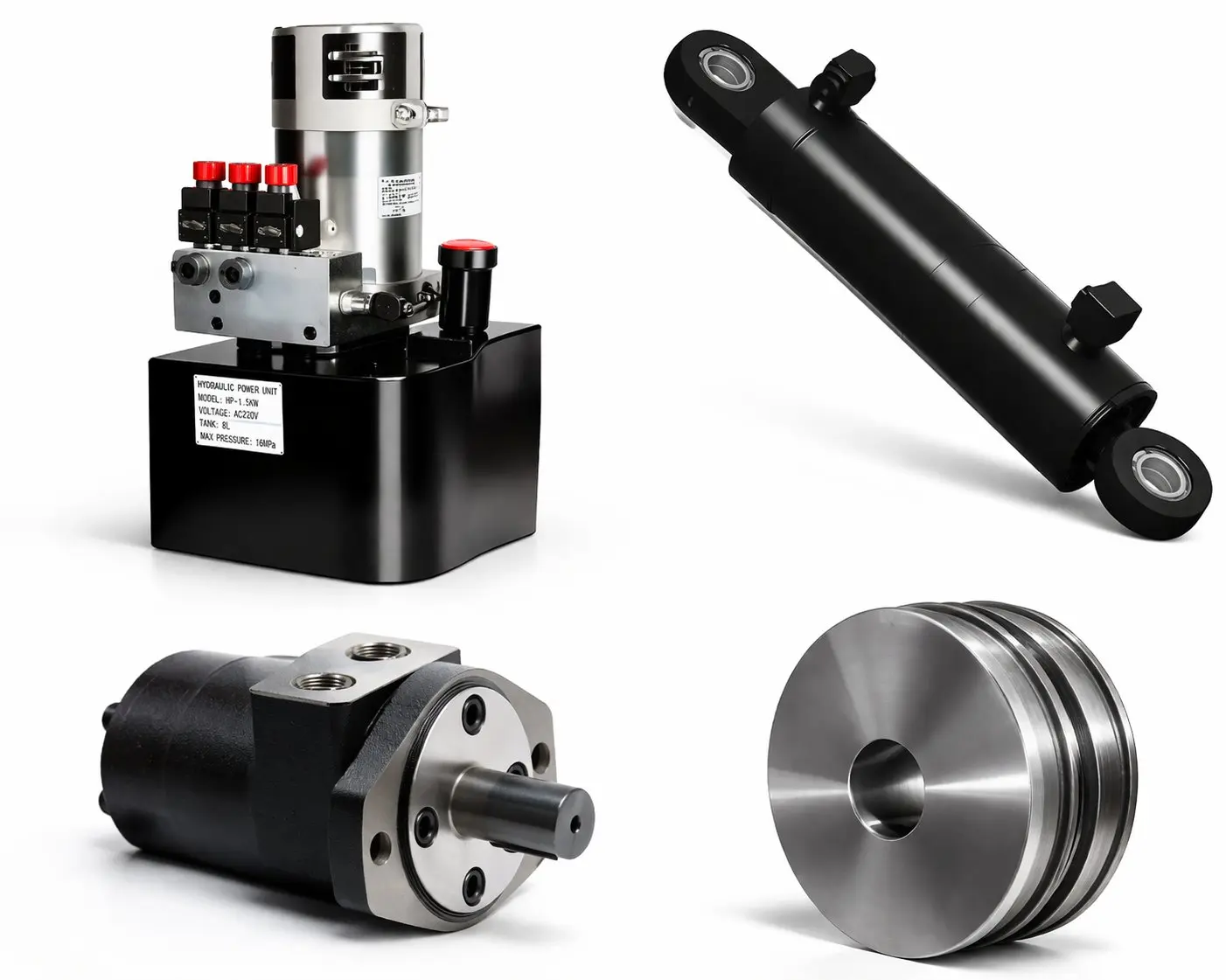
Hydraulic Power Unit: PTO-driven and electric power units for trailer stabilizer and dump tipping systems. Flow and pressure pre-matched to our stabilizer cylinder bore sizes. Built-in priority valve option supplies stabilizer deployment before dump tipping to ensure stabilizers are always deployed first.
Hydraulic Pump: Gear pumps for tractor PTO-driven stabilizer and dump circuits. Flow rates from 10 to 40 liters per minute. Dual-circuit pump options available for independent stabilizer and dump body hydraulic supply.
Hydraulic Motor: Low-speed motors for mechanized stabilizer leg deployment systems that extend and retract the leg structure independently of the cylinder stroke. Suitable for automated stabilizer systems on modern agricultural trailers.
Replacement Piston Rod: Factory-matched replacement rods for all our stabilizer leg cylinder models. Same Q345D material, chrome spec, and tolerance as original production. Supplied with new rod seal kit and metal-cased scraper for complete rod-end rebuild.
Replacement Cylinder Barrel: Precision-honed replacement barrels with pre-welded forged ears and gussets—the complete structural assembly ready for rod and seal installation. Same material, bore finish, and specifications as original production. This is a unique offering: most suppliers cannot provide replacement barrels with forged ears already attached, requiring the customer to re-forge and re-weld, which defeats the purpose of the forged construction.
All related products and spare parts available alongside new hydraulic cylinders for sale or separately for existing trailer fleets.
Frequently Asked Questions
Why do forged ears last so much longer than cast ears on stabilizer cylinders?
What bore size is typical for a dump trailer stabilizer leg cylinder?
Do you recommend adding a pilot-operated check valve to the stabilizer circuit?
What is the lead time for stabilizer leg cylinders with forged ears?
Forged Ears. Gusset Ribs. Zero Tip-Over Risk.
Share your vehicle gross weight, stabilizer geometry, and typical field conditions. We will design a safety-rated forged-ear stabilizer leg cylinder with matched check valve and deliver a complete quotation within 48 hours.
Editor: Cxm


























