Thrust Cylinder for Shield Machine TBM
Engineered for synchronized high-pressure propulsion in extreme underground mud-water environments.
Product Overview and Industrial Value
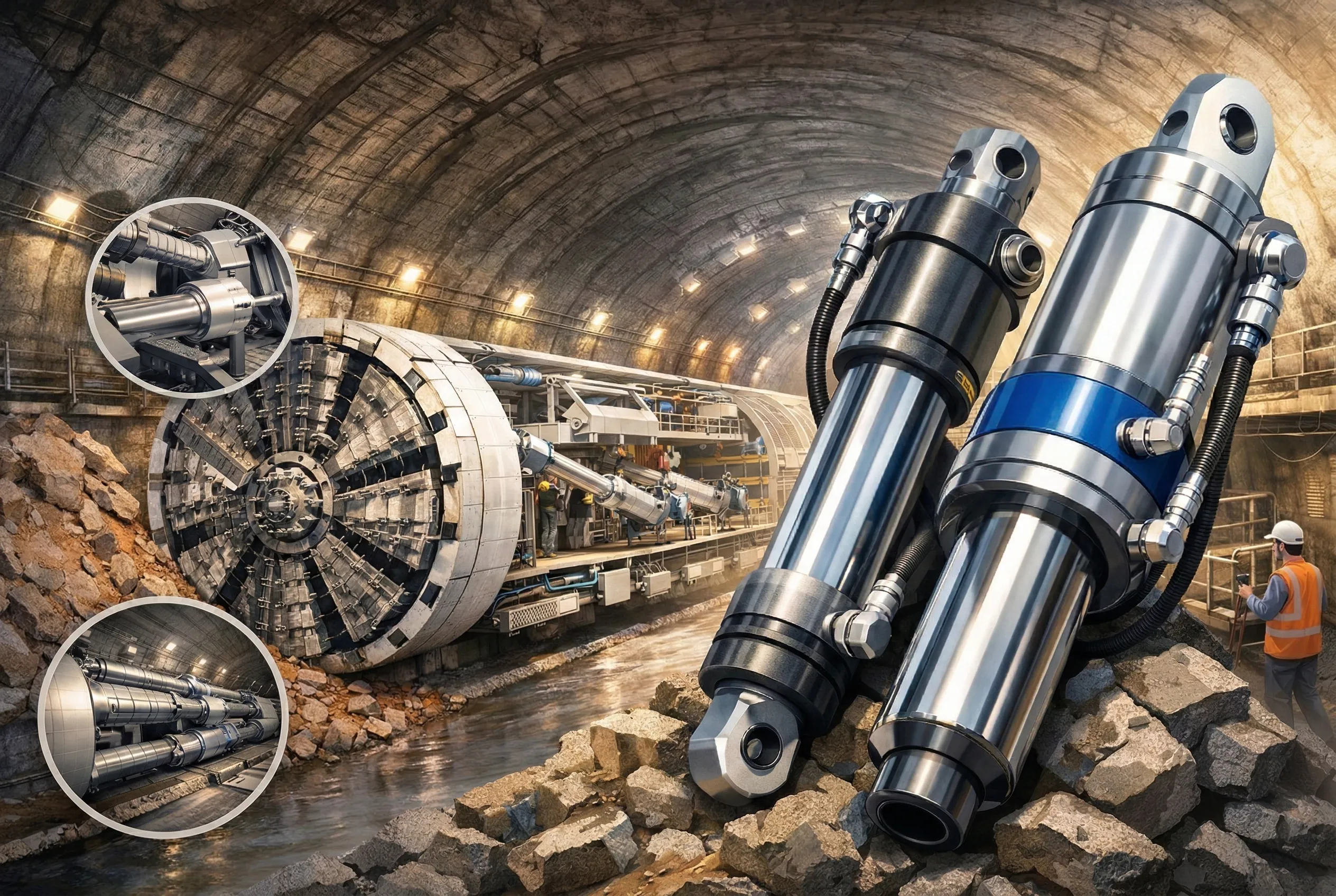
In the highly demanding sector of underground civil engineering, the reliability of heavy machinery is the absolute baseline for project success. As a dedicated hydraulic cylinder manufacturer with decades of specialized experience, we recognize that the main propulsion system of a Tunnel Boring Machine (TBM) or Shield Machine dictates the pace, safety, and ultimate profitability of the entire excavation operation. The thrust cylinder serves as the primary muscular force, driving massive cutting heads through solid rock, abrasive soil, and complex geological faults.
The industrial value of a premium propulsion hydraulic cylinder cannot be overstated. When a TBM is hundreds of meters underground, equipment failure is not merely an inconvenience; it results in astronomical downtime costs, delayed civic infrastructure projects, and severe safety hazards. Our specialized propulsion units are meticulously engineered to operate continuously under relentless loads. Unlike commercial-grade actuators, our products are designed specifically for the unique combination of extreme physical stress and environmental contamination found in tunneling. By integrating high-grade metallurgical components with sophisticated servo-control capabilities, we provide a solution that maintains millimeter-level synchronized advancement, preventing structural damage to the tunnel lining rings and the machine itself.
Comprehensive Technical Parameters
Proper component selection begins with exact specifications. The table below outlines the customizable range and standard engineering baseline for our primary shield machine propulsion units. These parameters reflect a design philosophy focused entirely on eliminating typical failure modes such as cylinder barrel fatigue and seal degradation.
| Industry | Equipment Category | Subsystem / Action | Cylinder Name |
|---|---|---|---|
| Engineering Machinery | Shield Machine TBM | Main Propulsion System | Thrust Cylinder |
| Action Mode | Structure Type | Manufacturing Structure | Material System |
| Double Acting Hydraulic Cylinder | Servo Piston Cylinder | Welded / Thick-wall Forged | 42CrMo Alloy Steel |
| Surface Treatment | Environment Grade | Working Condition | Typical Failure Mode |
| Hard Chrome Plating | High Pressure + Mud Water | Synchronous Propulsion | Cylinder Barrel Fatigue |
| Recommended Configuration Points | |||
| Thick-wall forged tube + Advanced servo control integration + Triple-lip mud scraper seals | |||
Dynamic Working Principle in Underground Applications
Understanding the functional dynamics of a propulsion hydraulic cylinder clarifies why precision engineering is non-negotiable. In a TBM, an array of these cylinders—often numbering anywhere from a dozen to over fifty depending on the machine diameter—are arranged circumferentially against the newly installed concrete tunnel lining. They operate as a synchronized collective to push the massive cutter head into the earth.
During the excavation phase, highly pressurized hydraulic fluid is pumped into the cap end of the double acting hydraulic cylinder. This generates massive linear force against the piston, extending the rod. Because ground conditions are rarely uniform, one side of the cutter head might hit solid granite while the other side is in soft clay. If equal pressure were applied to all cylinders, the TBM would deviate from its intended path. To counteract this, our cylinders are equipped as servo piston cylinders. High-resolution linear displacement sensors built directly into the rod provide real-time feedback to the machine’s Programmable Logic Controller (PLC). The PLC then commands proportional valves to independently adjust the flow and pressure to specific cylinder groups, ensuring perfectly synchronous propulsion and precise directional steering.
Once the stroke is complete, the machine must pause excavation to install the next ring of concrete segments. The directional valves reverse, sending pressurized fluid to the rod end. This retracts the cylinder, pulling the propulsion shoe away from the tunnel wall to create space for the segment erector. Throughout this entire cycle, the cylinder rod is exposed to a highly abrasive slurry of rock dust, water, and excavated muck. The environmental grade of “High Pressure + Mud Water” demands a sealing architecture that aggressively wipes the rod clean upon retraction, preventing any particulate matter from bypassing the seals and contaminating the internal hydraulic parts.
Seamless Integration and Global Brand Replacement
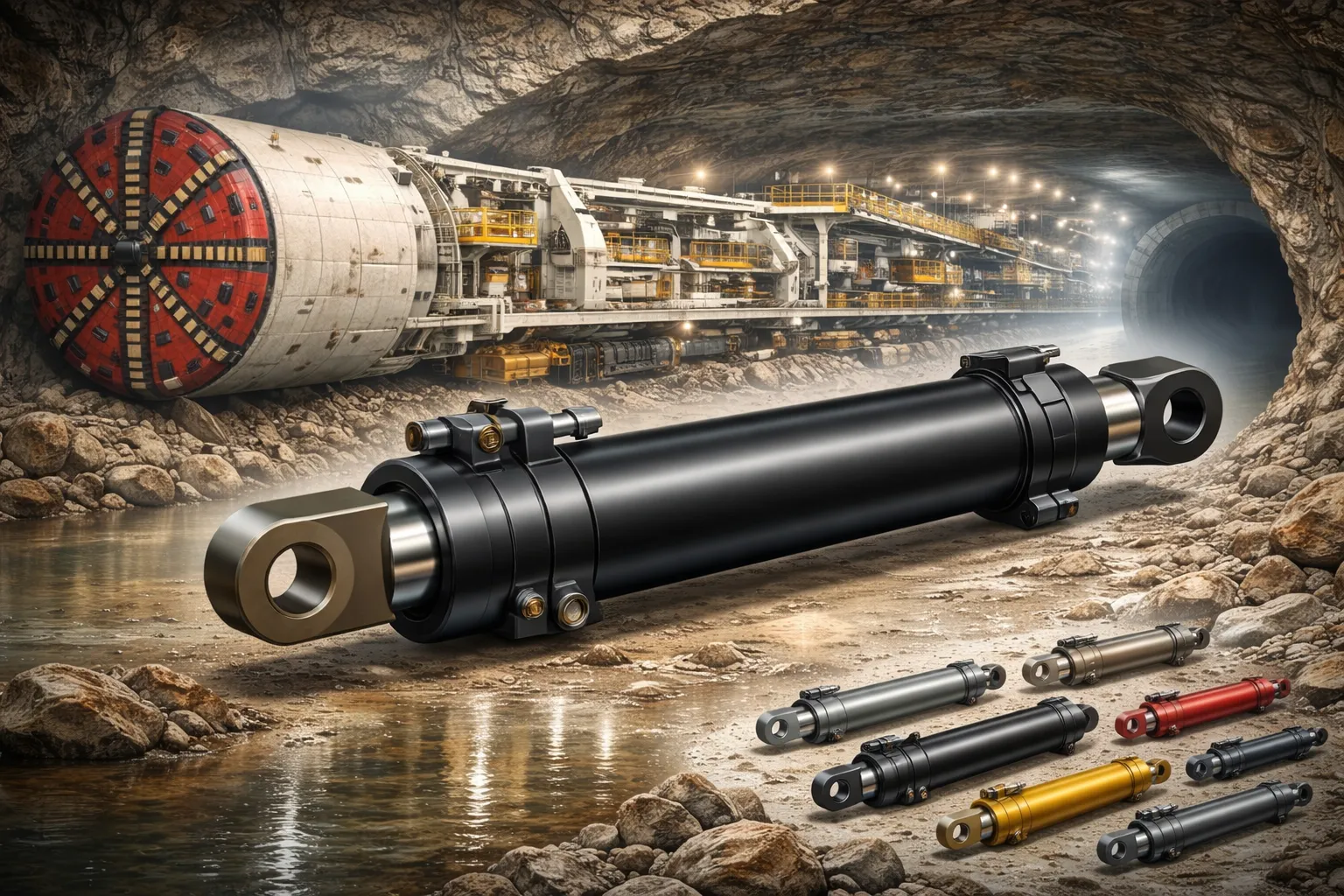
When maintaining heavy machinery, relying solely on Original Equipment Manufacturer (OEM) parts can lead to extensive delays and bloated maintenance budgets. As an independent, high-capability hydraulic cylinder manufacturer, we specialize in reverse-engineering and upgrading existing systems. Our thrust cylinder assemblies are dimensionally identical to those used by world-leading equipment manufacturers, guaranteeing a drop-in fit without the need for structural modifications to your machine.
(Note: The following brand names are mentioned strictly for the purpose of indicating technical compatibility and assisting engineers in equipment selection. We respect all intellectual property rights and do not claim affiliation with or endorsement by these trademark holders.)
- European & American TBMs: Fully compatible replacements for main propulsion and articulation cylinders on Herrenknecht, Robbins, and Lovsuns equipment.
- Asian Heavy Machinery: Direct fit upgrades for Komatsu, Hitachi Zosen, CREG (China Railway Engineering Equipment Group), CRCHI, and Tianhe Mechanical shield machines.
- General Engineering Integration: Beyond tunneling, our components serve as superior upgrades for heavily loaded systems requiring a reliable lift cylinder or pressing unit in standard construction machinery. Browse our wider range in our detailed product catalog.
Five Core Engineering Advantages
What distinguishes a premium cylinder from a standard industrial actuator? It is the microscopic attention to detail in material science and fluid control. Here are five technical pillars that define our manufacturing superiority:
1. Advanced Anti-Mud-Water Sealing Architecture
Standard polyurethane seals disintegrate rapidly when exposed to pulverized quartz and pressurized water. We employ a multi-stage, ultra-low friction composite sealing system. The outer layer utilizes a heavy-duty metallic or reinforced PTFE scraper that physically chips away dried mud. Secondary and tertiary nitrile and polyurethane step-seals handle the pressure differential, ensuring absolute fluid retention and preventing internal contamination.
2. High-Rigidity 42CrMo Thick-Wall Forging
The most common failure in TBM propulsion is cylinder barrel fatigue, where the intense, pulsating internal pressure causes the barrel to expand and contract, eventually leading to micro-cracking and catastrophic failure. We mitigate this by using 42CrMo alloy steel. Unlike standard welded seam tubing, our thick-wall forged tubes maintain their molecular integrity under massive hoop stress, ensuring a rigid housing that extends the cylinder’s service life indefinitely.
3. Precision Servo-Control Integration
Synchronous propulsion requires absolute dimensional awareness. Our piston rods are gun-drilled with extreme precision to house magnetostrictive linear displacement transducers. These sensors operate within the rod, protected from the hostile external environment, providing the central PLC with continuous, high-fidelity positional data critical for automated steering.
4. Specialized High-Frequency Chrome Plating
The exposed piston rod is the most vulnerable component. We apply a highly specialized, micro-cracked hard chrome plating over a hardened substrate. The micro-cracks hold a microscopic layer of hydraulic oil, reducing seal friction, while the dense chrome matrix provides exceptional resistance to the acidic groundwater and mechanical abrasion typical in underground sites.
5. Thermal Stability and Fatigue Life Optimization
High-pressure oil flow generates significant heat. Our internal porting designs are computationally optimized using fluid dynamics software to reduce turbulence. Furthermore, the thick-wall construction acts as an efficient heat sink, maintaining fluid viscosity and protecting the seals from thermal degradation during prolonged boring cycles.
Uncompromising Quality Control in Manufacturing
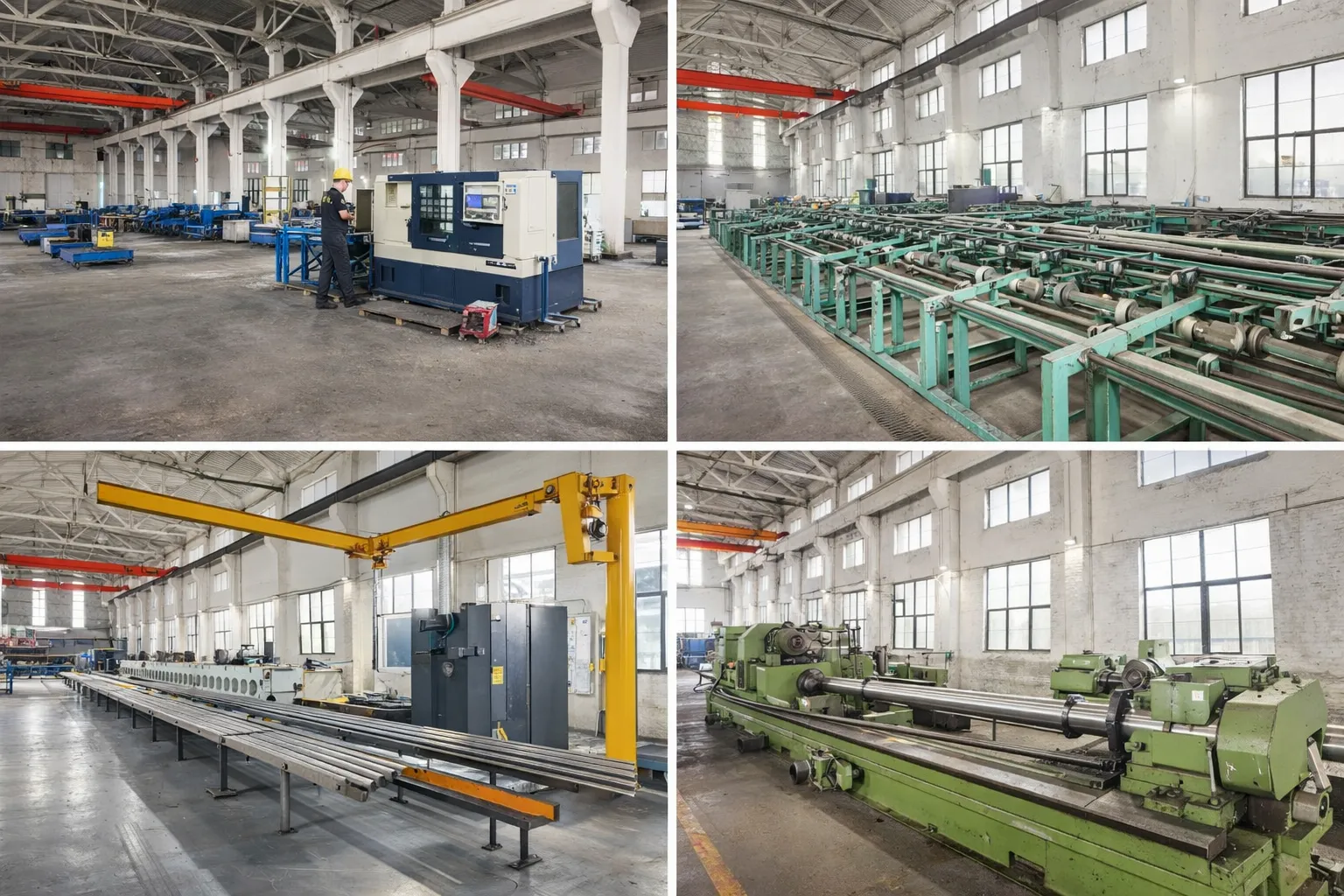
When you invest in a critical component, the hydraulic cylinder price must reflect guaranteed reliability. Our production facility operates under a stringent, vertically integrated quality management system. From raw steel ingot to the final painted assembly, we control every variable.
Every batch of 42CrMo steel undergoes ultrasonic non-destructive testing (NDT) to detect any internal voids or inclusions before machining begins. During the CNC turning and deep-hole boring processes, dimensional tolerances are verified via laser micrometry. Perhaps most importantly, 100% of our cylinders undergo rigorous end-of-line testing. They are mounted on custom test rigs and subjected to pressures exceeding 150% of their rated operational capacity. We monitor for internal bypass leakage, measure breakaway friction, and verify the accuracy of the servo sensors. Complete material traceability certificates and test reports accompany every shipment, ensuring absolute peace of mind for site engineers.
Cross-Industry Applications
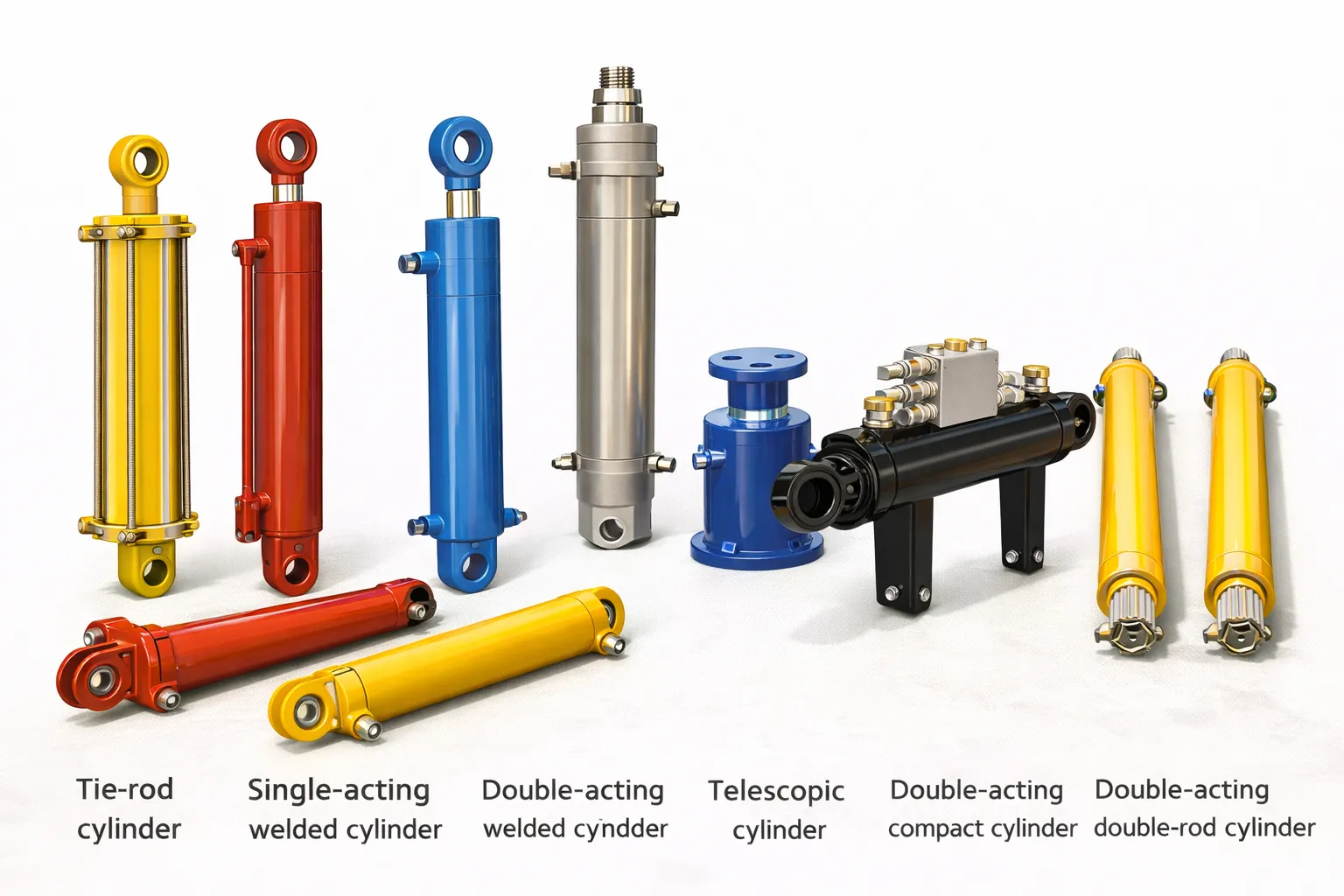
While heavily customized for shield machines, the robust engineering principles of our thrust cylinder make it highly adaptable across various heavy industrial sectors. For a deeper look at our solutions for heavy equipment, visit our Construction Machinery Applications page.
- Underground Engineering: Pipe jacking machines, roadheaders, and horizontal directional drilling rigs.
- Metallurgy & Heavy Forging: Continuous casting machines, rolling mill roll balance systems, and heavy forging press actuators.
- Marine & Offshore: Wave compensation systems, heavy-duty hatch cover actuators, and offshore crane luffing cylinders.
- Material Handling: Mega-tonnage straddle carriers, port reach stackers, and automated heavy-load logistics platforms.
- Renewable Energy: Hydropower dam gate hoists and wind turbine pitch control systems requiring long-term maintenance-free operation.
Comparative Analysis: Standard vs. High-Performance
Evaluating a hydraulic cylinder based purely on initial purchase cost is a false economy in heavy engineering. The following breakdown illustrates the technical delta between commercial-grade units and our specialized underground equipment.
| Technical Metric | Ordinary Commercial Cylinder | Our High-Performance Thrust Cylinder |
|---|---|---|
| Barrel Material | Standard Q345/E355 Welded Tubing | Thick-wall 42CrMo Forged Alloy Steel |
| Fatigue Resistance | Low; prone to expansion under shock loads | Exceptional; optimized to prevent barrel fatigue |
| Sealing System | Basic Nitrile/PU; fails rapidly in mud | Custom multi-stage PTFE/composite mud scrapers |
| Control Precision | On/Off directional control | High-resolution internal servo feedback |
| Lifecycle Value | Frequent downtime, high replacement rate | Long-term reliability, low total cost of ownership |
Verified Field Success in Asia-Pacific
We support major infrastructure projects across East Asia, with a particularly strong presence in South Korea and surrounding nations. Here are five documented cases where our engineering resolved critical site issues.
Case 1: Seoul Metropolitan Subway Extension (South Korea)
Client: Tier 1 South Korean Civil Contractor (May 2025)
Application: 12m EPB Shield Machine Main Propulsion.
Connection: Discovered us via Google while urgently seeking options for fixing hydraulic cylinders that were repeatedly failing due to high silica content in the soil.
Result: We supplied 32 customized thick-wall thrust cylinder units within a 45-day rush schedule. The upgraded scraper seals totally eliminated the silica ingress issue.
“The replacement parts we received exceeded OEM durability. Their engineering team understood our mud-water problem instantly, and the competitive hydraulic cylinder price helped keep our project budget intact.” – Mr. Park J., Lead Equipment Manager
Case 2: Busan Deep Underground Utility Tunnel (South Korea)
Client: Specialized Tunneling Subcontractor (November 2024)
Application: Small diameter Pipe Jacking Machine.
Connection: Referred by an existing client in the Korean machinery sector.
Result: The client needed compact, ultra-high-pressure units to navigate dense urban rock. We delivered double acting hydraulic cylinder configurations capable of sustaining 40MPa continuous pressure without barrel fatigue, increasing jacking speed by 15%.
“Compact strength was our priority. These cylinders delivered immense thrust in a very restricted tunnel profile. Brilliant manufacturing quality.” – Kim Y., Site Engineer
Case 3: Tokyo Stormwater Relief Project (Japan)
Client: Japanese Infrastructure Consortium (August 2025)
Application: TBM articulation and steering systems.
Connection: Contacted via our website inquiry form looking for specific hydraulic parts resistant to saltwater ingress.
Result: Implemented our special marine-grade chrome plating and dual-seal design. The TBM successfully navigated complex underwater curves with zero steering failure.
“The servo feedback on these units is incredibly precise. We achieved perfect alignment on the critical curved sections of the bore.” – H. Takahashi, Technical Director
Case 4: Incheon Port Heavy Logistics Upgrade (South Korea)
Client: Port Automation Equipment Integrator (January 2026)
Application: Straddle carrier heavy lift cylinder systems.
Connection: Met our sales engineers at an international construction machinery expo in Seoul.
Result: Replaced standard commercial cylinders with our heavy-duty forged units, instantly resolving issues of rod bending under asymmetrical container loads.
“Switching to a true heavy-duty manufacturer eliminated our downtime. The robust build quality of the rods is evident.” – Lee S., Maintenance Supervisor
Case 5: Singapore Cross Island MRT Line (Singapore)
Client: Multi-national Tunneling Joint Venture (March 2026)
Application: TBM propulsion hydraulic cylinder fleet replacement.
Connection: Sourced through a regional heavy machinery procurement portal linking back to our site.
Result: The JV needed to overhaul a used TBM rapidly. We supplied a complete set of 22 propulsion cylinders, perfectly matched to the existing manifold, saving the project a 12-week OEM delay.
“Logistics and manufacturing speed were phenomenal. The cylinders dropped right into the existing mounts and synced perfectly with the PLC.” – R. Chen, Project Manager
Frequently Asked Questions for B2B Procurement
We understand that sourcing critical heavy machinery components requires thorough technical vetting. Here are the most common questions our engineering team receives from international buyers.
1. What is the typical lead time for a custom set of TBM thrust cylinders?
Lead times depend on the level of customization. For standard bore/stroke configurations utilizing our existing 42CrMo forgings, we can typically manufacture and test a full set within 45 to 60 days. Complex bespoke designs involving custom servo integration may require 75 days. We always prioritize urgent replacement orders.
2. Can your products directly replace European or Japanese OEM components?
Absolutely. A significant portion of our business involves upgrading existing machinery. If you provide the original equipment drawings or dimensions, our engineers will manufacture a double acting hydraulic cylinder that matches the exact mounting trunnions, stroke length, and hydraulic porting, ensuring a seamless drop-in fit.
3. How do you address cylinder barrel fatigue in high-pressure scenarios?
Barrel fatigue is primarily caused by using standard welded tubing that cannot handle repetitive pressure spikes. We resolve this by utilizing thick-wall forged 42CrMo steel. The forging process aligns the metal grain structure, drastically increasing hoop strength and virtually eliminating the micro-expansion that leads to fatigue cracking.
4. Do you supply individual hydraulic parts and seal kits for maintenance?
Yes, as a comprehensive hydraulic cylinder manufacturer, we provide full aftermarket support. We supply custom seal kits, replacement piston rods, bearing assemblies, and other vital hydraulic parts to ensure your maintenance teams have exactly what they need for long-term operational health.
5. What makes your cylinders suitable for mud-water environments?
The key is our proprietary sealing architecture. Standard wipers allow fine grit to pass, tearing up internal seals. We use a multi-stage cassette system with an aggressive outer scraper specifically designed to chip away hardened concrete and mud, combined with inner PTFE glide rings that handle the high-pressure fluid retention.
6. Do you offer guidance on fixing hydraulic cylinders on-site?
Yes. When you purchase our systems, we provide comprehensive technical documentation, including safe depressurization procedures, seal replacement guides, and torque specifications. For complex issues involving fixing hydraulic cylinders with integrated servo sensors, our technical team is available for remote video consultation.
7. Why should we choose you over a local supplier in Korea?
Many local suppliers are merely assemblers or importers. We manage the entire metallurgical and manufacturing process in-house. This gives us total quality control and allows us to offer a highly competitive hydraulic cylinder price without the massive markups associated with middle-tier distributors, while delivering superior heavy-duty engineering.
Secure Your Equipment’s Reliability Today
Don’t let inferior components jeopardize your multi-million dollar infrastructure project. Partner with an expert manufacturer that understands the harsh realities of underground engineering. Whether you need a single replacement unit or a complete fleet overhaul, our technical team is ready to assist.
Submit your CAD drawings or technical specifications for a rapid engineering review.
Editor: Cxm