
Forklift Steering Hydraulic Cylinder — Double-Acting Dual-Rod Power Steering Cylinder for 2–10 Ton Forklifts
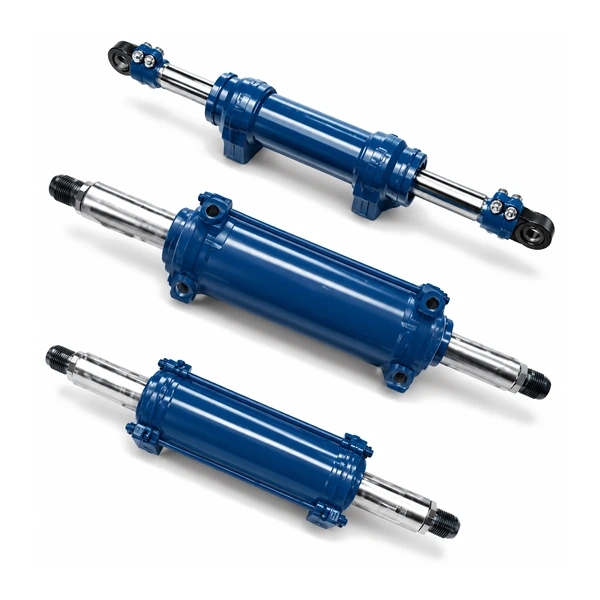
Forklift Steering Hydraulic Cylinder — Dual-Rod Power Steering
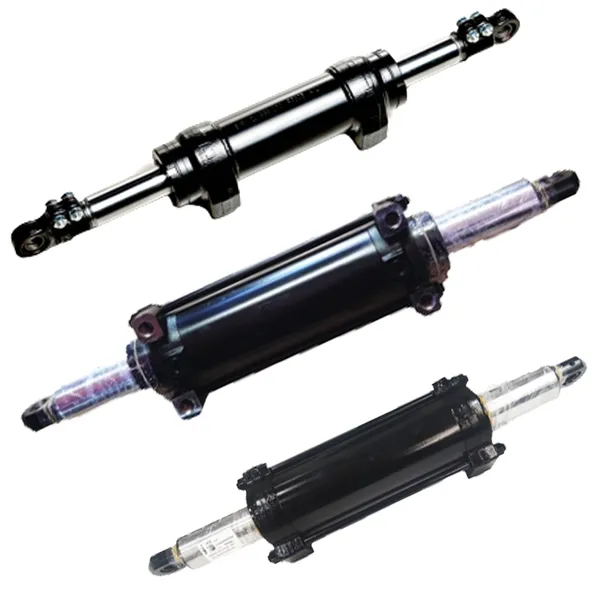
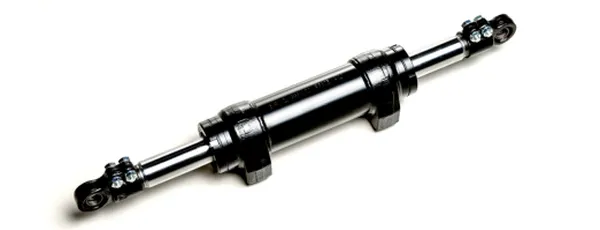
The forklift steering cylinder is unlike every other cylinder on the machine. Where lift and tilt cylinders have a single piston rod extending from one end, the steering cylinder has two rods — one protruding from each end of the housing — connected to the steering tie rods that pivot the rear wheels left and right. When hydraulic pressure enters one port, the piston pushes one rod out while simultaneously pulling the opposite rod in, turning both rear wheels through a coordinated arc.
This dual-rod, double-acting design means the steering cylinder is always under load in both directions. There is no gravity assist, no spring return, no neutral rest position where the cylinder is unloaded. The operator's steering input — amplified through the orbital steering valve — continuously pressurises one side or the other of the piston throughout every turn, every correction, and every straight-line hold. Korea Ever-Power manufactures 3 models covering 2–10 tonne counterbalance forklifts with bore diameters of Φ65 and Φ80.
15–20 kg
10–16 MPa
Why Two Rods — The Geometry of Forklift Rear-Wheel Steering
Counterbalance forklifts steer with the rear wheels — the opposite of a car, where the front wheels steer. The rear steer axle carries two stub axles (one per wheel) connected by tie rods to the steering cylinder. The cylinder mounts transversely across the axle beam, with each piston rod connected to one tie rod via a ball joint or clevis pin. The dual-stroke specification (e.g., 2×98 mm) means the piston travels 98 mm to the left of centre and 98 mm to the right of centre, providing equal turning geometry in both directions.
This center-mount, dual-rod arrangement is mechanically necessary to achieve Ackermann steering geometry — the condition where the inner wheel turns through a larger angle than the outer wheel during a turn, so both wheels track along concentric arcs rather than scrubbing sideways. The cylinder stroke, the tie rod length, and the stub axle geometry are all interdependent. Changing any one dimension — including the cylinder stroke — alters the Ackermann angle and produces uneven tyre wear, increased steering effort, and poor straight-line tracking.
Centre Position
Piston centred in bore. Both rods at equal extension. Rear wheels point straight ahead. Orbital valve in neutral — both cylinder ports blocked, holding the piston in position through trapped oil.
Full Left Turn
Piston displaced to maximum left stroke. Left rod fully retracted, right rod fully extended. Right tie rod pushes the right wheel spindle inward; left tie rod pulls the left spindle outward. Both rear wheels turn left.
Full Right Turn
Mirror image of the left turn. Right rod retracted, left rod extended. The symmetric dual-stroke design guarantees equal turning radius left and right — a manufacturing tolerance requirement that Korea Ever-Power holds to ±0.5 mm on stroke symmetry.
Dimensional Specifications — 3 Steering Cylinder Models
Three models cover the range from compact 2-tonne warehouse forklifts to heavy 10-tonne container handling machines. Note the dual-stroke notation: "2×98" means 98 mm stroke in each direction from centre (196 mm total piston travel). The working pressures are lower than lift or tilt cylinders because steering loads are substantially smaller than lifting loads.
Model R960 — Compact Class (2–3.5 Tonne)
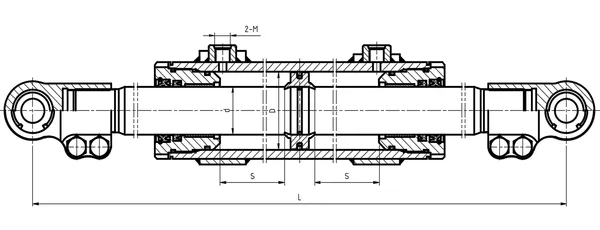
| Drawing Number | Bore (D) | Rod (d) | Stroke (S) | Install Dist (L) | Pressure | Ports (M) | Weight |
|---|---|---|---|---|---|---|---|
| R960-224000-001 | Φ65 | Φ40 | 2×98 | 672 | 10.5 MPa | 2-G1/4 | 15 kg |
Model A2A300 — Mid-Range (3.5–5 Tonne)
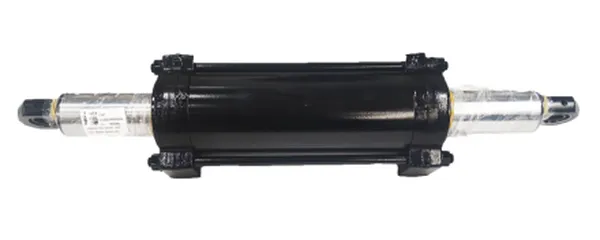
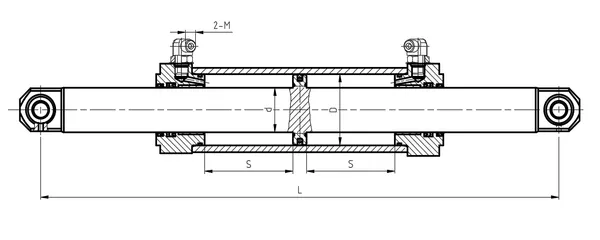
| Drawing Number | Bore (D) | Rod (d) | Stroke (S) | Install Dist (L) | Pressure | Ports (M) | Weight |
|---|---|---|---|---|---|---|---|
| A2A300-223000-000 | Φ80 | Φ50 | 2×10³ | 652.2 | 10 MPa | 2-M16×1.5 | 18 kg |
Model XF250 — Heavy-Duty (5–10 Tonne)
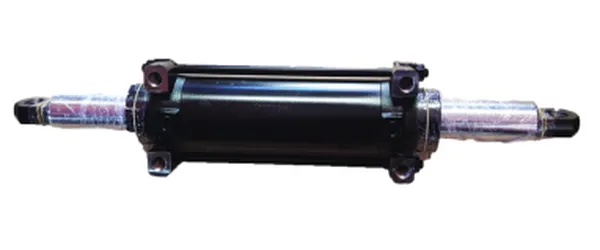
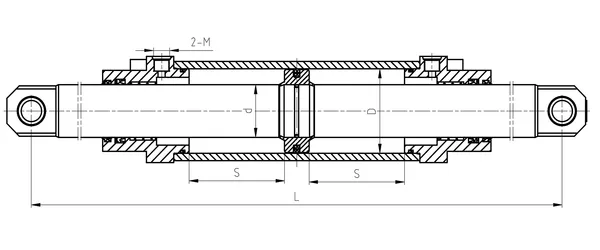
| Drawing Number | Bore (D) | Rod (d) | Stroke (S) | Install Dist (L) | Pressure | Ports (M) | Weight |
|---|---|---|---|---|---|---|---|
| XF250-223000-500T | Φ80 | Φ50 | 2×94 | 654 | 16 MPa | 2-M16×1.5 | 20 kg |
Stroke notation: 2×N means N mm stroke in each direction from piston centre position (total piston travel = 2N). Installation distance (L) measured clevis pin centre to clevis pin centre at piston centre position. Ports are located on the cylinder barrel between the two rod glands.
16-Component Internal Assembly
The steering cylinder uses a simpler internal assembly than tilt or lift cylinders because it operates at lower pressure and shorter stroke. However, it requires two complete rod seal and gland assemblies — one at each end — because both ends of the housing must seal against a moving piston rod. This doubles the sealing surface area exposed to wear compared to a single-rod cylinder.
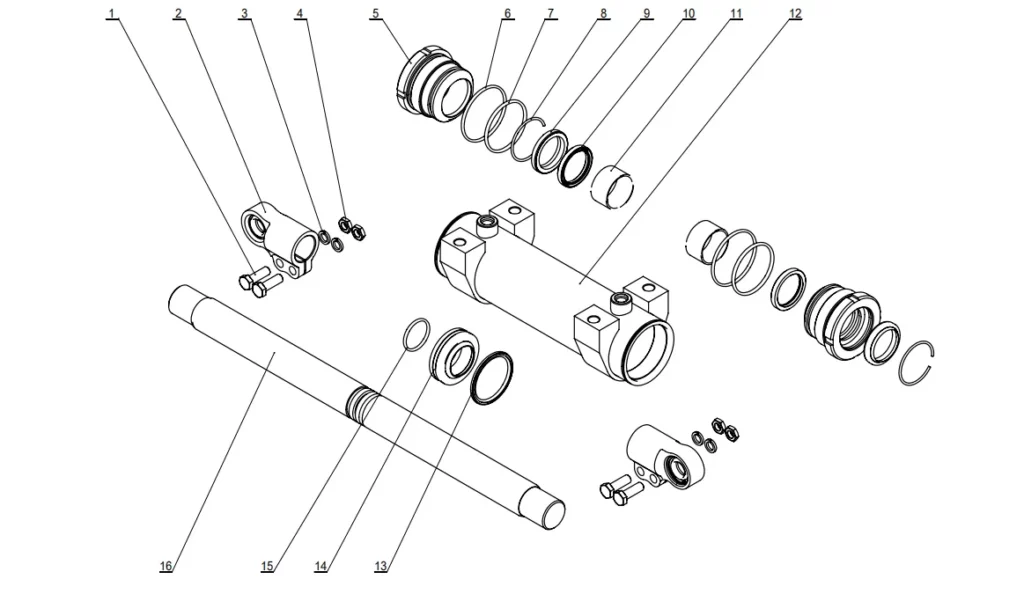
| # | Component | # | Component |
|---|---|---|---|
| 1 | Hex Bolt | 9 | Dust Wiper |
| 2 | Clevis | 10 | Rod Seal |
| 3 | Spring Washers | 11 | Du Bush |
| 4 | Hex Nut | 12 | Cylinder Housing Assy |
| 5 | Guide Bush | 13 | Hole Seal |
| 6 | O-Ring | 14 | Piston |
| 7 | O-Ring | 15 | O-Ring |
| 8 | Round Wire | 16 | Piston Rod |
Steering vs Tilt vs Lift — Why Steering Operates at Lower Pressure
A common question from forklift maintenance technicians: if all three forklift hydraulic cylinders connect to the same hydraulic pump, why does the steering cylinder operate at a much lower pressure? The answer lies in the loads each cylinder handles.
| Parameter | Steering Cylinder | Tilt Cylinder | Lift Cylinder |
|---|---|---|---|
| Typical Working Pressure | 10–16 MPa | 18.1 MPa | 18.1 MPa |
| Load Being Moved | Rear axle weight only (~500 kg) | Mast + load (~2–5 t) | Full payload (~1.5–3.5 t) |
| Cylinder Action | Double-acting, dual-rod | Double-acting, single-rod | Single-acting |
| Cycle Frequency | Continuous (always active) | Intermittent | Intermittent |
| Seal Wear Factor | High (continuous micro-movements) | Moderate | Moderate |
The steering system uses a separate hydraulic circuit branch with a dedicated priority valve that guarantees steering flow even when the lift and tilt functions demand maximum pump output. This priority arrangement means the steering cylinder always receives its required flow — typically 8–15 L/min — regardless of other hydraulic demands. The lower steering pressure is set by the orbital valve relief, not by the pump relief, providing an additional layer of circuit protection.
What Operators Notice First — Steering Cylinder Wear Symptoms
Unlike lift cylinder problems (which produce visible fork drift) or tilt cylinder problems (which produce visible mast angle changes), steering cylinder wear is felt before it is seen. Operators detect steering problems through the steering wheel before any external evidence appears on the cylinder itself.
Increasing Steering Wheel Play
The steering wheel must be turned further before the rear wheels begin to move. This "dead band" increases gradually over months. The cause is internal piston seal bypass — oil leaks past the piston from the pressurised side to the unpressurised side without moving the piston. A small amount of bypass is normal in worn seals, but when it becomes operator-detectable, the piston seal is approaching the end of its service life. Replace the full seal kit (both rod seals + piston seal).
Uneven Turning Radius Left vs Right
The forklift turns more tightly in one direction than the other. Before blaming the cylinder, check the more common cause first: a bent tie rod, a worn ball joint, or a damaged clevis pin that limits the mechanical travel on one side. If the mechanical linkage checks out, the issue may be asymmetric rod seal wear — one end of the cylinder has more internal friction than the other, creating a pressure imbalance that limits effective stroke in one direction.
Steering "Wander" at Highway Speed
The forklift does not hold a straight line during high-speed travel between work areas — it requires constant small steering corrections. This is the most subtle symptom and is often dismissed as normal behaviour. However, it indicates that the piston is not holding position under the dynamic loads generated by road surface irregularities. The trapped oil column on each side of the piston is leaking past the seal, allowing the road forces to shift the piston and change the wheel angle. This symptom warrants immediate inspection.
Steering Cylinder Application Environments
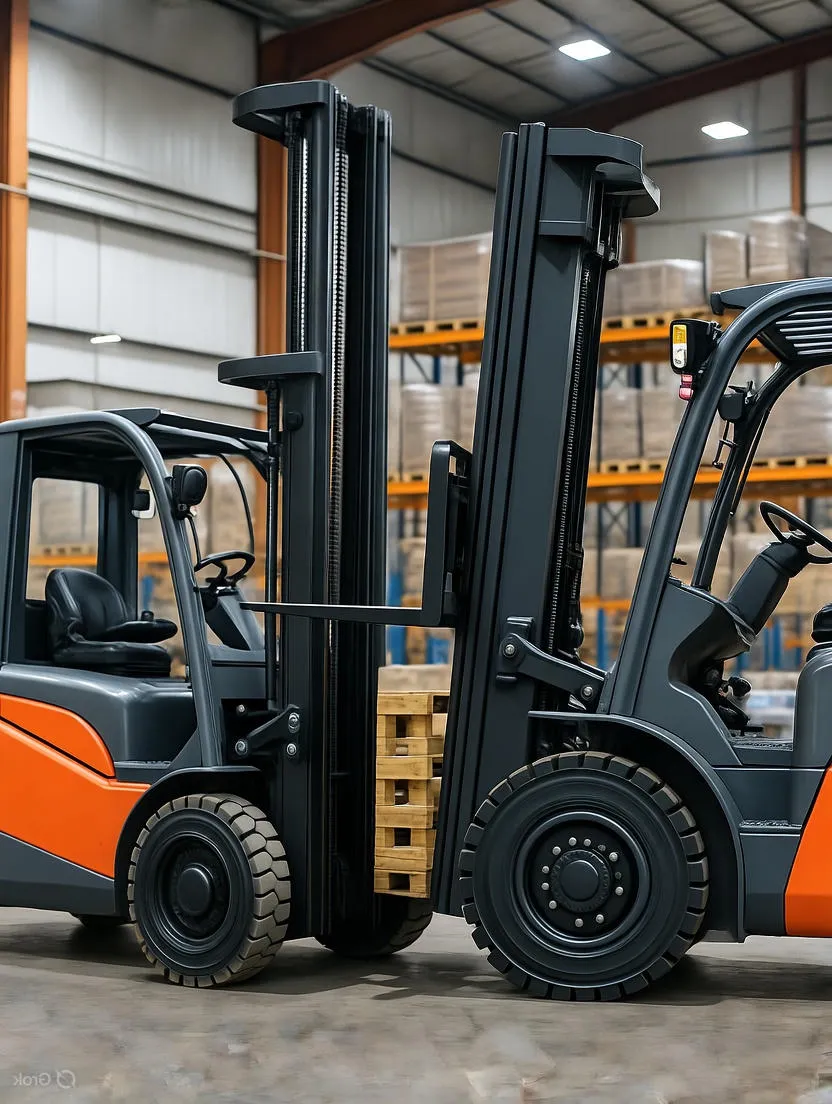
Narrow-Aisle Warehousing
Warehouses with aisle widths of 3.0–3.5 metres demand precise steering response with minimal dead band. The steering cylinder must translate small orbital valve inputs into immediate wheel angle changes for the operator to manoeuvre confidently in tight spaces. The R960 model (Φ65 bore) provides the quick response that narrow-aisle work requires — the smaller bore volume means less oil displacement per degree of wheel turn, producing faster response at lower flow rates.
Heavy Container Handling
Large counterbalance forklifts in the 7–10 tonne class handle loaded containers on port aprons and container yards where the rear axle load — amplified by the counterweight — can exceed 3 tonnes. The XF250 model at 16 MPa provides the steering force needed to turn the loaded rear axle on rough concrete surfaces where tyre-to-ground friction is high. The higher pressure rating also provides the reserve capacity for emergency steering manoeuvres under full load.
Multi-Surface Operations
Forklifts that operate across multiple surface types — smooth warehouse floors, rough yard surfaces, gravel loading areas — subject the steering cylinder to rapidly changing load patterns. The transition from low-friction polished concrete to high-friction rough asphalt creates pressure spikes that test the seal integrity and rod surface quality. All Korea Ever-Power hydraulic cylinders for steering applications use chrome rod surfaces rated for this mixed-surface duty profile.
Forklift Steering Cylinder — Frequently Asked Questions
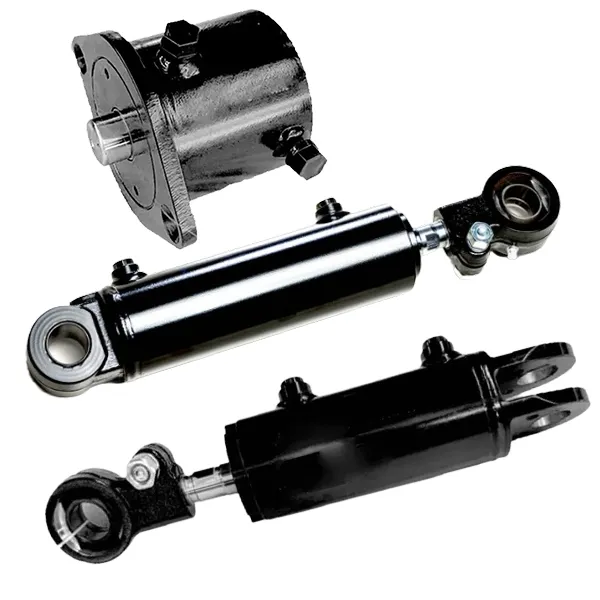
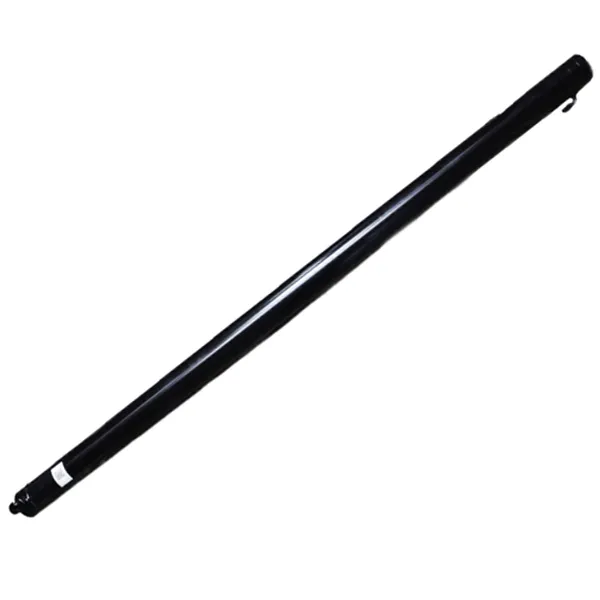
Complete the Forklift Cylinder Set
Additional information
| Editor | Cxm |
|---|
Related products
-
Forklift Tilt Cylinder | EP-HCYY11112001 Model
-
LS-HCZD30N-03 Forklift Truck Steering Cylinder
-
Forklift Truck Lift Oil Cylinder — Single-Acting Hydraulic Lift Cylinder
-
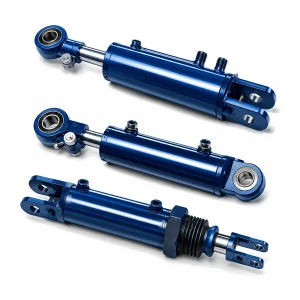
Custom Hydraulic Cylinder for Forklift Steering
-
Forklift Lifting Hydraulic Cylinder — Single-Acting Mast Lift Cylinder
-
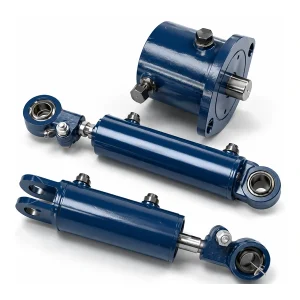
Forklift Tilt Hydraulic Cylinder — Double-Acting Mast Tilt Cylinder for 1.5–10 Ton Forklifts
-
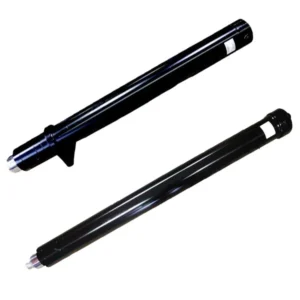
Forklift Short Lifting Hydraulic Cylinder
-
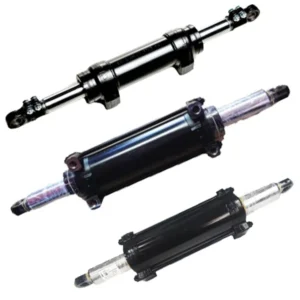
Forklift Steering Hydraulic Cylinder


























